
Table of contents
- What Underwriters Look for in Commercial Lines Submissions
- What Goes in Carrier-Ready Commercial Lines Submissions
- Why Commercial Lines Submissions Get Declined or Ignored
- How to Build Commercial Lines Submissions Step by Step
- Who Should Own Each Part of a Commercial Lines Submission?
- How a VA Speeds Up Commercial Lines Submissions
- Summing Up
- Frequently Asked Questions
- Also Reads
Every commercial account you remarket or write new lands on an underwriter’s desk as a packet of documents. Some packets get quoted within days. Others sit in a queue, come back with a list of questions, or get a polite decline. The difference usually has less to do with the risk itself than with how the commercial lines submissions were put together.
Underwriters work through a steady flow of submissions, and they naturally start with the ones they can price without chasing anyone. A complete, consistent and clearly explained packet tells them your agency knows the account and won’t waste their time.
This guide covers what underwriters look for, the documents that belong in a carrier-ready packet, the mistakes that get submissions declined, a step-by-step workflow, and how to split the work between licensed staff and a trained virtual assistant.
What Underwriters Look for in Commercial Lines Submissions
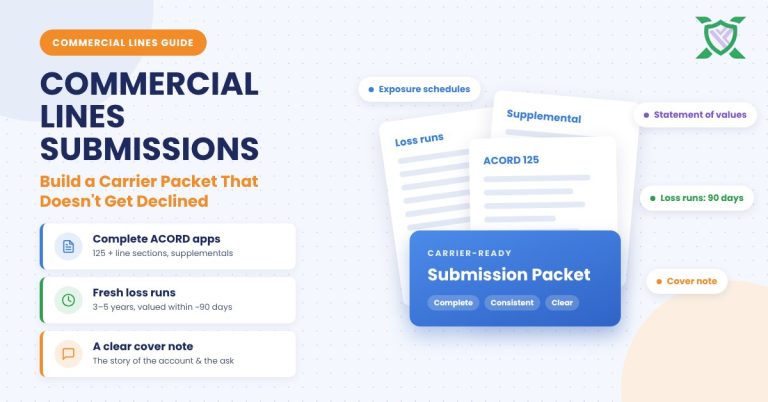
Carriers differ in appetite and paperwork, but most underwriters judge commercial lines submissions on the same three things before they ever look at price: completeness, consistency and clarity.
Completeness. Is everything they need to rate the risk already in the packet? Missing loss runs, a blank supplemental or an empty schedule of locations means the submission goes back to the bottom of the pile while someone emails your agency.
Consistency. Do the documents tell the same story? The named insured, FEIN, description of operations, class codes, payroll and sales figures should match across the ACORD application, the supplementals, the loss runs and the expiring policy. Inconsistencies make underwriters wonder what else is wrong.
Clarity. Can the underwriter understand the account in two minutes? A short cover note that explains the business, the reason for marketing, the loss history and what you are asking for does more to win a quote than any single form.
What Goes in Carrier-Ready Commercial Lines Submissions
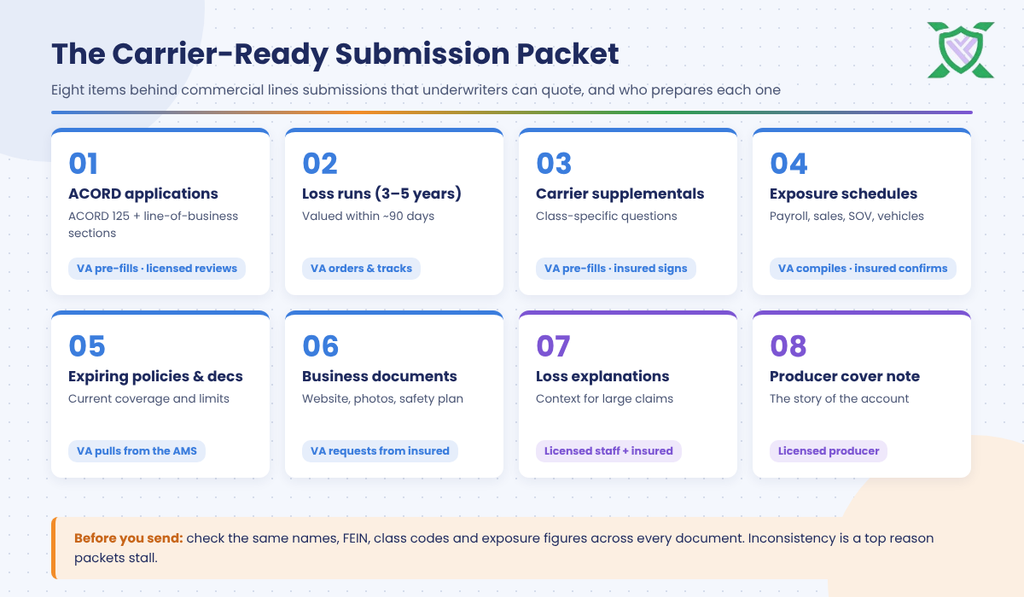
The exact list depends on the lines requested and the carrier, but most commercial lines submissions are built from the same eight items.
1. The ACORD 125 and Line-of-Business Sections
The ACORD 125 describes the applicant, and line sections such as the ACORD 126 (general liability), 127 (business auto), 130 (workers’ compensation) and 140 (property) describe each exposure. Our guide to ACORD forms explained covers what each form does and who should fill it in. The forms themselves are published as standardized ACORD forms and usually generated from your agency management system.
2. Currently Valued Loss Runs
Most carriers want loss runs from every prior carrier, commonly covering three to five years and valued within the last 90 days. Order them early. Waiting on a prior carrier’s loss runs is one of the most common reasons a submission stalls.
3. Carrier Supplemental Applications
Contractors, restaurants, habitational risks, trucking and many other classes need carrier-specific supplementals. They ask the questions the ACORD forms don’t, such as subcontractor use, cooking operations or radius of operation.
4. Exposure Schedules
Underwriters price on exposure, so the packet needs the numbers: payroll by class code, gross sales, a statement of values for property, vehicle and driver schedules for auto, and square footage or units where they apply.
5. Expiring Policies and Declarations
The current dec pages and key endorsements show the underwriter what coverage is in place, at what limits and with what deductibles. They also help you spot coverage that must be matched or improved.
6. Business Information and Documentation
A website link, photos of the premises, safety program documents, contracts with key customers or a list of current projects all help an underwriter understand operations that are hard to describe in a form.
7. Loss Explanations
Any significant claim deserves a short note: what happened, what it cost, and what the insured changed afterward. An unexplained large loss is a common reason for a quick decline.
8. The Producer Cover Note
A half-page summary that introduces the account, explains why it is being marketed, highlights its strengths, addresses its weaknesses and states the target effective date and coverage requested.
| Packet item | Why underwriters want it | Typically prepared by |
|---|---|---|
| ACORD 125 + line sections | Who the applicant is and what is being quoted | VA pre-fills, licensed staff reviews, insured signs |
| Loss runs (3–5 years) | Proof of claims history | VA orders and tracks |
| Carrier supplementals | Class-specific underwriting questions | VA pre-fills, insured completes and signs |
| Exposure schedules | The rating basis: payroll, sales, values, vehicles | VA compiles, insured confirms |
| Expiring policies and decs | Current coverage, limits and deductibles | VA pulls from the AMS |
| Business documentation | Context for operations and controls | VA requests from the insured |
| Loss explanations | Context for large or frequent claims | Licensed staff with the insured |
| Producer cover note | The story of the account and the ask | Licensed producer or account manager |
Why Commercial Lines Submissions Get Declined or Ignored
A decline isn’t always about the risk. These are the problems that most often sink commercial lines submissions before an underwriter gets to price.
- Out of appetite. The class, size or location doesn’t fit the carrier. Checking appetite before you send saves everyone time.
- Incomplete packet. Missing loss runs, unsigned applications or blank supplemental questions push the file to the back of the queue.
- Conflicting information. Sales on the ACORD 125 don’t match the ACORD 126, or the description of operations doesn’t match the class codes.
- Stale loss runs. Loss runs valued six months ago don’t show current claims activity.
- Unexplained losses. A large claim with no context reads as a risk the agency doesn’t understand.
- Sent too late. A packet that arrives a week before the effective date leaves no time for underwriting questions.
Most of these are process problems, not market problems. They happen when submissions are built in a rush by people who are also handling service calls, certificates and renewals. Our article on E&O risk and the overwhelmed CSR shows how that same workload pressure turns into errors.
How to Build Commercial Lines Submissions Step by Step
A repeatable workflow turns submissions from a scramble into a checklist. Here is the sequence many well-run commercial lines agencies follow.
Start 90 to 120 Days Before the Effective Date
Put every commercial renewal you plan to remarket on a calendar at least 90 days out, and 120 days for larger or harder accounts. That leaves time to collect information, order loss runs and answer underwriting questions without rushing.
Confirm Appetite Before You Send
Shortlist carriers whose appetite fits the class, size and location. Sending the right account to three well-matched markets beats spraying it to ten.
Collect, Assemble and Cross-Check
Send the insured a single information request with a clear deadline. Order loss runs from every prior carrier the same day. Then pre-fill the ACORD forms and supplementals from the AMS and cross-check every name, FEIN, class code and exposure figure across the packet.
Write the Cover Note and Review
The producer or account manager writes the cover note and reviews the underwriting-sensitive answers, such as operations, loss history and prior cancellations, before anything leaves the agency.
Send, Log and Follow Up on Every Commercial Lines Submission
Send each carrier a complete packet in its preferred format, log the submission in your AMS, and set a follow-up date. Track underwriter questions and quotes in one place so nothing falls through the cracks. If you use Applied Epic, our Applied Epic workflow guide shows where marketing submissions fit into your daily routine.
Who Should Own Each Part of a Commercial Lines Submission?
In many agencies the producer builds every packet personally, often late in the evening. A better split puts judgment with licensed staff and preparation with a trained assistant.
| Task | Owner |
|---|---|
| Coverage recommendations and limits | Licensed producer or account manager |
| Choosing carriers and negotiating terms | Licensed producer |
| Cover note and loss explanations | Licensed staff, with input from the insured |
| Final review of underwriting-sensitive answers | Licensed staff |
| Information requests and follow-up with the insured | VA |
| Ordering and tracking loss runs | VA |
| Pre-filling ACORD forms and supplementals from the AMS | VA |
| Cross-checking names, FEINs, class codes and exposures | VA |
| Packaging, sending, logging and follow-up dates | VA |
Split this way, your producer reviews a finished packet instead of building one. If you aren’t sure how much time submissions take today, an insurance agency task audit will show you quickly.
How a VA Speeds Up Commercial Lines Submissions
XAssure provides dedicated commercial lines virtual assistants who already know how commercial lines submissions are built. They handle the preparation work behind each packet:
- Ordering loss runs and tracking them until they arrive
- Pre-filling ACORD applications and carrier supplementals from your AMS
- Chasing missing information, signatures and trailing documents
- Cross-checking every packet for consistency before review
- Remarketing preparation and follow-up with underwriters
- Logging every step in AMS 360, Applied Epic, HawkSoft, EzLynx, NowCerts or QQ Catalyst
Every task appears on a live dashboard, a dedicated account manager oversees quality, and the work happens during your business hours.
Summing Up
Carriers quote the commercial lines submissions that are complete, consistent and clearly explained. Build each packet around the same eight items, start early, confirm appetite first, and cross-check everything before a licensed reviewer signs off.
Your producers should spend their time on coverage, carrier relationships and the cover note. The ordering, pre-filling, chasing and checking can go to a trained assistant. XAssure gives commercial lines agencies exactly that, with a 2-week free trial.
Frequently Asked Questions
It is the packet of information an agency sends a carrier to request a quote on a commercial account. It usually includes the ACORD 125 and line-of-business sections, loss runs, carrier supplementals, exposure schedules, expiring policy details and a producer cover note.
Start at least 90 days before the effective date, and 120 days for larger or more complex accounts. That leaves time to collect information, order loss runs and answer underwriter questions.
Most carriers ask for three to five years of loss runs from each prior carrier, valued within roughly the last 90 days. Check each carrier’s requirements, since some want more history for certain classes.
Common reasons are an account outside the carrier’s appetite, missing documents, conflicting information between forms, stale loss runs, unexplained large losses and packets sent too close to the effective date.
Yes, the preparation work. A trained VA can order loss runs, pre-fill ACORD forms and supplementals, chase information and cross-check the packet. Coverage advice, carrier selection and final review should stay with licensed staff.
A short description of the business, why the account is being marketed, its strengths, an explanation of any significant losses, the coverage and limits requested, and the target effective date.