
Table of contents
- Your Options at a Glance: In-House CSR vs. Generalist VA vs. Insurance-Trained VA
- Why Maryland Insurance Agencies Are Turning to Virtual Assistants
- What Maryland Law Lets Virtual Assistants Do for Insurance Agencies
- Data Security for Virtual Assistants at Maryland Insurance Agencies
- What to Look for in Virtual Assistants for Insurance Agencies in Maryland
- How XAssure’s Virtual Assistants Support Maryland Insurance Agencies
- What Do Virtual Assistants for Insurance Agencies in Maryland Cost?
- How to Onboard Virtual Assistants in Maryland Insurance Agencies
- Summing Up
- Frequently Asked Questions
- Also Reads
Maryland insurance agencies work in a compact but demanding market. Severe storms, nor’easters and the occasional tropical system keep P&C teams busy with claims and policy changes. Flood exposure around the Chesapeake Bay and the Eastern Shore adds its own paperwork. And hiring an experienced CSR in the Baltimore–Washington corridor is expensive. That is why more owners are looking at virtual assistants for insurance agencies in Maryland.
This guide compares your staffing options, explains what Maryland’s producer licensing law allows an unlicensed VA to do, covers how to keep client data secure, sets out realistic costs, and shows how to onboard a VA in your agency.
Your Options at a Glance: In-House CSR vs. Generalist VA vs. Insurance-Trained VA
Most Maryland agency owners are choosing between three ways to add service capacity. Here is how they compare.
| In-house CSR | Generalist offshore VA | Insurance-trained VA (XAssure) | |
| Estimated annual cost | $56,000–$78,000 | Roughly $8,000–$17,000 | $12,600 (part-time) to $24,000 (full-time) |
| Time to start | Often months to recruit | Days, then weeks of training | Onboarded in 7–10 days |
| Knows your AMS and carrier portals | Depends on the hire | No, you train them | Yes: AMS 360, Applied Epic, EzLynx, HawkSoft, NowCerts, QQ Catalyst |
| Understands licensed vs. unlicensed limits | Needs training | Rarely | Yes, built into every SOP |
| Data security controls | Your office, your policies | Varies widely | MFA, encrypted devices, device-free floor, background checks |
| Handles storm and renewal peaks | Hard to add hours | Limited insurance knowledge | Yes, add hours or a second VA |
| Visibility into the work | In the office | Varies | Live dashboard logging every task |
Why Maryland Insurance Agencies Are Turning to Virtual Assistants
A Market Built on Small Independent Agencies
Maryland’s agency market is dominated by small independents. Big I Maryland told state lawmakers in 2026 that it represents 200 independent agencies employing more than 2,000 people in the state, an average of about ten people per agency. In agencies that size, the owner is often the lead producer, and every open service role lands on someone who should be selling.
Hiring is the other problem. Wages in the Baltimore–Washington corridor are among the highest in the country, and experienced CSRs in Baltimore, Annapolis, Rockville or Frederick have plenty of options. Agencies in Salisbury, Hagerstown and the rest of the state face a smaller pool of licensed candidates. Virtual assistants for insurance agencies in Maryland fill the gap without another local salary.
Storms, Hurricanes and Flood Drive the P&C Workload
Maryland gets weather from every direction. According to NOAA’s billion-dollar disaster data for Maryland, the state was affected by 85 confirmed billion-dollar weather events between 1980 and 2024: 38 severe storms, 16 winter storms and 15 tropical cyclones among them. The pace has quickened sharply, from a long-run average of 1.9 events a year to 5.6 a year in 2020–2024.
Flood adds another layer. The Maryland Insurance Administration reminds consumers that most standard homeowners and renters policies don’t cover flood, that most flood policies have a 30-day waiting period, and that about a quarter of flood losses happen outside high-risk zones. Every one of those points creates quoting, application and renewal work for agencies along the Bay and on the Eastern Shore. Virtual assistants who handle the paperwork for Maryland insurance agencies keep service on track when the storms arrive.
Residual Markets Add Paperwork
Maryland relies on several markets of last resort. The Maryland Automobile Insurance Fund (MAIF) covers eligible drivers who can’t get private auto coverage. The Maryland Joint Insurance Association provides property coverage for people and businesses who can’t find it elsewhere. On the commercial side, Chesapeake Employers’ Insurance Company is the state’s largest workers’ compensation writer and its insurer of last resort, while NCCI files loss costs for the rest of the market.
Each of those markets has its own applications, documentation and renewal rules. That is detailed, repeatable work, which makes it a good fit for a trained VA.
What Virtual Assistants Do Inside Maryland Insurance Agencies
The day-to-day work of virtual assistants for insurance agencies in Maryland usually covers:
- Renewal pipeline management, remarketing preparation and renewal reminders
- Flood applications, elevation certificate requests and renewal follow-up
- Certificates of insurance for contractors working across the Baltimore–Washington region
- AMS and CRM data entry, carrier download matching and activity notes
- Endorsement and policy change processing
- First notice of loss intake and claim status follow-up after storms
- Workers’ compensation audit paperwork and employee benefits enrollment
- Commission statements, premium billing reconciliation and inbox management
What Maryland Law Lets Virtual Assistants Do for Insurance Agencies
The Clerical Exemption in § 10-103(b)(2)
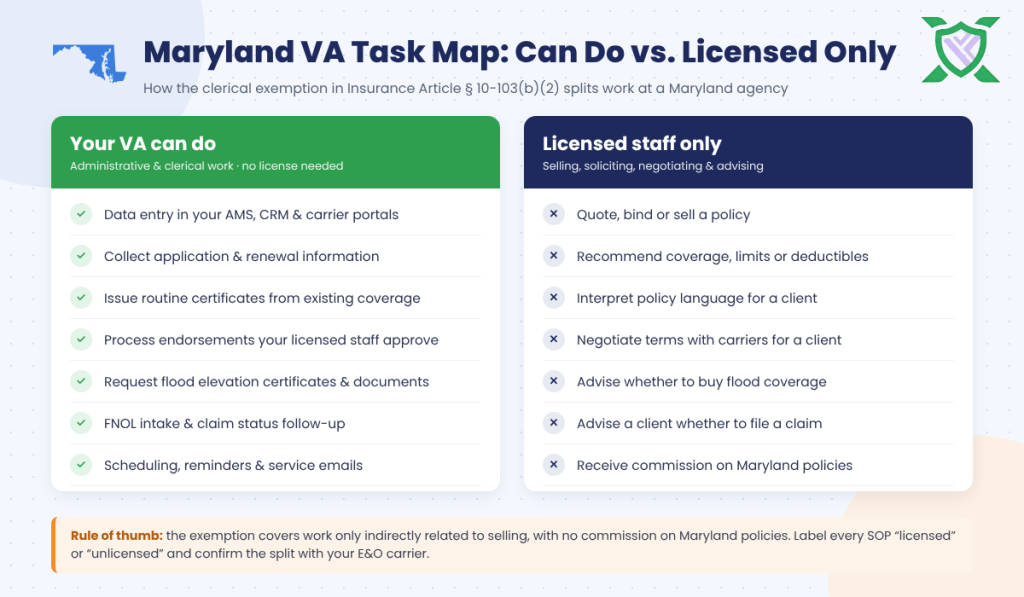
Maryland requires a producer license to sell, solicit or negotiate insurance. However, Maryland Insurance Article § 10-103 exempts an employee of an insurer or of an insurance producer who doesn’t receive any commission on policies covering Maryland risks, if the employee’s activities are executive, administrative, managerial or clerical, and only indirectly related to the sale, solicitation or negotiation of insurance.
In plain English: virtual assistants working for Maryland insurance agencies can do a great deal of processing and administration, as long as they are not selling, recommending coverage or being paid on policies.
Tasks Virtual Assistants for Maryland Insurance Agencies Can and Can’t Do
| A VA can do (no license needed) | Licensed staff must do |
| Data entry in your AMS, CRM and carrier portals | Quote, bind or sell a policy |
| Collect information for applications and renewals | Recommend coverage, limits or deductibles |
| Issue routine certificates from existing coverage | Interpret policy language for a client |
| Process endorsements your licensed staff approve | Negotiate terms with carriers on the client’s behalf |
| Request flood elevation certificates and documents | Advise a client on whether to buy flood coverage |
| FNOL intake and claim status follow-up | Advise a client on whether to file a claim |
| Scheduling, reminders and service emails | Receive commission on Maryland policies |
Your E&O carrier may have its own view on where the line sits, so share your VA task list with them and label every SOP “licensed” or “unlicensed”.
How the Maryland Insurance Administration Fits In
The Maryland Insurance Administration (MIA) licenses producers and agencies, and Marie Grant has served as Commissioner since 2024. Producer licenses renew on a two-year cycle based on the licensee’s birth month, and most lines require 24 hours of continuing education per cycle, including 3 hours of ethics. Producers who sell flood insurance also need flood-specific CE.
The MIA does not publish guidance aimed specifically at virtual assistants. Compliance for virtual assistants at Maryland insurance agencies therefore comes down to your own documentation: written task boundaries, a provider agreement confirming VAs will not perform licensed activities, and no commission-based pay for unlicensed staff. A VA can also help your producers track license renewal dates and CE hours.
Data Security for Virtual Assistants at Maryland Insurance Agencies
Maryland’s insurance data security law, Title 33 of the Insurance Article, was enacted in 2022. It applies to carriers, a term that includes insurers, managed general agents and third-party administrators, rather than to ordinary producers. But it requires those carriers to make their third-party service providers protect their systems and nonpublic information. In practice, that means carrier agreements and audits increasingly ask agencies how they protect data, including data handled by outsourced staff.
Your agency also has its own duty to safeguard client information under the Gramm-Leach-Bliley Act and state law. Before you give any VA access, check how the provider handles logins, devices, training and breach notification. We cover the full checklist in Is Your Client Data Safe Offshore? NPI, SOC 2 & What to Demand from a VA Provider.
What to Look for in Virtual Assistants for Insurance Agencies in Maryland
Not every VA is ready for insurance work. Before you sign with anyone, check for these seven things.
1. Insurance Training, Not Just General Admin
Your VA should already understand renewals, endorsements, certificates, loss runs and carrier downloads. If you have to explain what a dec page is, you are paying to train them.
2. Experience in Your AMS
Ask which agency management systems the VA has actually worked in. Real experience in AMS 360, Applied Epic, EzLynx or HawkSoft saves weeks of ramp-up.
3. A Clear Licensed vs. Unlicensed Boundary
The provider should confirm in writing that VAs will not quote, bind, sell or advise on coverage, and should never pay VAs on commission. That is what keeps you inside § 10-103(b)(2).
4. Flood and Commercial Experience, Not Just Auto and Home
Maryland books carry flood policies, contractor certificates and workers’ compensation paperwork. Make sure the VA can handle commercial lines work as well as personal lines service.
5. Proven Data Security Controls
Look for named logins, multi-factor authentication, encrypted devices, a password manager, background checks and physical security at the provider’s office. Ask to see the provider’s security and compliance controls before you share any client data.
6. Visibility Into the Work
You should be able to see what your VA did, when and for which client, without chasing them for updates.
7. A Real Trial Period
A trial on your own workload is the only reliable test. Be wary of long contracts before you have seen any work.
How XAssure’s Virtual Assistants Support Maryland Insurance Agencies
XAssure provides insurance-trained VAs for personal lines, commercial lines and employee benefits work, built around the checklist above:
- Insurance-trained from day one: renewals, certificates, endorsements, loss runs, FNOL intake, flood paperwork and enrollment processing
- Works in your systems: AMS 360, Applied Epic, EzLynx, HawkSoft, NowCerts and QQ Catalyst, plus major carrier portals
- Clear task boundaries: every SOP is labelled licensed or unlicensed, VAs are never paid on commission, and work is overseen by US licensed agent management
- Security first: MFA, least-privilege access, BitLocker-encrypted computers, mobile device management, background checks, a device-free office floor and 24/7 physical security
- Live dashboard: every task is logged with real-time timers, so you see the work as it happens
- Dedicated account manager: one point of contact for quality, cover and extra hours in storm or renewal season
- Low risk: a 2-week free trial before any commitment
Best for: Maryland agencies that need one team to cover storm-season P&C service, flood paperwork and commercial certificates without adding a local salary.
What Do Virtual Assistants for Insurance Agencies in Maryland Cost?
The Bureau of Labor Statistics put the national mean wage for insurance claims and policy processing clerks at $49,530 in May 2023, and Maryland’s metro areas typically pay above the national average. Once you add payroll taxes, health benefits, PTO, equipment and recruiting time, a full-time in-house hire costs considerably more than the salary line. Here is how that compares with virtual assistants for insurance agencies in Maryland.
| Cost item | In-house CSR (Maryland) | XAssure dedicated VA | Budget generalist VA |
| Base pay | $42,000–$54,000 | Included | Included |
| Payroll taxes and benefits | $11,000–$18,000 | None | None |
| Equipment, software, office | $3,000–$6,000 | None | Varies |
| Recruiting and turnover risk | High | Replacement included | Your problem |
| Insurance training | Your time | Already trained | Your time |
| Estimated annual cost | $56,000–$78,000 | $12,600 (part-time) to $24,000 (full-time) | Roughly $8,000–$17,000 |
In-house figures are estimates; your local wages will vary. For a fuller breakdown, see the true cost of hiring an insurance CSR.
How to Onboard Virtual Assistants in Maryland Insurance Agencies
Build Your SOPs Before Day One
Write a short step-by-step SOP and record a screen walkthrough for each task you plan to hand over. Label each one “licensed” or “unlicensed” so the boundary under § 10-103(b)(2) is clear from the start.
Set Up Secure AMS and Carrier Access
Create a named VA user in your AMS and each carrier portal with only the permissions they need. Use multi-factor authentication and a business password manager, and never share a producer’s login. Record the provider in your written information security program.
Then plan the first 30 days in three stages:
- Week 1: System access, shadowing and low-risk tasks such as data entry and certificates
- Weeks 2–3: Supervised work on renewals, endorsements and flood applications, with daily check-ins
- Week 4: Independent work with a weekly quality review
Our guide on how to onboard an insurance virtual assistant walks through every step.
Summing Up
Maryland insurance agencies face storm-driven service spikes, flood paperwork, residual market applications and a costly hiring market. The right virtual assistant partner for a Maryland agency brings real insurance training, respects the licensed and unlicensed boundary in § 10-103(b)(2), protects client data with proven controls, and works inside the AMS you already use.
Use the checklist to judge any provider, and onboard with documented SOPs and secure access. When you are ready to test it with your own workload, XAssure gives you an insurance-trained VA, a dedicated account manager and a live dashboard, free for the first two weeks.
Frequently Asked Questions
Not for administrative work. Maryland Insurance Article § 10-103(b)(2) exempts employees of producers whose work is executive, administrative, managerial or clerical and only indirectly related to selling insurance, provided they receive no commission on Maryland policies. A VA cannot quote, bind, sell or advise on coverage.
Insurance-trained VAs typically cost far less than an in-house hire. XAssure plans start at $1,050 per month for 20 hours a week and $2,000 per month for 40 hours a week, compared with an estimated $56,000 to $78,000 a year for a fully loaded in-house CSR in Maryland.
Yes. A VA can collect application details, request elevation certificates, track the 30-day waiting period and manage renewal follow-ups. Advising a client on whether to buy flood coverage, or how much, stays with licensed staff.
Maryland’s Title 33 data security law applies to carriers, including insurers, managed general agents and third-party administrators, rather than to ordinary producers. Carriers must require their service providers to protect data, though, and your agency still has duties under GLBA and state privacy law.
XAssure VAs work in AMS 360, Applied Epic, EzLynx, HawkSoft, NowCerts and QQ Catalyst, along with carrier portals and ACORD forms.
The Maryland Insurance Administration (MIA) licenses producers and agencies. Producer licenses renew every two years based on the licensee’s birth month, and most lines require 24 hours of continuing education per cycle, including 3 hours of ethics.
Also Reads
- Virtual Assistants for Insurance Agencies by State: The 2026 Guide
- Best Virtual Assistants for Insurance Agencies in Pennsylvania [2026]
- Best Virtual Assistants for Insurance Agencies in Virginia [2026 Guide]
- Best Virtual Assistants for Insurance Agencies in New Jersey [2026]
- Is Your Client Data Safe Offshore? NPI, SOC 2 & What to Demand from a VA Provider