
Table of contents
- Why Your State Changes What You Need From a VA
- What Stays the Same in Every State
- Virtual Assistants for Insurance Agencies: State Guides Directory
- Choosing Virtual Assistants for Insurance Agencies: Questions for Any State
- How XAssure Supports Agencies in Every State
- Don’t See Your State?
- Summing Up
- Frequently Asked Questions
- Also Reads
Insurance is regulated state by state, and the back-office work of an agency changes with it. That’s why choosing virtual assistants for insurance agencies isn’t only about hours and price. An agency in Tampa spends each summer preparing for hurricane season. An agency in Denver fields a steady run of hail claims. An agency in Detroit is still walking clients through PIP choices years after Michigan’s no-fault reform.
On paper the task list looks the same everywhere: renewals, endorsements, certificates, quotes and billing. In practice, what fills a CSR’s week depends on your state’s regulator, its catastrophe exposure, its residual market and even its time zone.
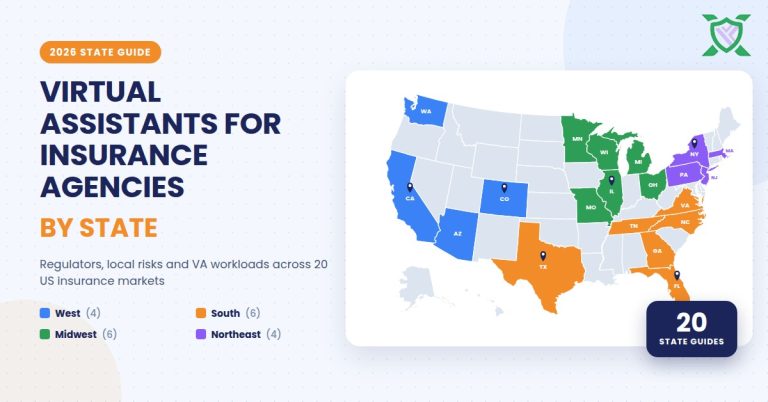
This hub brings together our state-by-state guides to virtual assistants for insurance agencies in 20 US states. Use it to find your state, see what shapes agency workloads there, and understand what a trained VA can take off your team’s plate.
Why Your State Changes What You Need From a VA
Good virtual assistants for insurance agencies follow your SOPs whatever state you’re in. But the volume and mix of work they handle is driven by local factors. These are the ones that matter most.
1. Your State Regulator and Its Rules
Every state has its own insurance department that licenses agents and sets rules on marketing, record keeping and data protection. New York’s Department of Financial Services, for example, applies its Cybersecurity Regulation (23 NYCRR Part 500) to licensed insurance entities, and a growing number of states have adopted versions of the NAIC Insurance Data Security Model Law. The NAIC directory of state insurance departments links to every regulator.
For your VA, this shapes how client data is accessed and stored, and where the line sits between administrative support and licensed activity such as advising on coverage.
2. Catastrophe Exposure and Seasonal Surges
Hurricane states, hail belts and wildfire zones all produce predictable surges in FNOL calls, claim follow-ups, endorsements and non-renewal remarketing. Agencies in these states benefit most from support that can scale up for a season and back down afterwards.
3. Residual Markets and Remarketing
When admitted carriers pull back, business moves to residual markets such as Florida’s Citizens Property Insurance, the California FAIR Plan or the Texas Windstorm Insurance Association. Every placement means more applications, inspections and paperwork, and every depopulation offer or carrier re-entry means more remarketing.
4. Auto Insurance Systems
No-fault and choice no-fault states such as Michigan, New York, New Jersey, Pennsylvania and Florida add PIP selections, tort options and extra forms to every auto policy change. More forms mean more servicing work.
5. Time Zones
An agency in Seattle and an agency in Boston open three hours apart. Your VA should work your business hours, not the provider’s, so clients get answers when they call.
What Stays the Same in Every State
Whatever state you operate in, the core of insurance back-office work doesn’t change, and neither does the list of tasks virtual assistants for insurance agencies handle best. A trained VA can take on:
- Certificates of insurance, ACORD applications and policy checking
- Endorsements: adding and removing drivers, vehicles, locations and scheduled coverage
- Renewal reviews, remarketing and new business quoting
- Ordering loss runs and following up on trailing documents
- Billing updates, payment plan changes and cancellation monitoring
- IVANS download reconciliation and AMS data hygiene
- Claims support, from FNOL intake to adjuster follow-up
The state guides below show how that core workload plays out in each market.
Virtual Assistants for Insurance Agencies: State Guides Directory
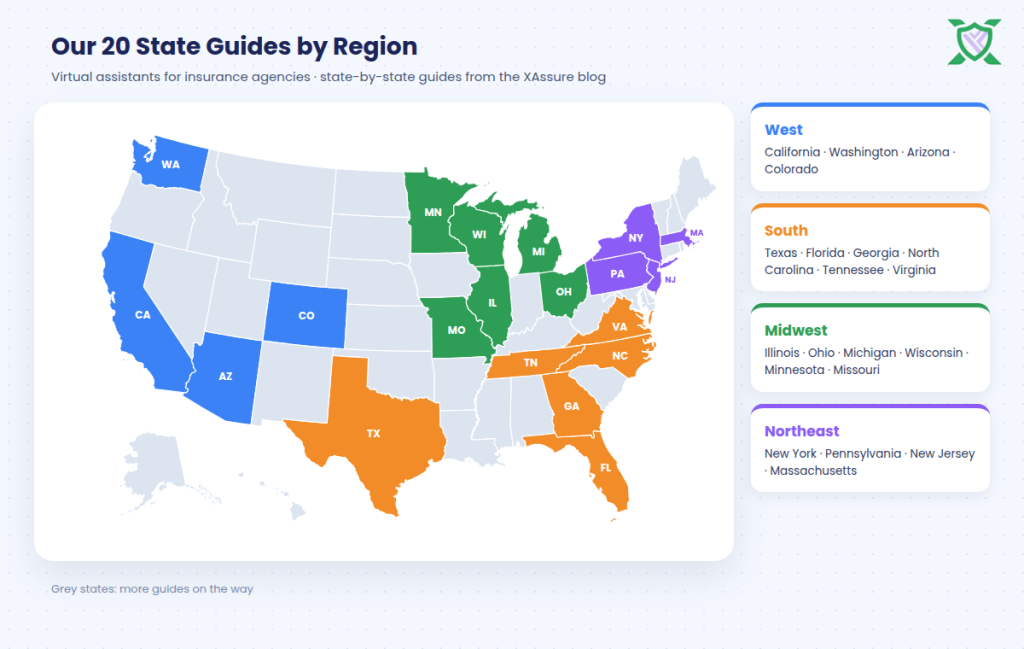
Our state guides are grouped by region. Each one covers the local market, the regulator, the tasks that keep agencies busy there, and how to compare VA providers.
West
| State | Regulator | What keeps agencies busy | Read the guide |
|---|---|---|---|
| California | California Department of Insurance (CDI) | Wildfire exposure, homeowners non-renewals and FAIR Plan placements; a very large commercial market | California VA guide |
| Washington | Office of the Insurance Commissioner (OIC) | Growing Seattle-area commercial accounts; wildfire exposure east of the Cascades; earthquake coverage questions | Washington VA guide |
| Arizona | Department of Insurance and Financial Institutions (DIFI) | Fast population growth in Phoenix and Tucson driving new personal lines business; monsoon storm claims | Arizona VA guide |
| Colorado | Colorado Division of Insurance | One of the most hail-prone states; Front Range wildfire risk; frequent roof claims and renewal increases | Colorado VA guide |
South
| State | Regulator | What keeps agencies busy | Read the guide |
|---|---|---|---|
| Texas | Texas Department of Insurance (TDI) | Hail, wind and hurricane exposure; TWIA coastal windstorm policies; very high personal and commercial volume | Texas VA guide |
| Florida | Office of Insurance Regulation (OIR) | Hurricane-season surges; Citizens placements and depopulation; frequent carrier changes and remarketing | Florida VA guide |
| Georgia | Office of Commissioner of Insurance and Safety Fire | Atlanta metro growth; severe storm claims; high auto volume | Georgia VA guide |
| North Carolina | NC Department of Insurance | Coastal wind exposure and Beach Plan (NCIUA) placements; rate bureau system for home and auto | North Carolina VA guide |
| Tennessee | Department of Commerce & Insurance | Nashville-area growth; tornado and severe storm claims | Tennessee VA guide |
| Virginia | Bureau of Insurance (State Corporation Commission) | Northern Virginia commercial and contractor accounts; coastal exposure around Hampton Roads | Virginia VA guide |
Midwest
| State | Regulator | What keeps agencies busy | Read the guide |
|---|---|---|---|
| Illinois | Illinois Department of Insurance | Chicago commercial market; hail and severe convective storm claims | Illinois VA guide |
| Ohio | Ohio Department of Insurance | Home to several major carriers and a large independent agency market; winter weather claims | Ohio VA guide |
| Michigan | Department of Insurance and Financial Services (DIFS) | No-fault reform with PIP choice levels; ongoing auto policy reviews and endorsements | Michigan VA guide |
| Wisconsin | Office of the Commissioner of Insurance (OCI) | Strong mutual carrier market; farm and small commercial accounts; winter claims | Wisconsin VA guide |
| Minnesota | Minnesota Department of Commerce | Hail and severe storm claims; homeowners renewal increases | Minnesota VA guide |
| Missouri | Department of Commerce and Insurance (DCI) | Hail and tornado exposure; St. Louis and Kansas City commercial accounts | Missouri VA guide |
Northeast
| State | Regulator | What keeps agencies busy | Read the guide |
|---|---|---|---|
| New York | Department of Financial Services (DFS) | Part 500 cybersecurity obligations; no-fault auto; a dense commercial market | New York VA guide |
| Pennsylvania | Pennsylvania Insurance Department | Choice no-fault auto with full and limited tort options; a large commercial and contractor book | Pennsylvania VA guide |
| New Jersey | Department of Banking and Insurance (DOBI) | Auto tort options and basic/standard policies; coastal exposure; a dense commercial market | New Jersey VA guide |
| Massachusetts | Division of Insurance | Managed-competition auto market; coastal homeowners placements through the Massachusetts FAIR Plan | Massachusetts VA guide |
Choosing Virtual Assistants for Insurance Agencies: Questions for Any State
Local factors change the workload, but the way to evaluate virtual assistants for insurance agencies is the same everywhere. Before you sign, ask:
- Are the VAs insurance-trained, or general admins? Look for experience with certificates, endorsements, renewals and carrier portals.
- Do they know your AMS? AMS360, Applied Epic, HawkSoft, EZLynx, NowCerts and QQ Catalyst each have their own workflows.
- Will they work your hours? Coverage should follow your time zone, not the provider’s.
- How is client data protected? Ask about background checks, NDAs, MFA, encrypted devices and whether work runs through secure US-based remote desktops. See how XAssure handles security and data protection.
- Is your VA dedicated or pooled? A dedicated VA learns your book, your carriers and your preferences.
- Can you see the work? A live dashboard and daily reports replace guesswork.
- Is there a trial? You should be able to test real tasks before committing.
It also helps to know what the alternative really costs. Our breakdown of the true cost of hiring an insurance CSR in 2026 covers salary, benefits and overhead, so you can compare like for like.
How XAssure Supports Agencies in Every State
XAssure provides dedicated, insurance-trained VAs to independent agencies across the US. Whichever state you operate in, the model is the same:
- Part-time (20 hours a week) or full-time (40 hours a week) dedicated VAs
- Support across commercial lines, personal lines and employee benefits
- Trained on AMS360, Applied Epic, HawkSoft, EZLynx, NowCerts and QQ Catalyst
- Working during your business hours, in your time zone
- Secure, US-based remote desktop environments, background-checked staff and a dedicated account manager
- A live client dashboard with activity tracking and daily, weekly and monthly reports
- Onboarding in 7 to 10 days, and around 60% savings compared with an in-house hire
Commercial lines agencies in particular get the most from state-aware support, because certificate volume, loss runs and remarketing all rise and fall with local conditions.
Don’t See Your State?
We are adding new state guides regularly. In the meantime, virtual assistants for insurance agencies can support you wherever you’re licensed, because renewals, endorsements and certificates follow the same basic process across the country. If your state isn’t listed yet, start a free trial and we’ll match you with a VA who works your hours and knows your AMS.
Summing Up
The best virtual assistants for insurance agencies understand both the universal work (certificates, endorsements, renewals, quotes) and the local pressures that shape it, from hurricane seasons and hail belts to no-fault rules and residual markets.
Use the directory above to read the guide for your state, then compare providers on training, AMS experience, security and visibility.
XAssure brings all of that together: dedicated, insurance-trained VAs who work your hours, inside your systems, with full dashboard visibility from the first day.
Frequently Asked Questions
Yes. Administrative and servicing work (certificates, endorsements, renewals, data entry, billing and follow-ups) can be done remotely for an agency in any state. Licensed activities such as quoting, advising on coverage or binding should stay with appropriately licensed staff, especially in states that require a license for anyone who discusses coverage with clients.
Generally not for purely clerical and administrative work, but rules differ by state, especially around discussing coverage with clients. Check your state insurance department’s guidance and keep advice and binding with licensed staff.
A dedicated VA works your agency’s business hours, whether you’re on Eastern, Central, Mountain or Pacific time, so they are available when your clients and carriers are.
It depends on the provider’s controls. Ask about background checks, NDAs, multi-factor authentication, encrypted devices, secure US-based remote desktops and how access is removed. Agencies in states with data security rules, such as New York, should also confirm the provider supports their third-party service provider obligations.
Costs vary by provider and hours. XAssure clients typically save around 60% compared with an in-house hire once salary, benefits, taxes and overhead are counted.
Start with the state where most of your book sits, then skim the others for local issues such as catastrophe seasons or residual markets. The day-to-day VA workflows are largely the same across states.
Also Reads
11 Best Virtual Assistant Companies for Insurance Agents (2026)
How to Hire a Virtual Assistant for Your Insurance Agency: The Complete 2026 Guide