
Table of contents
- What Are ACORD Forms?
- ACORD 25: The Certificate of Liability Insurance
- ACORD 125: The Commercial Insurance Application
- ACORD 126: The Commercial General Liability Section
- Which ACORD Forms Do You Need? Quick Reference
- Common Mistakes on ACORD Forms That Stall Submissions
- Who Should Be Filling Out ACORD Forms at Your Agency?
- Summing Up
- Frequently Asked Questions
- Also Reads
Every commercial lines account at your agency runs on ACORD forms. A contractor needs proof of coverage before stepping onto a job site. A new restaurant client needs a general liability quote by Friday. A renewal has to be remarketed to three carriers. Behind each of those tasks sits a form, and behind each form sits someone at your agency typing, checking and chasing information.
ACORD forms are the standard language of the insurance industry. When they are filled in accurately, submissions move and certificates go out the same day. When they are rushed, underwriters come back with questions, quotes stall, and certificate errors turn into E&O exposure.
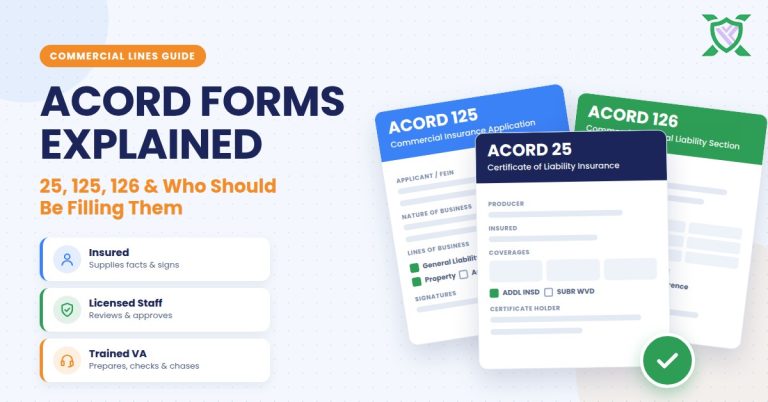
In this guide, you’ll learn what the three most-used forms (the ACORD 25, 125 and 126) actually do, the mistakes that slow them down, and how to divide the work between your licensed staff, your insureds and a trained virtual assistant.
What Are ACORD Forms?
ACORD (the Association for Cooperative Operations Research and Development) is a non-profit standards body founded in 1970 to give insurers, agents and brokers a common format for exchanging information. Its standardized ACORD forms are used across the US property and casualty market, so an underwriter in Ohio and an agency in California read the same fields in the same places.
Most agencies don’t download forms one at a time. They are licensed through your agency management system (AMS), such as Applied Epic, AMS360, HawkSoft or EZLynx, which pre-fills them from the client and policy records already stored there. That is also why AMS data quality matters so much: a wrong FEIN or an old mailing address flows straight onto every form you generate.
ACORD forms fall into a few broad families:
- Certificates and evidence forms prove to a third party that coverage exists (ACORD 25 for liability; ACORD 24 and ACORD 28 for property).
- Applications collect what a carrier needs to underwrite and quote (the ACORD 125 is the common base).
- Line-of-business sections attach to the application for each coverage requested (ACORD 126 for general liability, 127 for business auto, 130 for workers’ compensation, 140 for property).
For most commercial lines agencies, three forms make up the bulk of daily volume. Let’s go through them one at a time.
ACORD 25: The Certificate of Liability Insurance
The ACORD 25 is the form your commercial clients ask for most. It is a one-page snapshot showing a certificate holder (a general contractor, landlord, event venue or lender) that the insured has liability coverage in force on the date it is issued.
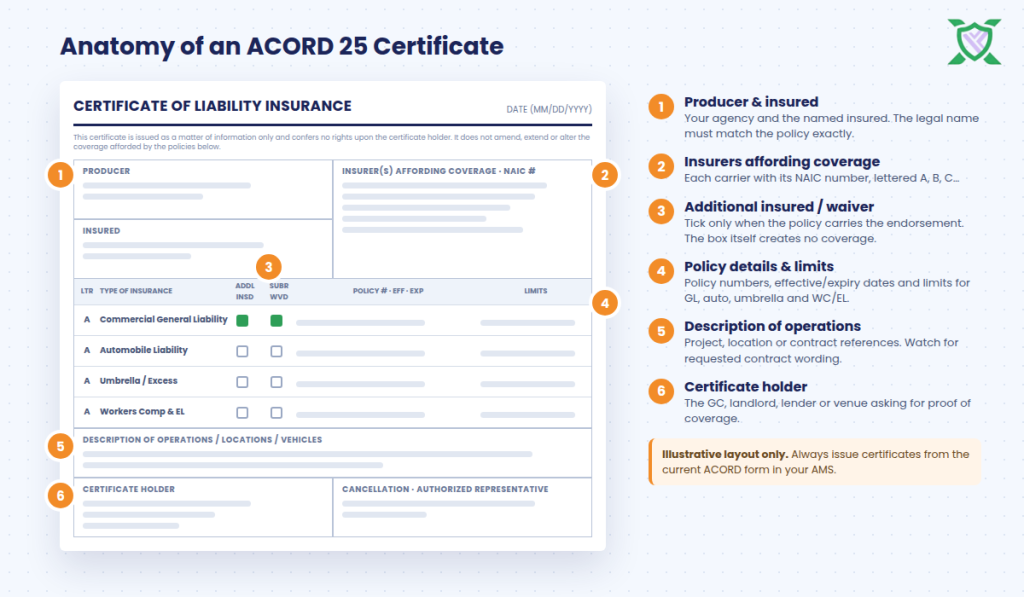
A standard ACORD 25 lists:
- The producer (your agency) and the named insured
- The insurers providing coverage, with their NAIC numbers
- Policy numbers and effective and expiration dates for general liability, auto liability, umbrella/excess and workers’ compensation/employers’ liability
- Limits for each coverage
- Additional insured and waiver of subrogation indicators
- The description of operations box and the certificate holder’s details
The most important thing to understand about the ACORD 25 is what it does not do. The form itself states that it is issued as a matter of information only, confers no rights on the certificate holder, and does not amend, extend or alter the coverage provided by the policies. If the holder needs to be an additional insured or needs a waiver of subrogation, the policy must actually carry that endorsement. Ticking a box on the certificate does not create coverage.
That is where certificates become an E&O risk. A certificate that promises something the policy doesn’t deliver is one of the most common ways agencies get pulled into a coverage dispute. A number of states have also passed certificate-of-insurance laws that restrict altering standard forms or adding contract language to them.
Who should fill it: Routine certificates (a new holder on an existing account, no special wording) are ideal for a trained CSR or virtual assistant working from an SOP inside your AMS. Requests for additional insured status, primary and non-contributory wording, waivers or specific contract language should be checked against the policy endorsements and escalated to a licensed account manager when the endorsement isn’t there. Our guide on how to process certificates of insurance faster walks through a full COI workflow.
ACORD 125: The Commercial Insurance Application
The ACORD 125 is the foundation of nearly every commercial submission. It captures the applicant information every carrier needs no matter which line you are quoting, so it is completed once and paired with the relevant line-of-business sections.
The ACORD 125 covers:
- Applicant details: legal name, entity type (corporation, LLC, partnership, individual), FEIN, mailing address and contacts
- Nature of business, description of operations, years in business and SIC/NAICS codes
- Premises information for each location
- The lines of business being requested and the proposed policy period
- Prior carrier information and loss history
- General information questions about the applicant’s operations and history
- Signatures from both the applicant and the producer
Because the ACORD 125 describes who the business is, small inconsistencies ripple through the whole submission. If the description of operations says “residential remodeling” and the class code on the ACORD 126 says “commercial roofing”, the underwriter will stop and ask, or simply decline to quote.
Who should fill it: The insured supplies the facts and signs. A VA or account manager can pre-fill almost everything from the AMS, the expiring policy, prior applications and your client intake questionnaire, then chase the gaps. A licensed producer or account manager should review the underwriting-sensitive answers (operations, loss history, prior cancellations) before anything goes to a carrier.
ACORD 126: The Commercial General Liability Section
The ACORD 126 attaches to the ACORD 125 whenever general liability is being quoted. Where the 125 describes the business, the 126 describes the liability exposure the carrier is being asked to take on.
Key sections of the ACORD 126 include:
- Coverages and limits: each occurrence, general aggregate, products-completed operations aggregate, personal and advertising injury, damage to rented premises and medical expense
- Occurrence or claims-made coverage form, and any deductibles
- The schedule of hazards: classification codes, premium basis (such as payroll, gross sales or square footage) and exposure amounts for each location
- Additional interests and any requested endorsements
- General information questions on subcontractors, products, hazardous operations, safety programs and more
The schedule of hazards is where most ACORD 126 problems start. Exposure figures need to match what the insured reports elsewhere (financial statements, payroll records or the last audit), and the class codes need to reflect what the business actually does. An understated exposure leads to an audit bill that surprises the client later. An overstated one prices you out of the quote.
Who should fill it: The same split as the 125. The VA or account manager assembles and cross-checks the data, the licensed team reviews classification and coverage choices, and the insured confirms and signs.
Once you know what each form does, the practical question for most agency owners is who should be spending hours on them each week.
Which ACORD Forms Do You Need? Quick Reference
Use this table as a cheat sheet for your team and for writing SOPs. The “typical owner” column reflects how well-run commercial lines agencies usually split the work.
| Form | What it is | When you use it | Typical owner |
|---|---|---|---|
| ACORD 25 | Certificate of Liability Insurance | A client needs proof of liability coverage for a contract, job site, lease or vendor agreement | CSR / VA for routine requests; licensed AM for special wording |
| ACORD 24 / 28 | Certificate of Property Insurance (24); Evidence of Commercial Property Insurance (28) | A holder or lender needs proof of property coverage | CSR / VA |
| ACORD 125 | Commercial Insurance Application | Every new commercial submission or remarket | VA pre-fills, producer reviews, insured signs |
| ACORD 126 | Commercial General Liability Section | Quoting or remarketing general liability | VA pre-fills, producer reviews, insured signs |
| ACORD 127 | Business Auto Section | Quoting commercial auto | VA pre-fills, producer reviews |
| ACORD 130 | Workers Compensation Application | Quoting workers’ compensation | VA pre-fills, producer reviews |
| ACORD 140 | Property Section | Quoting commercial property | VA pre-fills, producer reviews |
Common Mistakes on ACORD Forms That Stall Submissions
Carriers rarely decline a good account because of one bad field, but they do push incomplete or inconsistent submissions to the bottom of the pile. These are the errors that come up most often.
1. Mismatched Names and FEINs
The named insured on the ACORD 125 should match the entity on the loss runs, the expiring policy and any certificate you issue. “ABC Plumbing LLC” and “ABC Plumbing & Heating Inc.” are two different legal entities to an underwriter.
2. Blank General Information Questions
Leaving a yes/no question blank is not the same as answering “no”. Underwriters will send the submission back, and in the worst case a blank answer can later lead to a declination or a material misrepresentation dispute.
3. Class Codes That Don’t Match the Operations Description
The description of operations on the 125 and the classification codes on the 126 have to tell the same story. If the business has grown into new types of work, the application should say so.
4. Stale Loss Runs
Most carriers want currently valued loss runs, commonly dated within the last 90 days and covering several years of history. Ordering them late is one of the most common reasons a submission sits in “pending”.
5. Missing Signatures and Dates
An unsigned application is not a complete application. Build e-signature collection into the workflow from the start, not as an afterthought the day before the effective date.
6. Certificates That Overpromise
Issuing an ACORD 25 that shows additional insured or waiver status the policy doesn’t support is the fastest way to turn an admin task into an E&O claim. Our article on E&O risk and the overwhelmed CSR explains how workload drives exactly these mistakes.
Most of these errors have the same root cause: the person filling in the form is doing it in a hurry, between other jobs. Which brings us to the real question.
Who Should Be Filling Out ACORD Forms at Your Agency?
In many agencies the honest answer today is “whoever has time”, which usually means a producer at 7 p.m. or an account manager already juggling renewals. A better model splits the work by what actually needs a license and professional judgment.
What the Insured Owns
- Providing accurate information about operations, locations, payroll, sales and vehicles
- Answering the general information questions truthfully
- Reviewing and signing applications
What Licensed Staff Should Own
- Coverage recommendations and limit choices
- Final review of classification, exposures and underwriting-sensitive answers
- Approving non-standard certificate wording, additional insured and waiver requests
- Carrier negotiation and the coverage conversation with the client
What a Trained Virtual Assistant Can Own
- Issuing routine ACORD 25 certificates from your AMS, following your SOP
- Pre-filling the ACORD 125, 126 and other line sections from AMS records and prior applications
- Ordering loss runs and tracking them until they arrive
- Chasing missing information and signatures from insureds
- Cross-checking names, FEINs, class codes and exposures across every form before submission
- Packaging submissions for each carrier and logging activity in the AMS
Split this way, your licensed team reviews a finished, consistent packet instead of building it from scratch. That is usually the difference between a producer losing an evening to paperwork and spending ten minutes on a review.
If you haven’t mapped where your team’s hours go, an insurance agency task audit is a good place to start. Work on ACORD forms almost always lands near the top of the list.
XAssure provides dedicated commercial lines virtual assistants trained on certificates of insurance, ACORD applications, loss runs and policy checking. They work inside AMS360, Applied Epic, HawkSoft, EZLynx, NowCerts and QQ Catalyst, during your business hours.
Summing Up
ACORD forms are the paperwork backbone of commercial lines. The ACORD 25 proves coverage, the ACORD 125 introduces the business to the carrier, and the ACORD 126 defines the liability exposure. Filled in carefully and consistently, they move accounts through underwriting faster and keep your agency out of E&O trouble.
Not all of that work needs a licensed professional. Let your producers and account managers own the judgment calls, and hand the data gathering, pre-filling, chasing and cross-checking to a trained assistant.
XAssure gives commercial lines agencies exactly that: insurance-trained VAs, a dedicated account manager, and a live dashboard where you can see every certificate and application as it is worked.
Frequently Asked Questions
The ACORD 25 is a certificate that proves to a third party that coverage already exists. The ACORD 125 is an application used to request coverage from a carrier. The 125 is completed before a policy is bound; the 25 is issued once coverage is in force.
No. The ACORD 126 is only needed when general liability is being quoted. A property-only submission would pair the ACORD 125 with the ACORD 140 instead, and many submissions include several line sections at once.
No. The certificate only reports coverage. Additional insured status has to come from an endorsement on the policy, and the certificate should reflect that endorsement, not replace it.
Yes, for the data work. A trained VA can issue routine certificates, pre-fill applications from your AMS, order loss runs and chase signatures. Coverage advice, underwriting judgment and final approval should stay with licensed staff.
Most agencies use ACORD forms through their agency management system, which licenses the forms and pre-fills them from client and policy records. Licensing details and the full forms catalogue are available from ACORD directly.
ACORD releases new editions of its forms from time to time, and the edition date is printed on each form. Carriers generally expect current editions, so check that your AMS forms library is kept up to date.
Also Reads
Process COIs Faster with Expert Insurance VAs
Insurance Agency E&O Risk Management: The Overwhelmed CSR Problem