
Table of contents
Running a business often means spending hours on low-value tasks, emails, scheduling, follow-ups, while critical work gets delayed. Yet many founders hesitate to hire a virtual assistant (VA), unsure if it’s a smart investment or just another expense.
Data suggests otherwise: hiring a VA can reduce operational costs by up to 78%.
In this guide, you’ll learn what VAs actually do, how much they cost, their real pros and cons, and how to evaluate ROI for your situation.
What Is a Virtual Assistant?
A virtual assistant (VA) is a remote professional who provides administrative, technical, or creative support to individuals or businesses without being a full-time, on-site employee. Instead of hiring in-house staff, you can delegate tasks to a VA on a part-time, project-based, or ongoing basis, often at a significantly lower cost.
Virtual assistants are not limited to basic admin work anymore. Today, they support a wide range of business functions depending on their skills and specialisation.
Common tasks virtual assistants perform include:
- Administrative support: email management, calendar scheduling, data entry, document formatting
- Customer service: handling queries, live chat support, CRM updates, follow-ups
- Marketing support: social media management, content scheduling, basic SEO tasks, email campaigns
- Sales assistance: lead generation, outreach, pipeline management
- Technical tasks: website updates, CMS management (like WordPress), basic automation
- Creative work: graphic design, presentation creation, video editing
In practice, a VA acts as an extension of your team, handling repetitive or time-consuming tasks so you can focus on higher-impact work like strategy, growth, and decision-making.
As businesses grow, the real challenge is not just workload, it’s how much of that workload actually drives results. This is where the role of a virtual assistant becomes more strategic than operational.
How Virtual Assistants Drive Measurable Business Value?
A virtual assistant doesn’t just “save time” they directly impact efficiency, cost structure, and scalability when used correctly.
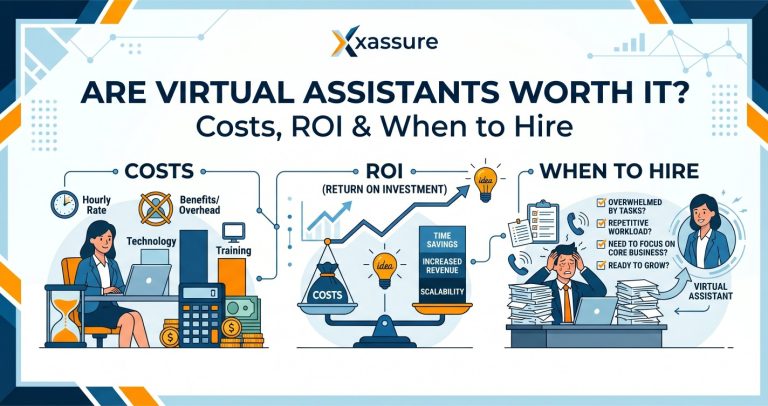
A key advantage is cost optimisation. Hiring a full-time employee comes with salaries, benefits, infrastructure, and training costs. A VA, on the other hand, works on-demand. You only pay for the hours or tasks you need, making it a far more flexible and cost-efficient model, especially for startups and growing teams.
Another major value driver is time reallocation. Founders and managers often spend hours on repetitive tasks that don’t require their expertise. By offloading these to a VA, you free up high-value time for strategy, revenue-generating activities, and decision-making.
Virtual assistants also improve operational consistency. Tasks like email responses, CRM updates, and scheduling get handled systematically, reducing errors and delays. This creates smoother workflows and a more professional customer experience.
From a growth perspective, VAs enable scalability without overhead. You can quickly increase or decrease support based on workload—without the long-term commitment of hiring and onboarding full-time staff.
In practical terms, a VA adds value by:
- Reducing operational costs and overhead
- Freeing up leadership time for high-impact work
- Improving task turnaround and consistency
- Supporting business growth without fixed hiring risk
- Enhancing customer experience through faster responses
After understanding the role of a virtual assistant, the next step is to look at the concrete advantages they bring to day-to-day operations and long-term business growth.
The Real Benefits of Hiring a Virtual Assistant
Hiring a virtual assistant is not just about reducing workload; it’s about improving how your business operates, scales, and allocates resources. When used strategically, a VA can directly impact both efficiency and growth.
Here’s a closer look at the specific benefits that make virtual assistants a high-ROI decision for many businesses.
1. Significant Cost Savings Compared to Full-Time Hires
One of the most immediate advantages is cost efficiency. A full-time employee brings fixed expenses, salary, office space, equipment, benefits, payroll taxes, and recruitment costs. A VA eliminates most of these. You only pay for productive hours or completed tasks. This makes VAs a highly efficient cost model, especially for task-based work.
2. Reclaimed Time for High-Value Work
Time is often a bigger constraint than money. Executives spend nearly 16 hours per week on administrative tasks. That’s two full working days lost to low-impact activities.
When a VA takes over scheduling, inbox management, follow-ups, and routine coordination, you regain that time. The real question is not “what does a VA cost?” but “what could you achieve with an extra half-day, or more, every week?” This is where ROI becomes tangible.
3. Flexibility and Scalability
Unlike traditional hiring, VAs offer built-in flexibility. You can scale support up during busy periods, product launches, seasonal demand, or campaigns, and scale down when workloads reduce.
Whether you need support for 10 hours a week or full-time equivalent output, the model adapts to your needs. This eliminates the risk of over-hiring while ensuring you’re never understaffed when it matters.
4. Access to a Global Talent Pool
With virtual assistants, geography is no longer a limitation. You are not restricted to local hiring markets or talent shortages. Instead, you gain access to a global pool of professionals with diverse skill sets, from specialised admin support to marketing, tech, and creative roles.
This broader access increases your chances of finding the right expertise at the right cost, rather than settling for what’s locally available.
5. Better Focus and Reduced Burnout
Beyond cost and efficiency, VAs improve how you work. Delegating repetitive and non-core tasks reduces mental clutter, helping you stay focused on strategic priorities.
Fewer distractions mean better decision-making, improved execution, and reduced stress. Over time, this directly impacts performance and sustainability. Business owners who delegate effectively are less likely to experience burnout and more likely to operate with clarity.
Building on these benefits, some businesses move beyond ad-hoc hiring and adopt a more structured support model to maximise consistency and results.
XAssure is one such managed virtual assistant solution, designed to handle specialised workflows with trained professionals, defined processes, and quality control, making it easier to scale support without operational friction.
However, as valuable as virtual assistants can be, a well-informed decision also requires understanding where the model can fall short and how to manage those risks effectively.
The Honest Downsides, Challenges to Know Before You Hire
Virtual assistants are not a plug-and-play solution. Like any hiring decision, they come with trade-offs that can impact outcomes if not addressed early.
The key is not to avoid these challenges, but to anticipate and manage them with the right systems and expectations in place.
1. Onboarding Takes Time Upfront
A VA will not be instantly productive on day one. They need time to understand your processes, tools, and expectations. While they eventually become efficient, the initial investment in onboarding is real.
Solution: Create clear SOPs (standard operating procedures), record screen walkthroughs, and start with a defined trial period to ease the transition.
2. Communication and Time Zone Gaps
Working remotely, often across time zones, can lead to delays or miscommunication if not managed well. The lack of real-time, in-person feedback loops can slow down decision-making.
Solution: Set regular check-ins, use project management tools like shared dashboards, and document instructions clearly to reduce ambiguity.
3. Quality and Reliability Vary Widely
Not all virtual assistants deliver the same level of quality. Without proper vetting, you may face inconsistencies in output, missed deadlines, or a lack of accountability.
Solution: Review portfolios, check references, define KPIs, and begin with small test tasks or trial engagements before scaling.
4. Data Security and Confidentiality Concerns
Delegating tasks often means sharing access to sensitive systems, emails, financial tools, or customer data. This introduces potential security risks if safeguards are not in place.
Solution: Use secure, encrypted tools, grant limited access based on role, and ensure confidentiality agreements (NDAs) are signed before onboarding.
As you weigh the benefits against the challenges, the decision ultimately comes down to fit your workload, business model, and readiness to delegate.
Who Should (and Shouldn’t) Hire a Virtual Assistant?
Not every business needs a virtual assistant immediately, but for the right use cases, the impact can be significant. The key is recognising whether your current bottlenecks are operational (which a VA can solve) or strategic (which require a different approach).
Here’s how to evaluate where you stand.
Who Should Hire a Virtual Assistant
You are a strong candidate for hiring a VA if your time is being consumed by repetitive, non-core tasks that limit growth.
- Entrepreneurs and founders spending more than 5–10 hours per week on admin work
- Business owners struggling with overflowing inboxes and disorganised calendars
- Small businesses needing specialised support (content, SEO, customer service) without full-time hiring costs
- Consultants and freelancers losing billable hours to scheduling, follow-ups, and coordination
- E-commerce operators managing orders, product listings, and customer queries
- Real estate professionals handling listings, client communication, and marketing tasks
- Insurance agencies and advisors managing policy documentation, claims processing, CRM updates, and client servicing workflows.
In practical terms, it’s time to consider a VA if your inbox is out of control, follow-ups are slipping, delays are increasing, and you feel constantly busy but not making real progress. If your workload is affecting your personal time, the tipping point has likely already been reached.
For insurance agencies managing policies, claims, and client servicing at scale, structured VA support like XAssure can bring immediate operational clarity and consistency.
Who May Not Need a VA Yet
In some cases, hiring a VA too early or without preparation, can create more friction than value.
- Businesses with highly sensitive or regulated workflows not yet ready for remote delegation.
- Early-stage founders who haven’t defined or documented their own processes.
- Teams unwilling to invest time in onboarding and training, which is essential for long-term success.
As you move from considering a VA to actually evaluating one, the question shifts from “what do they cost?” to “what do they return?”
Is There a Real ROI, How to Measure It?
The ROI of a virtual assistant becomes clear when you compare the value of your time against the cost of delegation.
Start with a simple calculation: what is one hour of your focused, high-impact work worth?
If your time generates $100/hour and a VA costs $20/hour, delegating just 10 hours per week frees up $1,000 worth of strategic time for a $200 investment.
Beyond numbers, track practical signals that reflect real impact:
- Time reclaimed from repetitive tasks each week
- Fewer missed follow-ups and reduced opportunity leakage
- Faster response times to customers and prospects
- Improved clarity and decision-making due to reduced workload
With structured workflows, many business owners reclaim 12+ hours per week to focus on revenue, leadership, and growth.
Nevertheless, it’s important to set realistic expectations; ROI is not immediate. The first 4–6 weeks involve onboarding and alignment. Evaluate outcomes at the 60-day mark, not after just a couple of weeks, to see the true impact.
Summing Up
Virtual assistants are not just a cost-saving tactic; they are a strategic way to reclaim time, improve efficiency, and scale operations without adding fixed overhead. When used correctly, they shift your focus from day-to-day execution to high-impact growth.
XAssure takes this a step further by offering structured, managed virtual assistant support, combining trained professionals, defined workflows, and consistent quality, especially for process-heavy industries like insurance and financial services. This ensures you don’t just delegate tasks, you improve how work gets done.
If your workload is growing but your time isn’t, it may be time to rethink how your business operates.
Frequently Asked Questions
Yes, small businesses particularly benefit because they typically lack the budget for full-time specialist hires. A VA provides skilled support on a flexible basis, covering tasks like customer service, content, and admin without the overhead of a permanent employee.
A freelancer is typically hired for a specific project with a defined deliverable (design, copy, code). A virtual assistant provides ongoing support across a range of tasks, often working recurring hours. VAs are relationship-based; freelancers are project-based.
Most first-time VA users start with 10–20 hours per week. This is enough to cover inbox management, scheduling, and one or two recurring tasks. You can scale up once you have built effective delegation habits.
Yes, with the right precautions. Use a signed confidentiality agreement, limit access to only necessary accounts, use password managers rather than sharing raw credentials, and opt for agencies that perform background vetting if your work involves sensitive data.
Avoid delegating decisions that require deep contextual business judgment, tasks involving highly regulated data without proper security protocols in place, or responsibilities that require in-person presence. Strategic decisions, investor conversations, and sensitive HR matters are best kept in-house.
Absolutely. Virtual assistants are not only still in demand — their relevance is growing faster than ever, as businesses adapt to leaner, remote-first operational models and the need for skilled virtual support has skyrocketed.
Also Reads
What Is a Customer Service Virtual Assistant and How Can It Help Your Business?
How Does an Administrative Virtual Assistant Support Your Business?
What Is a Marketing Virtual Assistant? A Complete Guide
Accounting Virtual Assistants: What They Do, Costs & Best Services (2026 Guide)