
Table of contents
- What Is a Customer Service Virtual Assistant?
- Human VA vs. AI Virtual Assistant for Customer Service: What’s the Difference?
- What Does a Customer Service Virtual Assistant Do?
- Why Businesses Are Investing in Customer Service Virtual Assistants: Key Benefits
- 1. 24/7 Availability without overtime costs
- 2. Significant cost reduction
- 3. Faster response times
- 4. Scalability on demand
- 5. Improved customer retention
- 7. Multilingual and time-zone coverage
- eCommerce & Retail
- Healthcare
- Banking & Financial Services (BFSI)
- SaaS & Technology
- Travel & Hospitality
- Legal & Professional Services
- Tools and Platforms Used by Customer Service Virtual Assistants
- How to Choose the Right Customer Service Virtual Assistant for Your Business?
- Why XAssure Stands Out as a Customer Service Virtual Assistant Solution
- Summing Up
- Frequently Asked Questions
Customer expectations have shifted sharply toward instant, always-on support, and businesses are racing to keep up. According to Precedence Research, the global intelligent virtual assistant market is valued at USD 25.42 billion in 2025 and is projected to reach USD 178.80 billion by 2034, growing at a 24% CAGR.
People now expect instant responses, 24/7 availability, and personalised support. However, building an in-house team to meet these demands is expensive, slow, and difficult to scale.
This pushes companies to adopt customer service virtual assistants (CSVAs), both AI-powered and human-backed. This guide breaks down what CSVAs are, their types, benefits, and how to choose the right solution. Whether you’re a startup or enterprise, it will help you decide if, and how, a CSVA fits your business.
What Is a Customer Service Virtual Assistant?
A customer service virtual assistant (CSVA) is a dedicated professional or AI-powered system that manages customer interactions remotely on behalf of a business. It handles queries, complaints, and support requests across channels such as live chat, email, phone, and social media, ensuring customers receive timely and consistent responses without requiring an in-house team.
At its core, a CSVA combines the responsibilities of a traditional customer service representative with the flexibility of remote or automated delivery. As defined by Executively, it performs standard customer support tasks while operating virtually, enabling businesses to scale support efficiently.
There are two types of customer service virtual assistants:
1. Human Virtual Assistant
A trained remote professional who handles customer interactions manually.
- Ideal for complex, sensitive, or high-value conversations
- Brings empathy, judgment, and personalised problem-solving
- Commonly used for email support, escalation handling, and relationship management
2. AI Virtual Assistant (Intelligent Virtual Assistant – IVA)
A software-driven system powered by natural language processing (NLP) and machine learning.
- Automates repetitive queries and high-volume interactions
- Provides instant, 24/7 responses across platforms
- Continuously improves through data and interaction history
As you explore customer service virtual assistants, the next key question is not whether to use one, but which type fits your business needs best.
Human VA vs. AI Virtual Assistant for Customer Service: What’s the Difference?
At a high level, both human virtual assistants and AI-powered assistants aim to improve customer support efficiency, but they operate in fundamentally different ways. One brings human judgment and empathy, while the other delivers speed, automation, and scale. The right choice depends on how your business balances volume, complexity, and customer experience.
| Feature | Human Customer Service VA | AI-Powered Virtual Assistant |
| Availability | Business hours / agreed schedule | 24/7/365 |
| Response to complex queries | Strong — contextual empathy | Limited — may escalate |
| Setup cost | Hourly/monthly rate | Initial integration + subscription |
| Scalability | Requires additional hiring | Instantly scalable |
| Tone/empathy | High | Improving (via LLMs) |
| CRM/tool integration | Depends on VA skills | Natively integrated |
| Best for | Relationship-intensive support | High-volume, routine queries |
Human VAs are ideal where empathy, brand voice, and complex conversations matter. AI VAs handle high-volume, repetitive tasks like FAQs, order status, and scheduling with speed and consistency.
Most businesses adopt a hybrid model, AI manages routine queries, while human VAs handle escalations, balancing efficiency with quality at scale.
Once you understand the types of virtual assistants, the next step is to look at what they actually do on a day-to-day basis.
What Does a Customer Service Virtual Assistant Do?
A customer service virtual assistant wears many hats depending on the size, industry, and needs of the business. Here are the core responsibilities most CSVAs handle:
1. Answering inbound queries
CSVAs manage day-to-day customer communication across email, live chat, phone, and social media. They respond to questions about products, pricing, shipping timelines, policies, and returns, ensuring quick, accurate, and consistent replies.
2. Issue resolution and complaint handling
They act as the first line of support for dissatisfied customers, de-escalating issues and providing solutions. When needed, they coordinate with internal teams to resolve technical or service-related problems efficiently.
3. Order processing and tracking
In e-commerce and retail, CSVAs handle order confirmations, provide real-time shipping updates, and manage returns or refund requests, keeping customers informed at every stage.
4. Appointment scheduling and calendar management
For service-based industries like healthcare or legal, they book appointments, manage calendars, send reminders, and reduce no-shows through timely follow-ups.
5. CRM data entry and management
CSVAs update customer records, log interactions, and maintain clean, organised data in systems like Salesforce, Zendesk, or HubSpot—ensuring better tracking and personalised service.
6. Feedback collection and survey follow-ups
They gather customer feedback through post-interaction surveys such as CSAT or NPS, helping businesses identify gaps and improve service quality.
7. Proactive customer outreach
Beyond reactive support, CSVAs send follow-ups, renewal reminders, and re-engagement messages to maintain customer relationships and reduce churn.
8. Multichannel support management
They ensure a consistent tone, response quality, and SLA adherence across all communication channels, delivering a seamless customer experience regardless of where the interaction begins.
Now that you understand what CSVAs do, let’s have a look at why so many businesses are actively investing in them.
Why Businesses Are Investing in Customer Service Virtual Assistants: Key Benefits
The shift toward virtual support is not just a trend; it’s driven by measurable impact.
To understand why adoption is accelerating, it’s important to look at the tangible business benefits CSVAs deliver across operations, cost, and customer experience.
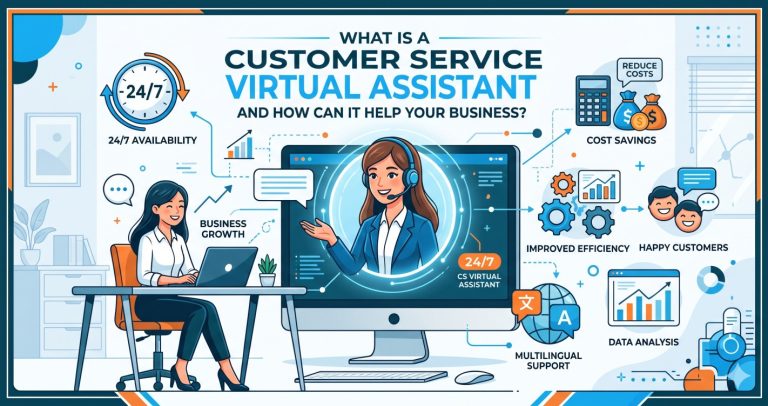
1. 24/7 Availability without overtime costs
Customers expect support at any time, not just during business hours. A CSVA, whether AI-powered or offshore, ensures your support remains active round the clock, which is especially critical for global and e-commerce businesses.
2. Significant cost reduction
Maintaining an in-house team involves salaries, infrastructure, training, and overhead. Virtual assistants, particularly remote human VAs, can reduce operational costs by up to 78%, making them a highly cost-efficient alternative.
3. Faster response times
Speed is a key driver of customer satisfaction. CSVAs handle queries in real time, reducing first-response time and improving overall service efficiency and CSAT scores.
4. Scalability on demand
During peak periods like product launches or seasonal sales, CSVAs can scale instantly. This flexibility removes the delays and costs associated with hiring and training new staff.
5. Improved customer retention
Consistent, timely, and personalised support builds trust. CSVAs trained in your brand voice ensure every interaction meets a defined standard, helping reduce churn.
6. Freeing internal teams for strategic work
By handling repetitive queries, CSVAs allow your in-house teams to focus on growth, product development, and high-value customer relationships.
7. Multilingual and time-zone coverage
With globally distributed human VAs and multilingual AI capabilities, businesses can offer seamless support across regions, improving accessibility and customer experience in international markets.
As adoption grows, it becomes clear that certain industries benefit more immediately due to the volume, complexity, and nature of their customer interactions.
Industries That Benefit Most From Customer Service Virtual Assistants
While CSVAs are adaptable across sectors, their impact is especially significant in industries where high query volume, repetitive workflows, and customer expectations for speed intersect.
To see how this plays out in practice, here’s how different industries are using CSVAs to streamline operations and improve customer experience:
eCommerce & Retail
Customer queries around order tracking, returns, product details, and cart abandonment are constant. CSVAs help manage this volume efficiently, reducing support costs while enabling businesses to handle higher order volumes without increasing headcount.
Healthcare
From appointment scheduling to insurance queries and prescription follow-ups, CSVAs streamline administrative workloads. With admin tasks accounting for nearly 25% of healthcare operating costs, virtual assistants also help reduce no-show rates by 15–20% through timely reminders.
Banking & Financial Services (BFSI)
This sector deals with high-frequency queries like account information, loan status, and transaction disputes. AI-powered CSVAs are particularly effective here, provided they operate within strict compliance and data security frameworks.
SaaS & Technology
Global user bases demand 24/7 support for onboarding, subscription management, and troubleshooting. CSVAs ensure continuous assistance while reducing the burden on internal support teams.
Travel & Hospitality
Handling booking modifications, cancellations, itinerary queries, and loyalty program support requires speed and availability. CSVAs enable real-time responses, improving customer satisfaction during time-sensitive interactions.
Legal & Professional Services
Tasks like appointment scheduling, client intake, and document follow-ups often consume up to 40% of professionals’ time. CSVAs take over these non-billable activities, allowing experts to focus on core, revenue-generating work.
As customer service operations evolve, the tools behind them play a critical role in enabling speed, consistency, and scalability.
Tools and Platforms Used by Customer Service Virtual Assistants
Whether human or AI-powered, a customer service virtual assistant operates within a well-defined tech stack. These tools enable seamless communication, efficient workflows, and better customer experience across touchpoints.
To understand how CSVAs function effectively, here are the most commonly used platforms:
Helpdesk software
Platforms like Zendesk, Freshdesk, Gorgias, and Intercom manage support tickets, automate routing, and track SLAs—ensuring no customer query is missed.
CRM platforms
Tools such as Salesforce, HubSpot, and Zoho CRM store customer data, interaction history, and segmentation insights, enabling more personalised and informed support.
Live chat tools
Solutions like Tidio, Drift, and Crisp facilitate real-time conversations, helping resolve queries instantly and improve engagement.
Communication tools
Internal collaboration is powered by platforms such as Slack, Microsoft Teams, and Zoom, allowing CSVAs to coordinate with in-house teams efficiently.
AI and automation layers
AI-driven chatbots and conversational platforms use natural language processing (NLP) to automate responses, handle repetitive queries, and assist human agents with faster resolutions.
Project and task management tools
Platforms like Asana, Trello, and Notion help track tasks, escalations, and workflows, ensuring nothing falls through the cracks.
Now that you understand the value and use cases, the final step is choosing a solution that actually fits your business needs.
How to Choose the Right Customer Service Virtual Assistant for Your Business?
Selecting the right CSVA is less about trends and more about aligning your support volume, query complexity, and growth plans, which should drive the decision.
To make a confident choice, follow this practical framework:
Step 1: Define your support volume and channels
Start by assessing how many customer queries you handle daily and where they come from, email, chat, phone, or social media. This helps determine whether you need a human VA, an AI solution, or a hybrid model.
Step 2: Identify routine vs. complex queries
Break down your support tickets. If a large share involves repetitive queries like order status or FAQs, AI can handle them efficiently. For more nuanced, relationship-driven interactions, a skilled human VA is essential.
Step 3: Set your budget
Human VAs typically range from $15–$25/hour for offshore talent and $50–$90/hour for US-based specialists. AI solutions vary from subscription-based SaaS tools to custom enterprise pricing, depending on scale and features.
Step 4: Check tool compatibility
Ensure your chosen solution integrates seamlessly with your existing systems like Salesforce, Zendesk, or communication tools—this avoids workflow disruption.
Step 5: Evaluate quality assurance mechanisms
Look for features like QA scoring, call recordings, CSAT tracking, and performance dashboards. These ensure consistent service quality and provide visibility into support performance.
Step 6: Consider scalability
Your support needs will grow. Choose a solution that can handle spikes in demand, whether it’s a product launch or seasonal surge, without compromising response time or quality.
As you evaluate different providers, it’s helpful to look at solutions that combine both operational efficiency and real-world support expertise.
Why XAssure Stands Out as a Customer Service Virtual Assistant Solution
When businesses assess CSVA providers, they typically prioritise reliability, scalability, domain expertise, and seamless integration. XAssure is designed around these exact requirements, making it a strong option to evaluate.
- Hybrid support model built for scale: XAssure combines AI-powered automation with trained human agents. This ensures routine, high-volume queries are handled instantly, while complex or sensitive interactions receive human attention.
- Omnichannel and integration-ready: The platform supports email, chat, and voice, while integrating with systems like Salesforce and Zendesk, helping maintain a unified customer view and smoother workflows.
- Built for performance and global reach: With features like real-time dashboards, QA tracking, and multilingual support, XAssure is well-suited for businesses operating across geographies or managing large-scale support operations.
XAssure is particularly relevant for ecommerce, insurance, and service-driven businesses that need both efficiency and consistent customer experience at scale.
If you’re exploring customer service virtual assistant solutions, XAssure VA is worth a closer look, especially if you want a solution that grows with your support needs.
Try XAssure to see how it can streamline your customer support operations.
Summing Up
Customer service has shifted from a cost centre to a core growth driver. Speed, consistency, and personalisation now directly influence retention and revenue. Whether you deploy a human VA, an AI assistant, or a hybrid model, the real advantage lies in aligning support with your business scale and customer expectations.
The most effective teams today use CSVAs to reduce response times, control costs, and maintain quality as they grow. Solutions like XAssure reflect this shift, combining automation with human oversight to deliver reliable, scalable support without the complexity of building large in-house teams.
If you’re looking to upgrade your customer support without compromising experience, it’s worth exploring what this model can deliver.
Frequently Asked Questions
A customer service virtual assistant is either a remote human professional or an AI-powered software system (or both) that handles customer interactions, such as answering queries, resolving complaints, processing orders, and providing support on behalf of a business, typically across channels like email, live chat, phone, and social media.
A chatbot is a simple, rule-based (or AI-driven) program that responds to predefined triggers. A customer service virtual assistant, particularly an AI-powered IVA, is more sophisticated: it understands context, learns from interactions, handles multi-turn conversations, and can execute tasks (like processing a return or booking an appointment), not just answer questions.
Costs vary widely by type and geography. Offshore human VAs typically charge $13–$25/hour; US-based specialists may charge $50–$90/hour. AI VA platforms often operate on SaaS subscription models, ranging from $50/month for basic tools to enterprise pricing for full omnichannel deployments. The average annual salary for a US-based virtual assistant is around $56,000.
Yes. AI-powered virtual assistants operate around the clock without breaks or overtime. Human VAs can also provide 24/7 coverage through staggered shifts or by sourcing talent across different time zones — a common practice among outsourcing providers.
Key metrics include: First Response Time (FRT), Average Handle Time (AHT), Customer Satisfaction Score (CSAT), Net Promoter Score (NPS), First Contact Resolution (FCR) rate, and ticket deflection rate (for AI VAs). Regular QA reviews and conversation audits are also recommended.
Explore More Guides on Using Customer Virtual Assistants Effectively
How an Administrative Virtual Assistant Support Your Business?
What Is a Marketing Virtual Assistant? A Complete Guide
What Is a Virtual Assistant and How Can It Help Your Business?