
Table of contents
- What Is an Accounting Virtual Assistant?
- Core Tasks an Accounting Virtual Assistant Handles
- Benefits of Hiring an Accounting Virtual Assistant
- Accounting Virtual Assistant vs. In-House Accountant
- The Two Models: Freelance VA vs. Managed Bookkeeping Service
- Skills to Look for When Hiring an Accounting Virtual Assistant
- Streamline Your Accounting Without Expanding Your Team with XAssure
- Frequently Asked Questions
- Similar Reads
Accounting teams today are stretched thin. As a CPA or business owner, you may spend nearly 30–40% of your time on repetitive, non-billable tasks, bookkeeping updates, invoice tracking, and data entry, leaving little room for high-value financial strategy.
This shift is why many firms are turning to accounting virtual assistants to rebalance workloads without increasing in-house overhead. In fact, around 41% of American companies now outsource accounting functions to virtual assistants.
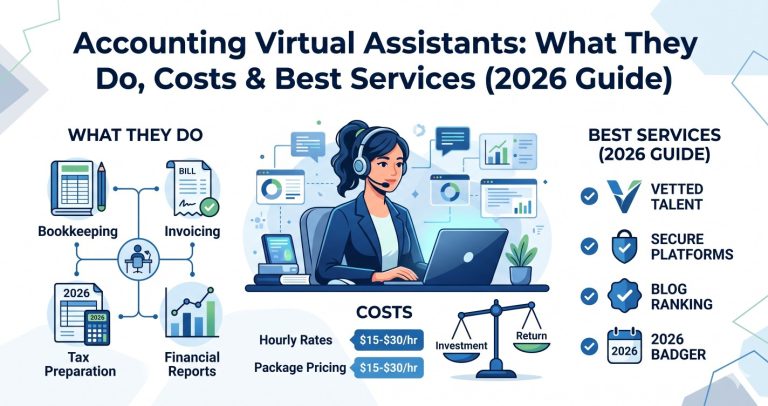
In this guide, you will understand what accounting virtual assistants do, their benefits, cost structures, how to hire the right one, and which providers to consider.
What Is an Accounting Virtual Assistant?
An accounting virtual assistant is a structured support system designed to handle financial workflows, bookkeeping tasks, and back-office accounting operations with minimal manual intervention.
Unlike a general virtual assistant, it is purpose-built for finance-heavy processes, helping you streamline repetitive accounting tasks, improve accuracy, and maintain consistent financial operations.
To understand the scope clearly, it helps to differentiate between related roles:
- Accounting Virtual Assistant: Covers a broader range of financial operations, including invoice processing, financial reporting, payroll support, reconciliation, compliance tracking, and workflow optimisation across accounting systems.
- Bookkeeping Virtual Assistant / Virtual Bookkeeper: Focuses specifically on transactional accuracy, recording entries, reconciling accounts, maintaining ledgers, and ensuring books are up to date.
- CPA Virtual Assistant: Tailored for accounting firms, supports client documentation, tax preparation workflows, audit readiness, and compliance-heavy processes.
You will typically see accounting virtual assistants used by CPA firms, solo accountants, SMBs, e-commerce businesses, startups, and real estate operators, especially those dealing with high transaction volumes or multi-entity finances.
Before you decide whether this model fits your workflow, it helps to understand what an accounting virtual assistant actually does on a day-to-day basis, and how it impacts your financial operations.
Core Tasks an Accounting Virtual Assistant Handles
An accounting virtual assistant is designed to take over structured, repeatable financial tasks that typically consume a large portion of your time. Here’s how they contribute across key accounting functions:
1. Bookkeeping & Financial Data Entry
At the core, they handle transaction recording, expense categorisation, and ledger updates. By integrating with tools like QuickBooks, Xero, FreshBooks, and NetSuite, they ensure your books remain accurate and consistently updated, reducing manual errors and audit risks.
2. Invoicing & Accounts Receivable
They automate invoice generation, send payment reminders, and track outstanding dues. This helps you maintain healthier cash flow by reducing delays in collections and improving visibility into receivables.
3. Accounts Payable Management
From processing vendor invoices to scheduling payments and maintaining supplier records, accounting virtual assistants ensure you never miss a due date, helping avoid penalties and maintain strong vendor relationships.
4. Bank & Credit Card Reconciliation
They match your internal records with bank and card statements, identifying discrepancies early. This prevents small errors from compounding into larger financial inconsistencies over time.
5. Payroll Coordination
They assist with timesheet preparation, verify working hours, and coordinate with payroll platforms like Gusto, ADP, and Paychex. This ensures employees are paid accurately while maintaining compliance with local regulations.
6. Tax Preparation Support
While they do not replace a licensed CPA, they organise financial documents, categorise expenses, and prepare reports ahead of tax season, making it easier for your accountant to file accurately and on time.
7. Financial Reporting & Analysis
They generate monthly, quarterly, and annual reports, including cash flow summaries, budget tracking, and variance analysis. This gives you a clearer financial picture to support decision-making.
8. Commission Tracking (Industry-Specific)
For industries like insurance and financial advisory, tracking commissions can be complex. Accounting virtual assistants handle carrier payouts, producer splits, and reconciliation of commission statements, areas where generic support often falls short.
9. Administrative & Client Communication
They also support scheduling, digital document management, and client-facing financial communication, ensuring your operations remain organised and responsive.
Pro Tip: Pair your accounting virtual assistant with QuickBooks Online or Xero for real-time financial visibility. This combination significantly reduces errors and speeds up your month-end close.
Now that you know what an accounting virtual assistant handles, the next step is understanding the real impact it can have on your business operations and bottom line.
Benefits of Hiring an Accounting Virtual Assistant
Hiring an accounting virtual assistant shifts your finance function from a fixed, resource-heavy setup to a streamlined, process-driven model. Instead of managing workloads through headcount, you manage them through structured execution, improving efficiency, consistency, and cost control at the same time.
This shift delivers measurable impact across cost, accuracy, scalability, and time utilisation, each of which directly influences how effectively your financial operations support business growth.
1. Significant Cost Savings
Hiring in-house accounting staff comes with fixed overhead, salaries, office space, equipment, benefits, and payroll taxes. An accounting virtual assistant, on the other hand, operates as a variable cost aligned with your workload.
- No infrastructure or employee overhead
- Pay only for hours or output
- Reduced long-term financial commitments
2. Improved Accuracy & Compliance
Financial errors are rarely about a lack of expertise; they are often the result of overload. When your team is stretched, inconsistencies creep in.
- Standardised workflows reduce manual errors
- Regular reconciliation ensures clean books
- Better audit readiness and compliance tracking
A structured accounting virtual assistant ensures consistency, which translates into more reliable financial reporting.
3. Scalable, Flexible Support
Your accounting needs fluctuate throughout the year, especially during tax season, audits, and month-end close.
- Scale support up during peak periods
- Reduce usage during slower months
- Avoid hiring or layoffs tied to demand cycles
4. Time Reclaimed for High-Value Work
Routine accounting tasks often consume time that could be better spent on strategic work.
An accounting virtual assistant takes over repetitive processes like data entry, reconciliation, and reporting prep, freeing you to focus on advisory, client relationships, and business growth.
5. Access to Specialised Expertise
Building niche accounting expertise in-house is expensive and time-consuming. Virtual models give you access to domain-specific capabilities instantly.
- Healthcare billing and compliance
- Legal and trust accounting
- Insurance commission tracking
- E-commerce revenue recognition
6. Better Work-Life Balance
Perhaps the most practical benefit is operational relief. When routine accounting tasks are consistently handled:
- No weekend reconciliation catch-ups
- Reduced month-end stress
- More predictable workflows
As you evaluate whether this model fits your business, a direct comparison with traditional hiring makes the trade-offs clearer.
Accounting Virtual Assistant vs. In-House Accountant
Choosing between an in-house accountant and an accounting virtual assistant comes down to cost structure, flexibility, and how your business scales its financial operations.
The differences become clearer when you compare them across key operational and financial factors:
| Dimension | In-House Accountant | Accounting Virtual Assistant |
| Annual Cost | $60,000–$95,000 + benefits | ~$25–$45/hr (varies by service model) |
| Flexibility | Fixed hours, fixed headcount | Scale up/down as needed |
| Overhead | Office space, equipment, HR costs | No infrastructure overhead |
| Onboarding | Weeks to months | Days to ~2 weeks |
| Specialisation | Often a generalist | Often industry-specific |
| Availability | Business hours only | Can span time zones |
Not every accounting virtual assistant works the same way. The real difference lies in how the support is delivered, managed, and quality-checked.
The Two Models: Freelance VA vs. Managed Bookkeeping Service
Not all accounting virtual assistant solutions are built the same. The way support is delivered, whether through an individual or a structured service, directly impacts consistency, scalability, and overall outcomes.
Understanding this distinction helps you choose the right model based on your workload complexity, control requirements, and growth stage.
Freelance / Marketplace Model
This model gives you flexibility and lower upfront commitment. However, output quality can vary depending on the individual’s experience, availability, and familiarity with your industry. It works best when your needs are straightforward, such as basic transaction entry, invoice tracking, or simple reconciliations.
Managed Service Model
A managed service is more structured. Instead of relying on one person, you get a dedicated team, defined workflows, quality checks, and faster onboarding. This makes it a better fit for accounting firms, agencies, and businesses that need consistency across month-end close, AP/AR, payroll coordination, reporting, and compliance support.
Here’s a quick overview:
| Model | How It Works | Best Fit |
| Freelance / Marketplace Model | You hire an individual through Upwork, Fiverr, or referrals. You manage their tasks, quality, deadlines, and workflow directly. | Simple, low-volume bookkeeping needs |
| Managed Service Model | A provider assigns a dedicated team with built-in oversight, QA, and standardised processes. | Firms with complex or recurring financial workflows |
If your accounting workflows are becoming more complex than basic bookkeeping, it may be time to move beyond ad-hoc support.
Explore a managed accounting support model that scales with your business without adding headcount.
Before you finalise a hiring decision, it is critical to evaluate not just availability, but capability, accuracy, and reliability.
Skills to Look for When Hiring an Accounting Virtual Assistant
The effectiveness of an accounting virtual assistant depends heavily on the skills they bring to your financial workflows. A strong candidate combines technical expertise with precision, communication, and accountability.
At a minimum, your accounting virtual assistant should be comfortable working across standard accounting tools and processes:
- Proficiency in QuickBooks (Desktop & Online), Xero, FreshBooks, Sage, and NetSuite
- Strong working knowledge of Excel or Google Sheets for reporting and data handling
- Understanding of GAAP principles and basic tax compliance requirements
- Hands-on experience with AP/AR workflows, reconciliations, and payroll systems.
If your business operates in specialised sectors like insurance or financial advisory, domain knowledge becomes critical:
- Familiarity with AMS platforms such as EZLynx, Applied Epic, and HawkSoft
- Understanding of direct bill vs. agency bill accounting
- Experience with commission tracking and reconciliation
As your workflows move beyond basic bookkeeping, managing accuracy, consistency, and scale with limited internal resources becomes increasingly challenging.
Streamline Your Accounting Without Expanding Your Team with XAssure
As your financial workflows grow more complex, especially with multi-source revenue, commissions, and compliance requirements, managing everything in-house or through fragmented support can lead to delays, inconsistencies, and missed insights. A structured, process-driven model helps you maintain accuracy and control without increasing headcount.
If you are considering a managed approach, XAssure is built specifically for industries where standard bookkeeping often breaks down, such as insurance agencies and financial advisory firms. Instead of generic support, XAssure delivers workflow-aligned execution across:
- Commission reconciliation and carrier statement matching
- Agency bill vs. direct bill accounting
- Producer split tracking and payout alignment
- Monthly close, AP/AR management, and payroll coordination
You are supported by a dedicated bookkeeping team working within defined processes, ensuring consistency, audit readiness, and faster turnaround times. With plans starting at $300/month and no long-term contracts, it offers a scalable way to handle complex accounting operations without adding internal overhead.
Move from reactive bookkeeping to a structured, reliable accounting workflow that supports your growth.
Summing Up
Accounting virtual assistants have become a core part of modern finance operations, handling execution-heavy tasks while improving accuracy and scalability. While freelance support works for basic bookkeeping, complex workflows require a more structured approach.
For insurance agencies and financial advisory firms, XAssure bring specialised support across commission reconciliation, carrier statements, and month-end close, without adding internal overhead.
Bring structure, accuracy, and scalability to your accounting operations.
Frequently Asked Questions
A freelance VA is an individual you hire and manage directly, more flexible, more variable. A managed service assigns a dedicated team with built-in processes, oversight, and often industry-specific expertise. For straightforward books, a freelancer works fine. For complex financial workflows, like those in insurance agencies, a managed service is usually the better fit.
A freelance VA is an individual you hire and manage directly, more flexible, more variable. A managed service assigns a dedicated team with built-in processes, oversight, and often industry-specific expertise. For straightforward books, a freelancer works fine. For complex financial workflows, like those in insurance agencies, a managed service is usually the better fit.
Yes, with the right controls: signed NDA, role-based access in your accounting software, encrypted file sharing, and two-factor authentication. Reputable managed providers also conduct background checks and publish documented security policies.
Look for experience with your accounting tools, strong attention to detail, and knowledge of your industry. For complex workflows, consider a managed service like XAssure, which offers structured processes and specialised expertise.
You should consider switching when your workflows become complex, such as handling multi-entity accounts, high transaction volumes, or industry-specific processes. Managed services like XAssure offer structured support, better consistency, and scalability for growing businesse
Similar Reads
What Is a Customer Service Virtual Assistant and How Can It Help Your Business?
How an Administrative Virtual Assistant Support Your Business?