
Table of contents
- Generic Offshore VA vs. Insurance-Trained Virtual Assistant at a Glance
- Why “Insurance-Trained Virtual Assistant” Has Become a Marketing Label
- What an Insurance-Trained Virtual Assistant Actually Knows
- Where Generic Offshore VAs Usually Fall Short
- How to Test an Insurance-Trained Virtual Assistant Before You Sign
- 1. “Walk Me Through a Certificate Request That Needs an Additional Insured”
- 2. “Which Agency Management Systems Have Your VAs Actually Worked In?”
- 3. “What Will Your VA Refuse to Do?”
- 4. “Who Checks the VA’s Work?”
- 5. “How Is My Clients’ Data Protected?”
- 6. “What Happens When the VA Is Sick or Leaves?”
- 7. “Can I Try It on My Own Workload?”
- XAssure’s Insurance-Trained Virtual Assistant vs. Generic Offshore VA Firms
- What It Costs: Generic VA vs. Insurance-Trained Virtual Assistant
- When You Don’t Need an Insurance-Trained Virtual Assistant
- Summing Up
- Frequently Asked Questions
- Also Reads
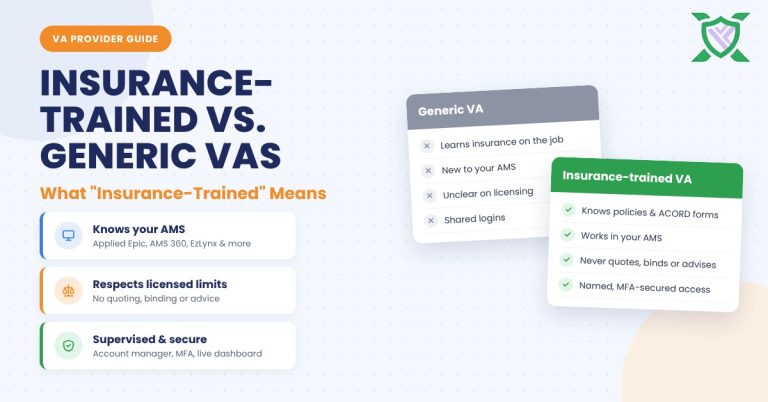
Almost every offshore VA firm now says its assistants “know insurance”. Some do. Many mean a general admin assistant who has been shown a carrier portal once. For an insurance agency, the difference between a generalist and an insurance-trained virtual assistant shows up in certificates issued with the wrong wording, endorsements that never get followed up, and hours of your best CSR’s time spent training someone who will leave in six months.
This guide explains what an insurance-trained virtual assistant actually knows, where generic offshore VA firms usually fall short, how to test the claim before you sign, and how XAssure compares on the things that matter to an agency.
Generic Offshore VA vs. Insurance-Trained Virtual Assistant at a Glance
Here is how the two models usually compare. Individual firms vary, which is why the testing questions later in this guide matter.
| Generic offshore VA firm | Insurance-trained VA (XAssure) | |
| Trained for | Any industry: email, scheduling, data entry | Insurance agencies only: personal lines, commercial lines, employee benefits |
| Insurance knowledge on day one | Usually none; you train them | Renewals, endorsements, certificates, loss runs, ACORD forms |
| AMS experience | Rarely; learns your system on your time | Applied Epic, AMS 360, EzLynx, HawkSoft, NowCerts, QQ Catalyst |
| Licensed vs. unlicensed limits | Often not understood | Built into every SOP |
| Who checks the work | You do | Account manager and US licensed agent management |
| Access to client data | Varies; shared logins are common | Named logins, MFA and password manager credentials |
| Visibility | Status emails, if you ask | Live dashboard with real-time task timers |
| Cover and replacement | Often your problem | Replacement under a satisfaction guarantee |
Why “Insurance-Trained Virtual Assistant” Has Become a Marketing Label
Agencies are hiring virtual help faster than ever, and VA firms know it. Adding “insurance” to a services page costs nothing. Building a team that understands policies, carriers and agency management systems takes years.
The cost of getting it wrong falls on you, not the VA firm. A missed endorsement, a certificate that shows coverage the client doesn’t have, or a renewal that slips past its date is an E&O problem for your agency. We explain how service overload turns into exposure in Why Your Agency E&O Risk Goes Up When Your CSR Is Overwhelmed. Hiring help that adds errors does the same thing.
So before comparing prices, it helps to define what an insurance-trained virtual assistant should bring to the job.
What an Insurance-Trained Virtual Assistant Actually Knows
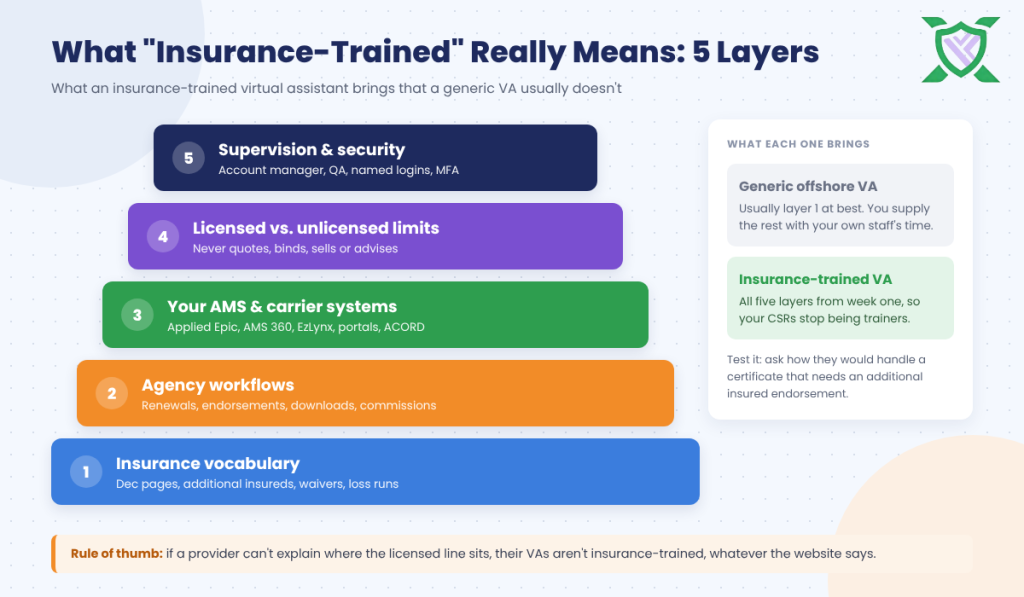
The Language of a Policy
An insurance-trained virtual assistant can read a declarations page and find the named insured, limits, deductibles and forms. They know the difference between an additional insured and a certificate holder, what a waiver of subrogation is, why a loss run matters at renewal, and when a binder is needed. You should never have to explain what a dec page is.
The Agency Workflow
Insurance work runs on cycles: the 90-day renewal pipeline, endorsements that wait days for the carrier, carrier downloads that need matching, and monthly commission statements. A trained VA knows these rhythms and sets follow-ups without being told. They also understand agency bill versus direct bill, which matters every time a client calls about a payment.
Your Systems
Most agencies run on one of a handful of agency management systems. An insurance-trained virtual assistant has already worked in them, along with carrier portals, comparative raters and ACORD forms. If your agency runs Applied Epic, for example, a trained VA already knows how activities, Suspense and Renewals Manager work. See our Applied Epic workflow guide for what that looks like day to day.
The Licensed vs. Unlicensed Line
Insurance is a licensed profession, and most states base their rules on the NAIC Producer Licensing Model Act. A trained VA knows they can collect information, process paperwork and update records, but cannot quote, bind, sell or advise on coverage. Generic assistants often don’t know the line exists, which is how well-meaning help ends up answering “Am I covered for that?” on the phone.
The Differences Between Lines of Business
Personal lines, commercial lines and employee benefits are different jobs. Commercial work means certificates with contract wording, workers’ compensation audits and fleet schedules. Benefits work means census files, enrollment processing and COBRA notices. A real insurance-trained virtual assistant is trained for the line they will work in, not just for “insurance” in general.
Where Generic Offshore VAs Usually Fall Short
The hourly rate of a generalist VA looks attractive. The hidden costs show up later.
- Your best CSR becomes the trainer. Every hour spent explaining endorsements or carrier portals is an hour your most experienced person is not serving clients.
- Errors look like finished work. A generalist can issue a certificate perfectly formatted and completely wrong. Only someone who knows insurance spots the problem.
- Nobody checks quality. Many generic firms supply the person and leave supervision to you.
- Turnover restarts the clock. When a generalist VA leaves, all the insurance training you invested leaves with them.
- Security is improvised. Shared producer logins and passwords sent by email are common when a firm doesn’t specialise in handling regulated client data.
Here is a simple example. A contractor’s client asks for a certificate showing a waiver of subrogation in favour of a general contractor. A generic VA fills in the ACORD 25 and sends it. An insurance-trained virtual assistant first checks whether the policy actually carries a waiver endorsement, and if it doesn’t, routes the request to licensed staff before anything goes out. One of those outcomes is good service. The other is an E&O claim waiting to happen.
How to Test an Insurance-Trained Virtual Assistant Before You Sign
Use these questions with any provider, including us.
1. “Walk Me Through a Certificate Request That Needs an Additional Insured”
The answer should mention checking the policy for the right endorsement before issuing, and escalating if it isn’t there. If the answer is only “we fill in the form”, the VA isn’t trained for insurance.
2. “Which Agency Management Systems Have Your VAs Actually Worked In?”
Ask for specifics: which systems, which tasks and for how long. Better still, ask for a live walk-through of how they would work an activity or renewal in your AMS.
3. “What Will Your VA Refuse to Do?”
The right answer is clear: no quoting, binding, selling or advising on coverage, and no commission-based pay. A provider that can’t answer this hasn’t thought about licensing.
4. “Who Checks the VA’s Work?”
Look for named quality control: an account manager, documented SOPs and licensed oversight, not just “you can give feedback”.
5. “How Is My Clients’ Data Protected?”
Expect specifics: named logins, multi-factor authentication, a password manager, encrypted devices, background checks and physical security at the office. Our security and compliance page lists what XAssure has in place.
6. “What Happens When the VA Is Sick or Leaves?”
You should get cover and a replacement without restarting from zero, because the provider owns the training.
7. “Can I Try It on My Own Workload?”
A trial on your real tasks is the only test that counts. Be wary of long contracts before you have seen any work.
XAssure’s Insurance-Trained Virtual Assistant vs. Generic Offshore VA Firms
XAssure was built for insurance agencies only. Here is what that means in practice:
- Insurance-only training: 110+ tasks across personal lines, commercial lines, employee benefits, claims support and accounting, including endorsements, certificates of insurance, renewal processing, ACORD forms, premium billing and commission reconciliation
- System experience: AMS 360, EzLynx, HawkSoft, Applied Epic, NowCerts, QQ Catalyst and ImageRight, plus major carrier portals
- Licensed oversight: US licensed agent management and SOPs labelled licensed or unlicensed
- A support team, not just a person: a dedicated VA, an account manager and a program success manager who helps build and improve your processes
- Live dashboard: real-time task timers and daily, weekly and monthly reports
- Security by design: least-privilege access, MFA, BitLocker-encrypted devices, mobile device management and a device-free office floor
- Low risk: a 2-week free trial and a satisfaction guarantee with VA replacement
XAssure has served more than 100 insurance agencies and logged over 50,000 productive hours. You can see the full details of each insurance-trained virtual assistant plan.
Best for: agencies that want help who can work in their AMS from the first week, without turning a senior CSR into a full-time trainer.
What It Costs: Generic VA vs. Insurance-Trained Virtual Assistant
Price comparisons only work when you count everything. Our guide on how to hire a virtual assistant for your insurance agency puts general clerical VAs at roughly $5 to $12 an hour and insurance-trained VAs at around $12 to $22 an hour.
| Cost item | Generic offshore VA | XAssure insurance-trained VA |
| Typical hourly rate | About $5–$12 | About $11.50–$12.10 (based on plan price) |
| Monthly price | Varies by firm | $1,050 (20 hrs/week) or $2,000 (40 hrs/week) |
| Insurance training | Your staff’s time | Included |
| Quality control | Your staff’s time | Account manager included |
| Replacement if it doesn’t work | Often starts again from zero | Included under the satisfaction guarantee |
| Trial | Varies | 2 weeks free |
Run the numbers on training time. If a senior CSR spends five hours a week explaining tasks and correcting a generalist’s work, those hours cost far more than the gap in hourly rates. For the full in-house comparison, see Virtual Assistant vs. In-House CSR: A Side-by-Side Breakdown for Insurance Agencies.
When You Don’t Need an Insurance-Trained Virtual Assistant
To be fair, not every task needs insurance training. A generic VA can be fine for:
- Social media scheduling and basic marketing admin
- Calendar management for a producer
- Data clean-up projects that don’t involve client policy or personal data
- General research and document formatting
The moment the work touches policies, carriers, client nonpublic personal information or your agency management system, you need someone who knows insurance.
Summing Up
“Insurance-trained” should mean four things: the VA understands policy language, knows agency workflows, has already worked in your systems, and respects the licensed and unlicensed line. A generic offshore VA can be cheaper by the hour, but you pay the difference in training time, errors and turnover.
Test any provider with the seven questions above. When you are ready to see an insurance-trained virtual assistant on your own workload, XAssure offers a 2-week free trial with a dedicated VA, an account manager and a live dashboard.
Frequently Asked Questions
An insurance-trained virtual assistant is a remote assistant who already understands insurance policies, agency workflows and agency management systems. They can handle renewals, endorsements, certificates, loss runs and data entry from the first week, while respecting the limits on what unlicensed staff can do.
Usually a little more per hour, but often cheaper overall. XAssure plans work out at roughly $11.50 to $12.10 an hour and include training, an account manager and replacement, so you don’t spend your own staff’s time teaching insurance basics.
No. Quoting, binding, selling and advising on coverage require a license. An insurance-trained VA prepares the paperwork, enters data and tracks follow-ups, while licensed staff make recommendations and bind coverage.
Ask scenario questions, such as how they would handle a certificate that needs an additional insured endorsement, which AMS they have used, and what they refuse to do. Then test them on your own workload during a trial.
XAssure VAs work in Applied Epic, AMS 360, EzLynx, HawkSoft, NowCerts and QQ Catalyst, along with carrier portals and ACORD forms.
They can be, when the provider uses named logins, multi-factor authentication, password managers, encrypted devices and physical security. Always ask for specifics and review the provider’s security controls before granting access.
Also Reads
- How to Hire a Virtual Assistant for Your Insurance Agency: The Complete 2026 Guide
- Virtual Assistant vs. In-House CSR: A Side-by-Side Breakdown for Insurance Agencies
- Are Virtual Assistants Worth It? Costs, ROI & When to Hire
- Insurance Agency Task Audit: What to Delegate to a VA
- How to Onboard a Virtual Assistant for Your Insurance Agency in Under a Week