
Table of contents
- Why Benefits Open Enrollment Buries Agency Teams
- What an Employee Benefits VA Handles Before Benefits Open Enrollment
- What a VA Handles During the Enrollment Window
- What a VA Handles After Open Enrollment Closes
- Open Enrollment Task Split: VA vs. Licensed Staff
- Year-Round Work That Doesn’t Stop for Open Enrollment
- Keeping Employee Data Secure During Benefits Open Enrollment
- How to Get a Benefits VA Ready Before the Rush
- Summing Up
- Frequently Asked Questions
- Also Reads
Every autumn, benefits open enrollment turns a steady employee benefits book into a wall of deadlines. Renewals land, plan designs change, carriers push out rate sheets, and every group client wants enrollment materials, meetings and clean data at the same time. For most agencies, the people who should be advising employers end up keying enrollment forms at 9 p.m.
Much of the work behind benefits open enrollment doesn’t need a licensed benefits consultant. It needs someone organised, trained on your systems and carriers, and available every business hour of the season.
In this guide, you’ll see exactly what an employee benefits virtual assistant handles before, during and after the enrollment window, what should stay with your licensed team, and how to get a VA ready before the rush starts.
Why Benefits Open Enrollment Buries Agency Teams
The problem with benefits open enrollment is concentration. A large share of employer groups run on a calendar plan year starting January 1, so their renewals, decisions and enrollment windows all pile into October, November and early December. A typical employer window runs only two to four weeks, and each of your groups has its own.
At the same time, the rest of the calendar keeps moving:
- Agencies that also write Medicare business are working the Medicare Annual Enrollment Period, which runs from October 15 to December 7.
- Individual-market clients are shopping marketplace plans.
- Mid-year life events, new hires and terminations don’t pause for anybody.
- Commercial and personal lines renewals still need attention if your agency is multi-line.
Now multiply the admin. An agency with 50 groups averaging 40 employees is responsible for helping roughly 2,000 people make elections in a matter of weeks, and every election creates data that has to reach the carrier, the payroll system and the employer correctly. One missed dependent or a wrong effective date becomes a claim denial in February and an angry HR manager on the phone.
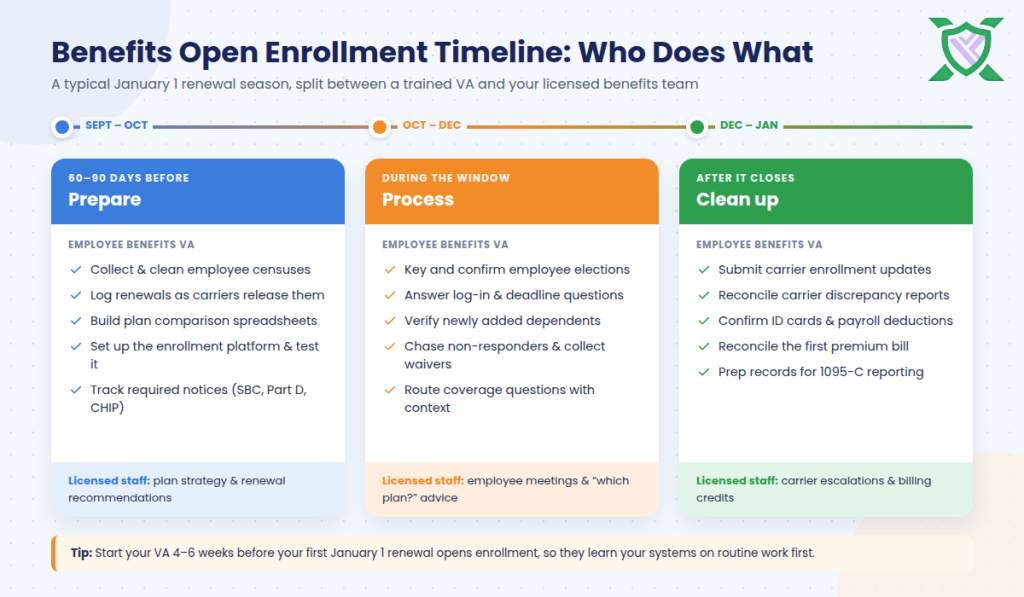
Here is how benefits open enrollment work breaks down across the season.
What an Employee Benefits VA Handles Before Benefits Open Enrollment
The best-run benefits open enrollment seasons are won 60 to 90 days out. This is where a VA gives your account managers the most time back, because the work is heavy on data and follow-up and light on judgment.
Renewal and Census Preparation
Carriers can’t quote without a clean census. A VA requests the current employee census from each group, checks it against your agency management system and last year’s enrollment, flags missing dates of birth, ZIP codes, coverage tiers and dependent counts, and chases HR until the file is complete. They also log renewal dates and pull the renewal packets as carriers release them.
Plan Comparison Spreadsheets and Benefits Summaries
Once renewals and alternative quotes arrive, someone has to put them side by side. A VA can build the comparison spreadsheet (current plan versus renewal versus alternatives, with rates by tier, deductibles, out-of-pocket maximums and copays) and draft the employee-facing benefits summary from the approved plan choices. Your consultant reviews and presents it; the VA does the building.
Enrollment Platform and Portal Setup
Whether your groups enroll through a benefits administration platform, a carrier portal or paper, the new plan year needs to be set up: plans loaded, rates entered, eligibility rules confirmed, enrollment dates set and employee records rolled forward. A VA can do the setup and then run a test enrollment so the errors surface before employees see them.
Required Notices Checklist
Benefits open enrollment is also notice season. A VA can keep a checklist per group and make sure each required document is prepared, approved and distributed on time. Common items include:
- The Summary of Benefits and Coverage (SBC) for each medical plan offered
- The Medicare Part D creditable coverage notice, which employers must give Medicare-eligible individuals before October 15 each year
- The annual CHIP notice and the Women’s Health and Cancer Rights Act (WHCRA) notice
- Plan documents, rate sheets and enrollment guides for the new year
The employer and your licensed team remain responsible for what the notices say. The VA makes sure nothing slips.
What a VA Handles During the Enrollment Window
Once the window opens, the job becomes speed and accuracy. Every day of the window matters, because late elections compress the time left to transmit clean data to carriers before January 1.
Enrollment Processing and Data Entry
For groups that still use paper or PDF forms, a VA keys elections into the platform or carrier portal and confirms each one. For online enrollments, the VA monitors completions, fixes rejected entries and keeps a running log by group so your account manager can see progress at a glance.
Employee Questions: Triage, Not Advice
Employees call with two kinds of questions. “Where do I log in?” and “When is the deadline?” are administrative, and a VA can answer them all day. “Which plan should I pick?” or “Is my doctor covered, and should I switch?” involve advice and interpretation of coverage. Those belong with a licensed benefits professional. A good VA answers the first kind, captures the second kind in a ticket with full context, and routes it to the right person the same day.
Dependent Verification
Many employers now require proof for newly added dependents, such as marriage or birth certificates. A VA can send requests, track what’s been received, follow up on missing documents and report unverified dependents to the employer before the deadline. This is repetitive, deadline-driven work that is ideal for a trained assistant.
Tracking Waivers and Non-Responders
Missing elections cause most January problems. A VA can run a daily non-responder report, send reminder emails on the employer’s behalf, collect signed waivers, and check whether passive enrollment rules roll anyone over automatically. Your consultant only steps in for the escalations.
At this point, most agencies realise the constraint on benefits open enrollment isn’t expertise. It’s hours.
What a VA Handles After Open Enrollment Closes
The window closing is not the finish line. The weeks after benefits open enrollment decide whether January goes quietly or turns into a stream of claim denials and billing disputes.
Carrier Enrollment Files and Discrepancy Reports
Elections have to reach each carrier, by EDI file, portal upload or form. A VA can prepare and submit the updates, then compare carrier confirmations and discrepancy reports against what employees actually elected. Mismatches get fixed in December, not discovered at the pharmacy counter in January.
ID Cards, Confirmations and Payroll Deduction Reports
The VA can confirm that ID cards have been ordered, send enrollment confirmation statements to employees, and produce the deduction report the employer’s payroll team needs for the first pay period of the year. Wrong deductions are one of the quickest ways to lose an HR manager’s trust.
Premium Billing Reconciliation
The first invoice of the new plan year almost never matches enrollment perfectly. A VA can reconcile carrier bills against the census line by line: terminated employees still billed, new hires missing, wrong tiers. They then prepare a correction summary for the carrier. The same discipline carries over to insurance agency commission reconciliation, where group business adds a lot of volume.
Setting Up for ACA Reporting Season
For applicable large employers, open enrollment data feeds the Forms 1094-C and 1095-C due early the following year. A VA can make sure offer-of-coverage and enrollment records are complete now, so reporting in the first quarter is a review job rather than a reconstruction job.
Open Enrollment Task Split: VA vs. Licensed Staff
Use this table when writing SOPs. The exact line depends on your state’s licensing rules and your E&O carrier’s guidance, but most agencies split the work like this.
| Task | Employee benefits VA | Licensed benefits staff |
| Census collection and clean-up | Owns it | Reviews unusual changes |
| Renewal analysis and plan comparison | Builds the spreadsheet | Interprets it and recommends |
| Employer strategy and plan design | Prepares materials | Owns it |
| Enrollment platform setup | Owns setup and testing | Approves before launch |
| Employee “how do I” questions | Answers directly | None |
| Employee “which plan” questions | Routes with full context | Answers and advises |
| Dependent verification | Owns tracking and follow-up | Handles disputes |
| Carrier enrollment updates | Submits and reconciles | Escalates to carrier reps |
| Premium bill reconciliation | Owns it | Approves credits and disputes |
| Required notices | Tracks and distributes | Approves content |
Year-Round Work That Doesn’t Stop for Open Enrollment
The hardest part of benefits open enrollment is that the regular workload keeps running underneath it. A benefits VA who already handles this work year-round keeps it from being dropped when everyone is focused on renewals.
- Life event changes. Under HIPAA special enrollment rules, employees generally have 30 days after events such as marriage or birth to request enrollment (60 days for events involving Medicaid or CHIP). A VA tracks each request against its deadline.
- New hires and terminations. Adds and drops still need to reach carriers on time, with the right effective dates.
- COBRA administration. Qualifying events trigger strict timelines. Under the federal COBRA rules, the plan administrator generally has 14 days after being notified to send the election notice, and qualified beneficiaries have 60 days to elect. A VA can manage the notices, deadlines and payment tracking.
- Service tickets. Claims questions, ID card requests and billing queries continue every day.
If you’re not sure how much of this is sitting with your account managers now, an insurance agency task audit will show you where the hours go.
Keeping Employee Data Secure During Benefits Open Enrollment
Benefits work involves some of the most sensitive data your agency touches: Social Security numbers, dates of birth, dependent records and, sometimes, health information. Before any VA touches benefits open enrollment data, put these controls in place:
- Named, individual logins for every platform and carrier portal, never shared credentials
- Multi-factor authentication and a business password manager for access
- Secure file transfer for census files and dependent documents, never personal email
- Access limited to the groups and systems the VA actually works on
- A signed confidentiality agreement and a written SOP for handling documents
- Activity logging, so you can see who touched which record and when
Ask any provider you evaluate how they handle each of these points. The answers tell you more than any sales page.
How to Get a Benefits VA Ready Before the Rush
The worst time to start a VA is the first week of a client’s benefits open enrollment window. The best time is four to six weeks before your first January renewals, so the VA can learn your systems on routine work before the volume hits.
- Pick the first tasks. Start with census clean-up, renewal logging and life event processing. These build system knowledge quickly.
- Write short SOPs. A one-page checklist and a screen recording per task is enough to begin.
- Set up access properly. Create VA user accounts in your platforms and carrier portals before day one.
- Agree on escalation rules. Define exactly which employee questions get routed to licensed staff.
- Review daily for two weeks. Short daily check-ins catch errors before they reach a carrier.
Our step-by-step guide on how to onboard an insurance virtual assistant covers the full process.
XAssure provides dedicated employee benefits virtual assistants trained on enrollment processing, life event changes, dependent verification, COBRA administration, carrier communication and premium billing reconciliation. Most agencies are matched with a VA within 24 hours, which still leaves time to be ready for this season.
Summing Up
Benefits open enrollment is mostly a data and deadline problem. Censuses, comparisons, platform setup, notices, dependent documents, carrier files and bill reconciliation make up the bulk of the hours, and none of them need a licensed consultant to do the work.
Let your licensed team own plan strategy, employer meetings and employee coverage questions. Hand the preparation, processing and clean-up to a trained assistant, and the season stops eating your evenings.
XAssure gives benefits agencies exactly that: insurance-trained VAs, a dedicated account manager, and a live dashboard where you can watch every enrollment task as it is worked.
Frequently Asked Questions
An employee benefits VA handles the administrative side of open enrollment: collecting and cleaning censuses, building plan comparison spreadsheets, setting up enrollment platforms, processing elections, verifying dependents, chasing non-responders, submitting carrier updates and reconciling the first premium bills.
No. Explaining coverage differences and recommending a plan is advice that belongs with licensed benefits staff. A VA can answer administrative questions such as log-ins and deadlines, and route coverage questions to your licensed team with full context.
For January 1 renewals, preparation usually starts 60 to 90 days out with census collection and renewal tracking. If you are adding a VA, start them four to six weeks before your first enrollment window so they learn your systems on routine work first.
It can be, with the right controls: individual logins, multi-factor authentication, a password manager, secure file transfer, limited access and activity logging. Ask any VA provider to explain how they handle each of these before you share data.
No. Life event changes, new hires, terminations, COBRA administration, carrier communication and billing reconciliation continue all year. Many agencies bring a VA on for the season and keep them because the year-round work justifies it.
XAssure plans start at $1,050 per month for 20 hours a week, with a full-time option at $2,000 per month for 40 hours a week. Every plan includes a dedicated account manager, a live dashboard and a 2-week free trial.