
![Best Virtual Assistants for Insurance Agencies in Indiana [2026 Guide]](https://xassure.co/blog/wp-content/uploads/2026/10/virtual-assistants-for-insurance-agencies-in-indiana-768x402.jpg "Best Virtual Assistants for Insurance Agencies in Indiana [2026 Guide]")
Table of contents
- Your Options at a Glance: In-House CSR vs. Generalist VA vs. Insurance-Trained VA
- Why Indiana Insurance Agencies Are Turning to Virtual Assistants
- What Indiana Law Says About Unlicensed VA Tasks
- What to Look for in Virtual Assistants for Insurance Agencies in Indiana
- How XAssure Supports Indiana Insurance Agencies
- Employee Benefits Season: Where Indiana Agencies Gain Most
- What Does an Insurance VA Cost in Indiana?
- How to Onboard Virtual Assistants in an Indiana Insurance Agency
- Summing Up
- Frequently Asked Questions
- Also Reads
Indiana insurance agencies carry an unusual mix of work. Spring hail and tornado seasons flood P&C teams with claims and policy changes. A manufacturing-heavy economy keeps commercial lines and group benefits books busy all year. And most independent agencies are small, so the same few people quote, service, renew and answer the phone. That is why more owners are looking at virtual assistants for insurance agencies in Indiana.
This guide compares your staffing options, explains what Indiana’s producer licensing law allows an unlicensed VA to do, sets out realistic costs, and shows where Indiana agencies usually get the fastest return.
Your Options at a Glance: In-House CSR vs. Generalist VA vs. Insurance-Trained VA
Most Indiana agency owners are choosing between three ways to add service capacity. Here is how they compare.
| In-house CSR | Generalist offshore VA | Insurance-trained VA (XAssure) | |
| Estimated annual cost | $53,000–$74,000 | Roughly $8,000–$17,000 | $12,600 (part-time) to $24,000 (full-time) |
| Time to start | Often months to recruit | Days, then weeks of training | Matched within 24 hours |
| Knows your AMS and carrier portals | Depends on the hire | No, you train them | Yes: AMS360, Applied Epic, EZLynx, HawkSoft, NowCerts, QQ Catalyst |
| Understands licensed vs. unlicensed limits | Needs training | Rarely | Yes, built into every SOP |
| Handles storm and open-enrollment peaks | Hard to add hours | Limited insurance knowledge | Yes, add hours or a second VA |
| Visibility into the work | In the office | Varies | Live dashboard logging every task |
| Cover for sick days and turnover | Your problem | Varies | Dedicated account manager arranges cover |
Why Indiana Insurance Agencies Are Turning to Virtual Assistants
A Market Built on Small Independent Agencies
Indiana’s agency market is dominated by independents. Big I Indiana alone represents more than 500 member agencies, from downtown Indianapolis to county-seat towns across the state. Most run lean teams where the owner is also the lead producer, and hiring an experienced CSR in markets like Fort Wayne, Evansville, South Bend or Lafayette can take months.
When a service role sits open, the work doesn’t disappear. It lands on producers, and new business slows. That gap is exactly where virtual assistants for insurance agencies in Indiana earn their keep.
Severe Storms Drive the P&C Workload
Indiana’s weather creates predictable spikes in service work. According to NOAA’s billion-dollar disaster data for Indiana, the state was affected by 100 confirmed billion-dollar weather events between 1980 and 2024, and 72 of them were severe storms. The pace has quickened: the long-run average is 2.2 events a year, but the 2020–2024 average was 6.2.
Every storm means first notice of loss calls, claim status follow-ups, roof and property documentation, policy changes and renewal re-shops when premiums rise. Virtual assistants who take intake and paperwork off Indiana insurance agencies during those weeks keep service standards from collapsing.
A Manufacturing Economy Means Heavy Commercial and Benefits Work
Indiana has one of the highest shares of manufacturing employment in the country, and the Indianapolis area is home to major insurers and benefits carriers. For agencies, that translates into a lot of commercial lines work (certificates, workers’ compensation, fleet schedules, audits) and a large group benefits market where employers expect hands-on help during open enrollment.
Indiana also runs its own workers’ compensation rating bureau, the Indiana Compensation Rating Bureau (ICRB), so commercial lines staff need to know Indiana-specific classification and experience rating paperwork.
What a VA Actually Does Inside an Indiana Agency
The day-to-day work of virtual assistants for insurance agencies in Indiana usually covers:
- Renewal pipeline management, remarketing prep and renewal reminders
- Certificates of insurance, ID cards and evidence of property
- AMS and CRM data entry, carrier download reconciliation and activity notes
- Endorsement and policy change processing
- First notice of loss intake and claim status follow-up after storms
- Employee benefits enrollment, life event changes and COBRA paperwork
- Commission statements and premium billing reconciliation
- Call handling, inbox management and appointment setting
What Indiana Law Says About Unlicensed VA Tasks
The Clerical Exemption in IC 27-1-15.6-4
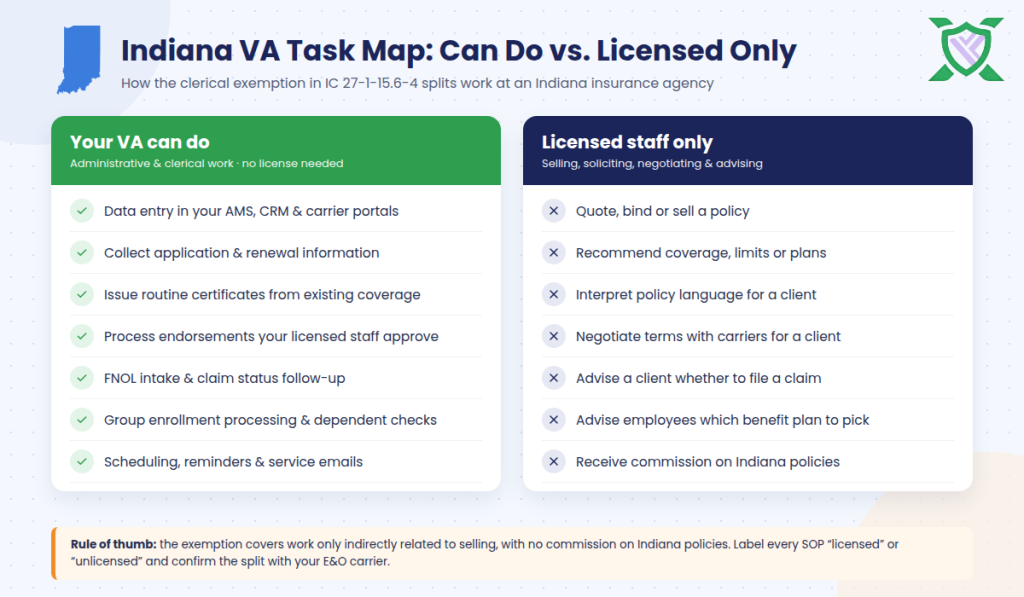
Indiana requires a producer license to sell, solicit or negotiate insurance. However, Indiana Code 27-1-15.6-4 exempts employees of insurers and producers whose work is executive, administrative, managerial or clerical, and only indirectly related to the sale, solicitation or negotiation of insurance, provided they receive no commission on policies written for Indiana risks.
The same section also exempts people who handle enrollment in group plans or administer employee benefit programs without receiving commission. In plain English: virtual assistants working for Indiana insurance agencies can do a great deal of processing and administration, as long as they are not selling, recommending coverage or being paid on policies.
Tasks Your VA Can and Can’t Do in Indiana
| A VA can do (no license needed) | Licensed staff must do |
| Data entry in your AMS, CRM and carrier portals | Quote, bind or sell a policy |
| Collect information for applications and renewals | Recommend coverage, limits or plans |
| Issue routine certificates from existing coverage | Interpret policy language for a client |
| Process endorsements your licensed staff approve | Negotiate terms with carriers on the client’s behalf |
| FNOL intake and claim status follow-up | Advise a client on whether to file a claim |
| Group enrollment processing and dependent verification | Advise employees on which benefit plan to choose |
| Scheduling, reminders and service emails | Receive commission on Indiana policies |
Your E&O carrier may have its own view on where the line sits, so share your VA task list with them and label every SOP as “licensed” or “unlicensed”.
How the Indiana Department of Insurance Fits In
The Indiana Department of Insurance (IDOI) licenses producers and agencies, and Holly W. Lambert has served as Commissioner since October 2024. Resident producer licenses are issued for two years and expire on the last day of the producer’s birth month, with 24 hours of continuing education required per renewal cycle.
The IDOI does not publish guidance aimed specifically at virtual assistants. Compliance for virtual assistants at Indiana insurance agencies therefore comes down to your own documentation: written task boundaries, a provider agreement confirming VAs will not perform licensed activities, and no commission-based pay for unlicensed staff. A VA can also help your producers keep track of license renewal dates and CE hours.
What to Look for in Virtual Assistants for Insurance Agencies in Indiana
Not every VA is ready for insurance work. Before you sign with anyone, check for these seven things.
1. Insurance Training, Not Just General Admin
Your VA should already understand renewals, endorsements, certificates, loss runs and carrier downloads. If you have to explain what a dec page is, you are paying to train them.
2. Experience in Your AMS
Ask which agency management systems the VA has actually worked in. Real experience in AMS360, Applied Epic, EZLynx or HawkSoft saves weeks of ramp-up.
3. A Clear Licensed vs. Unlicensed Boundary
The provider should confirm in writing that VAs will not quote, bind, sell or advise on coverage, and should never pay VAs on commission. That is what keeps you inside IC 27-1-15.6-4.
4. Commercial and Benefits Coverage, Not Just Personal Lines
Indiana books lean heavily on commercial lines and group benefits. Make sure the VA can handle certificates, workers’ compensation paperwork, enrollment processing and COBRA, not only auto and home service.
5. Secure Access to Client Data
Look for named logins, multi-factor authentication, password managers and a signed confidentiality agreement. Shared producer logins are a red flag.
6. Visibility Into the Work
You should be able to see what your VA did, when and for which client, without chasing them for updates.
7. A Real Trial Period
A trial on your own workload is the only reliable test. Be wary of long contracts before you have seen any work.
How XAssure Supports Indiana Insurance Agencies
XAssure provides insurance-trained VAs for personal lines, commercial lines and employee benefits work, built around the checklist above:
- Insurance-trained from day one: renewals, certificates, endorsements, loss runs, FNOL intake, enrollment processing and COBRA
- Works in your systems: AMS360, Applied Epic, EZLynx, HawkSoft, NowCerts and QQ Catalyst, plus major carrier portals
- Clear task boundaries: every SOP is labelled licensed or unlicensed, and VAs are never paid on commission
- Live dashboard: every task is logged with timestamps, so you see the work as it happens
- Dedicated account manager: one point of contact for quality, cover and extra hours in storm or enrollment season
- Fast start, low risk: matched with a VA within 24 hours and a 2-week free trial before any commitment
Best for: Indiana agencies that need one team to cover storm-season P&C service, commercial certificates and benefits open enrollment.
Employee Benefits Season: Where Indiana Agencies Gain Most
For many Indiana agencies, the fastest return comes in Q4. With so many manufacturers and mid-sized employers on January 1 plan years, October through December brings renewals, plan comparisons, enrollment meetings, dependent verification and carrier files all at once.
Indiana’s licensing law already recognises that enrollment processing and benefits administration can be done without a producer license, provided the person isn’t paid commission. That makes benefits admin one of the cleanest areas where virtual assistants for insurance agencies in Indiana can take over.
We break down the work task by task in Employee Benefits VA: What They Actually Handle During Open Enrollment.
What Does an Insurance VA Cost in Indiana?
The Bureau of Labor Statistics put the national mean wage for insurance claims and policy processing clerks at $49,530 in May 2023. Once you add payroll taxes, health benefits, PTO, equipment and recruiting time, a full-time in-house hire costs considerably more than the salary line. Here is how that compares with virtual assistants for insurance agencies in Indiana.
| Cost item | In-house CSR (Indiana) | XAssure dedicated VA | Budget generalist VA |
| Base pay | $40,000–$50,000 | Included | Included |
| Payroll taxes and benefits | $10,000–$18,000 | None | None |
| Equipment, software, office | $3,000–$6,000 | None | Varies |
| Recruiting and turnover risk | High | Replacement included | Your problem |
| Insurance training | Your time | Already trained | Your time |
| Estimated annual cost | $53,000–$74,000 | $12,600 (part-time) to $24,000 (full-time) | Roughly $8,000–$17,000 |
In-house figures are estimates; your local wages will vary. For a fuller breakdown, see the true cost of hiring an insurance CSR.
How to Onboard Virtual Assistants in an Indiana Insurance Agency
Build Your SOPs Before Day One
Write a short step-by-step SOP and record a screen walkthrough for each task you plan to hand over. Label each one “licensed” or “unlicensed” so the boundary under IC 27-1-15.6-4 is clear from the start.
Set Up Secure AMS and Carrier Access
Create a named VA user in your AMS and each carrier portal with only the permissions they need. Use multi-factor authentication and a business password manager, and never share a producer’s login.
The First 30 Days
- Week 1: System access, shadowing and low-risk tasks such as data entry and certificates
- Weeks 2–3: Supervised work on renewals, endorsements and service requests, with daily check-ins
- Week 4: Independent work with a weekly quality review
Our guide on how to onboard an insurance virtual assistant walks through every step.
Summing Up
Indiana insurance agencies face storm-driven service spikes, a busy commercial and benefits market and a tight hiring pool. The right virtual assistant partner for an Indiana agency brings real insurance training, respects the licensed and unlicensed boundary in IC 27-1-15.6-4, and works inside the AMS you already use.
Use the checklist to judge any provider, and onboard with documented SOPs. When you are ready to test it with your own workload, XAssure gives you an insurance-trained VA, a dedicated account manager and a live dashboard, free for the first two weeks.
Frequently Asked Questions
Not for administrative work. IC 27-1-15.6-4 exempts employees doing executive, administrative, managerial or clerical work that is only indirectly related to selling insurance, provided they receive no commission on Indiana policies. A VA cannot quote, bind, sell or advise on coverage.
Yes. Indiana’s exemptions specifically cover people who handle group plan enrollment or administer employee benefit programs without commission. A VA can process enrollments, verify dependents and reconcile carrier files, while licensed staff advise on plan choices.
Insurance-trained VAs typically cost far less than an in-house hire. XAssure plans start at $1,050 per month for 20 hours a week and $2,000 per month for 40 hours a week, compared with an estimated $53,000 to $74,000 a year for a fully loaded in-house CSR.
Yes. Many Indiana agencies add hours or a second VA ahead of spring storm season to handle FNOL intake, claim follow-ups and policy changes. Trained VAs ramp up faster because they already know insurance workflows.
XAssure VAs work in AMS360, Applied Epic, EZLynx, HawkSoft, NowCerts and QQ Catalyst, along with carrier portals such as Progressive, Travelers, Hartford, Nationwide and Liberty Mutual.
The Indiana Department of Insurance (IDOI) licenses producers and agencies. Resident producer licenses run for two years, expire at the end of the producer’s birth month and require 24 hours of continuing education per cycle.
Also Reads
- Virtual Assistants for Insurance Agencies by State: The 2026 Guide
- Best Virtual Assistants for Insurance Agencies in Illinois [2026] – Guide
- Best Virtual Assistants for Ohio Insurance Agencies in 2026
- Best Virtual Assistants for Insurance Agencies in Michigan [2026 Guide]
- How to Onboard a Virtual Assistant for Your Insurance Agency in Under a Week