
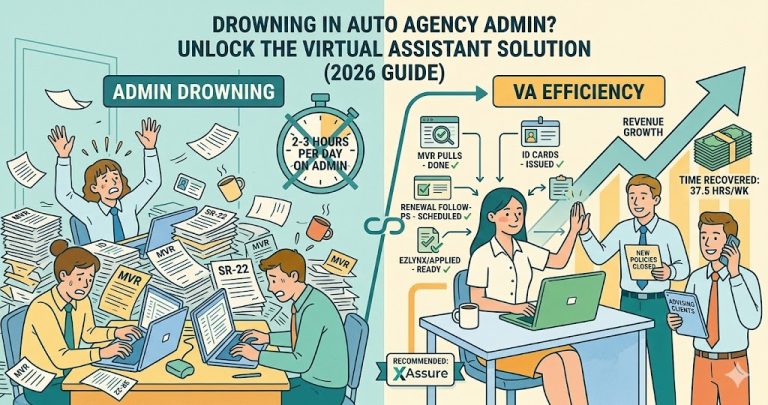
Auto insurance agencies are drowning in administrative work. MVR pulls, renewal follow-ups, ID card requests, carrier portal updates — these tasks eat hours that should go to selling policies and advising clients. Producers at personal lines agencies routinely spend two to three hours a day on work that never required a license to begin with.
Virtual assistants built specifically for auto insurance agencies solve this problem. But not all VA providers are built the same, and hiring the wrong one creates more headaches than it solves, especially when E&O exposure is on the line. This guide breaks down exactly what an insurance VA can and cannot do, what it costs, and which provider is built to handle the specific workflows your auto agency runs every day.
Top Virtual Assistant Providers for Auto Insurance Agencies (2026)
| Provider | Best For | Auto Training | Pros | Cons | Pricing | Compliance | Rating |
| XAssure (Recommended) | Auto agencies wanting full-service, compliance-ready support | Yes — personal lines, MVR, SR-22 | Purpose-built for auto insurance; strong compliance documentation; MVR and SR-22 trained | No public pricing; requires a consultation to get started | Custom quote | E&O-aware task boundaries + QA | ★★★★★ |
| Agency VA | Agencies needing licensed + non-licensed hybrid support | Yes | SOC2 certification; supports both licensed and unlicensed roles; multi-country staffing | Pricing not transparent; not auto-specific | Custom quote | SOC2 certified | ★★★★½ |
| LAVA Automation | Agencies wanting strong performance management | Partial | Strong QA and performance tracking; good for process-heavy operations | Partial auto training only; no public pricing | Custom quote | Documented QA | ★★★★ |
| Elevate Teams | Budget-conscious agencies valuing cultural fit | Partial | Good cultural alignment; cost-effective option | Partial auto training; basic compliance framework; pricing unclear | Custom quote | Standard | ★★★★ |
| BruntWork | Cost-minimization focus | General only | Lowest price point; transparent hourly rate; fast to hire | No auto-specific training; minimal compliance guardrails; not suitable for E&O-sensitive workflows | $4–$8/hr | Basic | ★★★ |
| How we evaluated providers: We scored each on five criteria: auto insurance-specific training depth, compliance and E&O awareness, pricing transparency, onboarding structure, and client testimonials from personal lines agencies. Providers without documented training protocols or clear licensed-task boundaries were scored lower. Reviewed based on publicly available information and agency owner feedback as of early 2026. |
What Does a Virtual Assistant Actually Do for an Auto Insurance Agency?
The most important thing to understand before hiring a VA is the line between licensed and unlicensed tasks. That line is not just a best practice — crossing it creates real E&O exposure. A VA who inadvertently recommends coverage, advises on a coverage gap, or quotes without agent review is acting in a capacity that requires a license. If something goes wrong, your agency could own the consequences.
The good news is that the majority of what eats a licensed agent’s time every day falls squarely on the unlicensed side of that line. Policy data entry, following up on unpaid renewals, issuing ID cards — none of that requires a license. It just requires time, and your producers are spending too much of theirs on it.
| VA CAN HANDLE THESE | MUST STAY WITH LICENSED STAFF |
|---|---|
| Policy data entry and CRM updates | Coverage recommendations |
| Renewal reminders and follow-up calls | Policy binding decisions |
| ID card issuance and certificate processing | Advice on coverage gaps or limits |
| Payment follow-ups and invoicing | Handling E&O-adjacent disputes |
| Appointment scheduling | State compliance decisions |
| Carrier portal navigation | Explaining exclusions to insureds |
| Quoting prep and data gathering | |
| MVR pulls and driver history research | |
| Document collection and filing | |
| Inbound client service calls (non-advisory) |
| ⚠ E&O RISK: WHERE THINGS GO WRONG A general VA with no insurance training may not know where the licensed-task line is. Agency VA, one of the top-rated providers in the space, explicitly structures its workflows around this boundary and documents it — which is one reason it earns high marks from E&O-conscious agencies. XAssure builds the same compliance guardrails directly into its daily task protocols so VAs never operate in a gray zone. If your VA provider cannot explain exactly how it handles this boundary, that is a red flag. |
Auto Insurance-Specific VA Tasks You Won’t Find A Generic VA Doing
Generic VA providers can handle calendar management and email triage. What they cannot do on day one is navigate EZLynx, pull an MVR from your carrier portal, or understand why SR-22 deadlines matter. Auto insurance has a specific operational vocabulary and a set of recurring workflows that generalist VAs have never seen. Here is what those workflows actually look like and why they belong with a VA, not a licensed agent.
Motor Vehicle Record (MVR) Pulls and Driver History Research
Before a personal lines auto renewal, someone needs to pull MVR data on every driver on the policy, flag any new violations or license suspensions, and organize that information for the agent to review. At a 200-policy book, that is a significant time commitment every month. A trained insurance VA can own this entire workflow from start to flag — the agent reviews the summary and makes the coverage decision. That is the model InsBOSS has documented across more than 56,000 audited tasks: structured prep by the VA, decision-making by the licensed agent.
SR-22 and FR-44 Filing Coordination
SR-22 work is time-sensitive and document-heavy. A client who needs an SR-22 after a DUI or license suspension typically has a state deadline attached. A VA can manage the carrier communication, collect the required documents, track the filing deadline, and confirm receipt — the agent reviews and authorizes the submission. This is exactly the kind of task that falls through the cracks when it lives on a producer’s to-do list and should not.
Auto ID Card Issuance and VIN Verification
In a busy personal lines agency, ID card requests come in daily. Some are routine renewals. Some come in because a client bought a new car at 7pm on a Friday. A VA handles all of it — pulling the correct policy, generating or requesting the card through the carrier portal, and delivering it to the client. VIN verification for newly added vehicles is the same kind of high-volume, low-complexity work that kills producer time. Agencies using Applied Systems or AMS360 can set up VA access with role-based permissions so this entire process runs without requiring agent involvement.
Remarketing and Re-quote Preparation at Renewal
When a personal lines auto renewal comes in with a significant rate increase, the agent needs comparison quotes ready before the client conversation. A VA can pull the prior policy data, run the re-quote in EZLynx or the relevant carrier portal, and deliver a formatted comparison to the agent before the call. The agent reviews, recommends, and presents. Elevate Teams has built its value proposition around exactly this kind of workflow support, citing time-zone alignment with Latin American VAs as a reason agents can arrive at morning client calls with overnight prep already done.
| AUTO AGENCY WORKFLOWS XASSURE HANDLES BY DEFAULT |
|---|
| MVR pulls and flagging for renewal review |
| ID card generation and delivery via carrier portals |
| Re-quote prep in EZLynx, Applied, and AMS360 |
| VIN verification for newly added vehicles |
| Renewal reminder sequences (30/15/7-day touchpoints) |
| Lapse and cancellation follow-up workflows |
| SR-22/FR-44 document collection and deadline tracking |
How Much Does a Virtual Assistant Cost for an Auto Insurance Agency?
The cost math on insurance VAs is one of the cleaner calculations in agency operations. The Bureau of Labor Statistics puts the median annual wage for an insurance customer service representative at around $44,000 as of 2024. Add benefits (typically 25–30% on top of salary), payroll taxes, equipment, and office space, and a single in-house CSR costs most agencies between $55,000 and $70,000 per year all-in.
| Cost Category | In-House CSR | VA Through Structured Provider |
| Base salary / annual rate | $40,000–$55,000 | $15,000–$24,000 |
| Benefits (health, PTO, 401k) | $10,000–$16,000 | Included or N/A |
| Payroll taxes | $3,000–$5,000 | Not applicable |
| Equipment and software | $1,500–$3,000 | Included by provider |
| Office space (allocated) | $2,000–$6,000/year | $0 |
| Total annual cost (est.) | $56,000–$85,000 | $15,000–$24,000 |
Source: Bureau of Labor Statistics Occupational Employment and Wage Statistics, May 2024. VA cost ranges based on published and estimated pricing from major providers.
Most agencies using structured VA providers report cost savings of 40–60%. PeopleBlue, which focuses on bilingual VA placements, uses this figure prominently in its positioning. The caveat is that cheaper is not always better — providers at the lower end of the cost range (some Philippines-based platforms like BruntWork start as low as $4–$8 per hour) tend to offer minimal insurance-specific training and fewer compliance safeguards.
Pricing Models to Understand Before You Sign
VA providers usually charge in a 3 different ways.
- Hourly pricing is common among generalist platforms and ranges from $4 to $25 per hour depending on specialization and geography.
- Monthly retainer pricing is more common among insurance-specific providers and reflects a dedicated resource at a flat rate.
- Full-time equivalent (FTE) pricing essentially replicates a salaried hire structure through the provider.
Before signing anything, confirm what is included: training, QA oversight, replacement coverage if your VA leaves, and tech tools like AMS access setup. Some providers advertise a low hourly rate and bill separately for everything else.
Case Study: How a 5-Agent Auto Insurance Agency Recovered 37.5 Hours of Producer Time with XAssure
The Agency Profile
A mid-sized auto insurance agency with five licensed producers was experiencing a common operational challenge: producers were spending a large portion of their day on administrative work rather than selling policies.
The Challenge
Each producer was handling routine operational tasks such as:
- CRM updates and documentation
- Generating and sending insurance ID cards
- Renewal reminders and follow-ups
- Motor Vehicle Record (MVR) pulls
- Policy data entry and record maintenance
On average, each producer spent 2.5 hours per day on these activities. While necessary, these tasks reduced the time available for prospecting, quoting, and closing new policies.
The XAssure Solution
The agency onboarded an insurance-trained XAssure Virtual Assistant to manage administrative workflows across the team. The VA handled back-office processes and system updates, allowing producers to focus on client-facing work.
Time Recovered
By centralizing administrative tasks through a specialized VA, the agency reclaimed a significant amount of producer time.
Time saved per producer:
- 2.5 hours per day
Across three producers supported by the VA:
- 12.5 hours per week per producer
Total licensed-agent time recovered:
- 37.5 hours per week
This is essentially the equivalent of adding another full-time sales capacity to the agency without hiring another licensed producer.
Revenue Impact
Before implementing the VA support model:
- Producers averaged two policies per day
- Average annual premium per policy: $1,400
With 90 minutes of additional selling time per producer per day, producers were able to spend more time on:
- Prospect conversations
- Quote follow-ups
- Cross-selling opportunities
- Closing policies
Even a small increase in daily policy production compounded quickly across the team.
How to Evaluate and Choose the Right VA Provider for Your Auto Agency
The difference between a good VA experience and a bad one almost always traces back to the provider evaluation stage, not the VA themselves. Agencies that go through a structured provider vetting process end up with better outcomes. Those that hire the cheapest option available and figure out training themselves typically report frustration within the first 90 days. Check out in-detail guide on hiring a VA for insurance vertical and tweak that to your auto insurance agents.
5 Questions to Ask Any VA Provider Before You Sign
1. How long is your insurance-specific training program, and can I see the curriculum?
A provider that cannot answer this with specifics is training your VA on your time and your dime.
2. What compliance safeguards prevent VAs from crossing into licensed-only tasks?
This should not be ‘we trust our VAs.’ It should be a documented protocol with specific workflow rules.
3. How do you handle performance issues, errors, or replacement?
Agencies that have had a VA make a mistake want to know there is a process, not just a vague promise to make it right.
4. Are your devices secured and remotely monitored?
Your AMS and carrier portals contain sensitive client data. Device security is not optional.
5. What does onboarding look like in weeks 1 through 4?
The best providers have a structured ramp, not ‘here are your login credentials, good luck.
⚠ RED FLAGS THAT SHOULD MAKE YOU WALK AWAY
- No documented training length or curriculum — you are effectively the training program
- Vague answers about data security or AMS access protocols
- No replacement policy if your VA resigns or underperforms
- Heavy sales pressure with no operational specifics (‘our VAs are great with insurance’)
- No mention of the licensed vs. unlicensed task boundary in their materials
- Pricing below $8/hour for insurance VA work — almost always means generalist training and no compliance depth
Getting Your Team to Actually Use a VA — The Adoption Problem Nobody Talks About
Here is something almost no VA provider will tell you upfront: the VA is often not the hardest part. The hardest part is getting your licensed agents to actually delegate. Insurance producers who have spent years doing everything themselves develop habits that are hard to break. The internal resistance is real, and if you do not address it deliberately, you will end up with an expensive VA who handles low-stakes tasks while your producers still do everything else themselves.
Why Licensed Agents Resist VAs (And How to Address It)
The objections are usually some version of three things: ‘It’s faster if I just do it myself,’ ‘I don’t trust that someone remote will do it right,’ or an unspoken fear that delegating admin work is the first step toward being replaced. All three objections are addressable, but they need to be named directly by agency leadership. The framing that works is not ‘the VA replaces admin work’ — it is ‘the VA extends your capacity so you can focus on what only you can do.’ Agents who resent having their non-licensed work taken away tend to be agents who were using that work as a buffer against harder sales conversations.
A 30-Day Adoption Plan That Actually Works
| 30-DAY VA ONBOARDING CHECKLIST Week 1: VA handles one task category only — start with ID card requests and certificate processing. These are high-volume, low-stakes, and easy to verify. Daily 10-minute check-in between agent and VA. Week 2: Expand to renewal reminders and CRM data entry. Agent reviews VA work daily but stops doing the tasks themselves. Week 3: Add MVR pulls and carrier portal tasks. Introduce a structured feedback loop — agent flags any errors, VA corrects in real time. Week 4: Full delegation handoff including quoting prep in EZLynx or Applied. Agent now reviews and approves rather than builds from scratch. Target: 30–45 minutes per day on VA output review instead of 2–3 hours on direct admin work. |
XAssure builds this exact ramp into its onboarding framework. Agency owners do not have to design the adoption plan themselves – it comes with the engagement.
Agencies using this structured approach consistently report that agents who were most resistant to VA delegation at week one are among the most enthusiastic advocates by week six. The turning point is almost always the first week where the agent realizes the work was done correctly without them touching it.
Frequently Asked Questions
A VA can handle all the prep — pulling prior policy data, generating renewal notices, remarketing in quoting systems like EZLynx, and following up with clients who have not responded. The licensed agent must review coverage, confirm any changes, and authorize the bind. In a well-structured workflow, the agent’s involvement at renewal drops from 45–60 minutes per file to a 10–15 minute review and approval.
Yes, and how that access is structured matters. Reputable providers like XAssure use role-based permissions so VAs can access only what they need for their specific tasks. Look for providers that also use remotely secured devices and activity monitoring. Your AMS contains sensitive client data and carrier credentials — any provider that is vague about access protocols should not have your login information.
A general VA requires months of agency-specific training before they can navigate carrier portals, understand ACORD form requirements, or know that binding a policy is not their call to make. An insurance-trained VA arrives with that foundation already in place. The first 30 days look completely different — and so do the error rates. Agency VA has built its entire model around pre-training VAs on AMS platforms and carrier workflows before they ever start with a client agency.
Most agencies using structured VA programs see meaningful productivity gains within 30–60 days. XAssure’s onboarding is designed to get VAs into live workflows by the end of week one, starting with your highest-volume, lowest-risk tasks. Full delegation across most task categories typically happens by the end of week four.
This depends entirely on what the VA did and whether your agency had proper oversight in place. If a VA crossed into licensed-only territory without agent review and a client acted on that guidance, your agency could face E&O exposure. This is exactly why task boundaries and oversight protocols are non-negotiable. Providers like XAssure document the task boundary and build it into daily workflows specifically to prevent this scenario. If a non-advisory error occurs — a wrong VIN entered, a renewal reminder sent to the wrong address — standard E&O policies typically address these, but your agent should always review VA output before it reaches the client or carrier.