
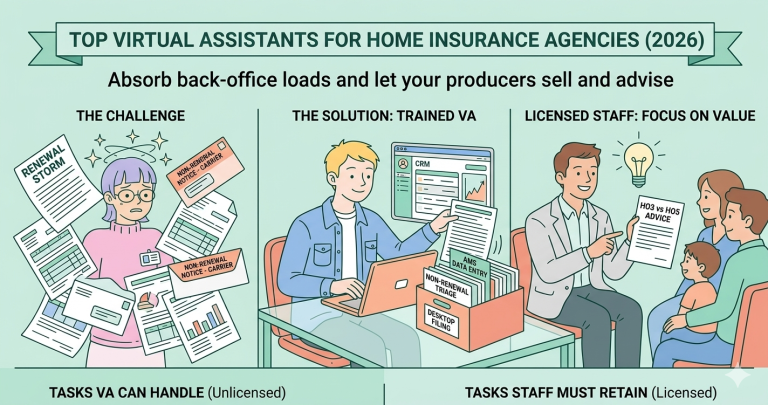
Home insurance agencies carry a back-office load that most general business content ignores entirely. Renewal storms hit every fall. Non-renewal notices from carriers drop without warning. Homeowners call after every major storm, and your producers are buried.
According to a 2023 McKinsey analysis of insurance agency operations, agents in personal lines spend roughly 40% of their working hours on administrative tasks rather than selling or advising clients.
A trained virtual assistant can absorb most of that load. This guide reviews the top VA providers for home insurance agencies specifically.
Top Virtual Assistants for Home Insurance Agencies (2026)
| Provider | Best For | Pricing | Personal Lines Training | Compliance Guardrails | Rating |
| XAssure | Home insurance agencies needing personal lines-trained VAs | Quote-based | ✓ Personal lines focus | ✓ Licensed/unlicensed boundaries enforced | ★★★★★ |
| Agency VA | Agencies wanting SOC2-certified, multi-country hiring | Custom | ✓ P&C trained | ✓ SOC2 certified | ★★★★ |
| Cover Desk | Agencies needing fast onboarding (approx. 2 weeks) | Custom | ✓ Quote & policy trained | ✓ Structured process | ★★★★ |
| InsBOSS | Unlicensed back-office task specialists with QA auditing | Custom | ✓ P&C focused | ✓ 56,000+ tasks audited | ★★★★ |
| BruntWork | Cost-focused agencies needing offshore admin support | $4–$8/hr | ⚠ General insurance only | ⚠ HIPAA-compliant, limited P&C guardrails | ★★★ |
How we evaluated these providers: Training depth on personal lines (HO3, dwelling, flood), clarity of compliance boundaries, AMS platform compatibility, pricing transparency, and client feedback patterns. Providers with vague or unverifiable training curricula were scored lower regardless of price. Pricing is quote-based for most providers; ranges are shown where publicly available.
What Is a Virtual Assistant for a Home Insurance Agency (and Why General VA Advice Gets It Wrong)
A commercial lines shop has different workflows, different carrier relationships, and a different renewal calendar than a personal lines agency writing homeowners policies. The administrative burden of an HO3 renewal cycle looks nothing like a commercial general liability renewal, and the compliance exposure from delegating tasks is different too.
A virtual assistant for a home insurance agency is a trained remote staff member who handles the operational and administrative work that ties up your producers and CSRs. The keyword there is trained. You cannot hand off a homeowner’s non-renewal notice to someone who has never seen one before and expect a good outcome for your client or your E&O carrier.
Why home insurance agencies have different needs
Home insurance is YMYL-adjacent in the most practical sense: when a homeowner’s policy lapses or a flood exclusion goes unnoticed, real financial damage follows.
The National Association of Insurance Commissioners has documented that personal lines account for the majority of consumer complaints in states like Florida and California, often tied to renewal and claims communication failures.
A VA working in that context has to understand what an HO3 is, what dwelling coverage means, and why an open claim affects a renewal submission. That is not general VA territory.
Case Study
A Florida-based personal lines agency with 800 homeowner policies under management had their senior CSR handling every non-renewal notice manually during hurricane season. Response time averaged 6 days. After onboarding a home insurance-trained VA through XAssure who handled non-renewal triage and carrier outreach, that dropped to under 48 hours and the agency retained 94% of at-risk policies that quarter.
What Tasks Should a Home Insurance Agency VA Actually Own?
The most useful thing you can do before hiring a VA is map out where your licensed staff is currently spending time on tasks that do not require a license. In most personal lines agencies, that list is longer than the principal expects.
High-ROI administrative tasks
CRM and AMS data entry is the most common time drain in any insurance agency. A VA can own all of it: updating client records in EZLynx or AMS360 after policy changes, logging renewal conversations, preparing ACORD forms for submission, processing certificate of insurance requests, and pulling loss runs when underwriters request them. These tasks are high-volume, deadline-driven, and require accuracy but not a license.
Renewal reminders are another clear win. A VA working from your AMS can run daily reports on policies renewing in the next 30, 60, and 90 days, send templated outreach to homeowners, and flag accounts that have not responded for your CSRs to follow up on directly.
Home insurance-specific workflows
This is where a general VA falls short. Home insurance agencies deal with carrier non-renewal notices under tight state-mandated timelines (California requires 75 days notice for policies in force more than 3 years; Florida requires 120 days in certain circumstances). A VA trained in personal lines can receive those notices, log them into your AMS, pull the client file, and start the re-market workflow the same day they arrive. That speed matters to your client and to your retention numbers.
Other home insurance-specific tasks a trained VA can handle include researching alternative carriers for clients being non-renewed, documenting HO3 vs. HO5 coverage differences for account notes, following up with homeowners on outstanding inspection items, managing flood and wind policy documentation, and processing endorsement requests for things like jewelry riders, home-based business additions, and pool liability coverage.
Client communication tasks that do not require a license
An unlicensed VA can answer the phone, triage inbound questions, schedule renewal calls with licensed staff, follow up with clients on outstanding documents, relay claims status updates from carriers, and send templated renewal confirmations. What they cannot do is provide coverage advice, quote new business, or make binding decisions. Those lines matter enormously, and we cover them in detail in the compliance section below.
⚠ E&O Risk Warning
If an unlicensed VA on your team recommends a coverage level, explains what a policy does or does not cover, or quotes a premium to a client, that can constitute unlicensed insurance activity under most state insurance codes. Depending on your state, this could void your E&O coverage for that interaction and expose your agency to regulatory action. See the full compliance section below before you delegate any client-facing tasks.
Licensed vs. unlicensed task reference chart
| VA Can Handle (No License Required) | Must Stay With Licensed Staff |
|---|---|
| CRM/AMS data entry and updates | Coverage advice of any kind |
| ACORD form preparation (not submission) | Explaining what a policy covers or excludes |
| Certificate of insurance requests (processing) | Quoting premiums to clients |
| Loss run requests and tracking | Binding or modifying coverage |
| Renewal reminder outreach (templated) | Recommending a carrier or policy type |
| Non-renewal notice logging and initial triage | Discussing claim merit or coverage applicability |
| Scheduling renewal calls for producers | Making market submissions (in most states) |
| Claims status follow-up calls (status only) | Signing or countersigning documents |
| Document collection from clients | |
| Carrier contact and inquiry routing | |
| Inspection report filing and tracking | |
| Endorsement request intake and processing |
How to Evaluate Any VA Provider Before You Sign
The comparison table above gives you a starting point, but every agency has different workflow complexity, different AMS platforms, and different risk tolerance. Before you commit to any VA provider, there are five questions that will tell you more than any sales call.
5 questions to ask every provider
1. What does your personal lines training curriculum cover, specifically? Ask for the actual training outline, not a summary. If they cannot produce a document that shows HO3 workflows, carrier non-renewal processing, and AMS-specific training, the curriculum probably does not exist in any meaningful form.
2. How do you document and enforce the licensed vs. unlicensed task boundary? A good answer is a specific policy document and an operational escalation protocol. A vague answer about “supervision” is not sufficient for E&O protection.
3. What background check and device security standards do you apply? VAs will have access to client data, carrier portals, and your AMS. The answer here should include criminal background checks, reference verification, and at minimum a policy on personal device vs. company-provided device use.
4. What is your replacement process if a VA leaves or underperforms? Placements that take 4-6 weeks to replace create coverage gaps that hurt real clients. Ask specifically how long a replacement takes and who covers the work in the interim.
5. What does your onboarding SLA look like, and who is responsible for it? The best providers have a structured onboarding playbook, not a list of tasks for the agency to figure out.
Red flags to watch for
- Vague training descriptions (“our VAs are experienced in insurance”) with no supporting documentation should stop the conversation.
- The same goes for providers who cannot explain their compliance boundaries or who promise rapid placements with no structured onboarding process.
- A VA placed in two days without a proper orientation to your agency’s workflows will create more work for your licensed staff than it saves in the first month.
Onboarding Checklist
- AMS platform access provisioned and tested before day one
- Task scope document signed by VA and agency principal
- Licensed vs. unlicensed task boundaries reviewed in writing
- Escalation protocol defined (who, how, how fast)
- First 30-day check-in scheduled at start
- Data access and security acknowledgment signed
- Sample workflows reviewed together before solo work begins
What Does a Home Insurance VA Actually Cost in 2026?
Pricing in this market breaks into two tiers that represent genuinely different products, not just different price points.
Offshore generalist VAs: $4 to $10 per hour
BruntWork and similar offshore generalist providers offer VAs at $4 to $8 per hour, sourced primarily from the Philippines. At that price, you get someone who can follow instructions and handle basic administrative tasks. You do not get someone with personal lines training, AMS experience, or any documented compliance framework. For a home insurance agency, the gap between what you need and what you get at that price level tends to show up quickly in the renewal queue and in claims communication errors.
Insurance-specialized VAs: $15 to $30+ per hour, or monthly retainers
Providers like XAssure, Agency VA, Cover Desk, and InsBOSS operate in this tier. The premium reflects real training investment and industry-specific knowledge. For a personal lines agency, the relevant comparison is not $6/hr offshore vs. $22/hr specialized. It is $22/hr specialized vs. the fully loaded cost of an in-house CSR.
| Cost Element | In-House CSR (US) | Insurance-Specialized VA | Offshore Generalist VA |
| Annual base salary / cost | $42,000–$58,000 | $28,000–$46,000 | $8,000–$16,000 |
| Benefits (health, PTO, 401k) | +$12,000–$18,000 | None | None |
| Payroll taxes | +$4,000–$6,000 | None | None |
| Recruiting / onboarding | $3,000–$7,000 (one-time) | Included | Low or included |
| Office / equipment | $2,000–$5,000/yr | None | None |
| Realistic annual total | $63,000–$94,000 | $28,000–$46,000 | $8,000–$16,000 |
| Personal lines training | Varies (agency bears cost) | ✓ Included | ✗ Not included |
| E&O compliance framework | Agency responsible | ✓ Provider documented | ✗ Agency responsible |
For a mid-sized home insurance agency managing 500 HO policies, the math on an insurance-specialized VA is straightforward. You are likely saving $35,000 to $50,000 per year over a full-time in-house hire, and you are getting someone with personal lines training already in place.
The offshore generalist option saves more money but requires your licensed staff to absorb the supervision and error-correction load, which erodes the savings faster than most principals expect.
The Compliance Risk Home Insurance Agencies Cannot Ignore
E&O exposure from VA use is real, it is under-discussed, and it is avoidable if you set things up correctly.
What counts as unlicensed insurance activity?
Every state defines unlicensed insurance activity slightly differently, but the common thread is this: if someone who is not licensed acts as an insurance producer by selling, soliciting, or negotiating insurance, they are likely in violation of the state insurance code.
The NAIC’s Producer Licensing Model Act provides the framework most states follow. In practice, this means a VA who explains what a policy covers, recommends a coverage level, quotes a premium to a client, or discusses whether a claim should be filed is operating in territory that requires a license.
The line is easier to cross than most agency principals realize. A homeowner calls and asks whether their fence is covered. A VA who says “yes” has potentially just committed an unlicensed coverage opinion. The right answer is: “Let me connect you with one of our licensed advisors who can answer that.” That distinction needs to be trained and reinforced, not assumed.
How this creates E&O exposure?
Your E&O policy covers errors and omissions by your agency’s licensed staff acting within their scope of practice. If an unlicensed VA makes a coverage statement that a homeowner relies on, and that statement turns out to be wrong, your E&O carrier will ask whether that activity was within the scope of what is covered under your policy. Depending on the carrier and the policy language, the answer may not be the one you want.
The documentation trail matters here. If you cannot show that your VA had written task boundaries, that they were trained on those boundaries, and that escalation protocols were in place, you have a harder conversation with your E&O carrier and potentially with your state department of insurance.
How to protect yourself?
Three things protect you. First, a written task scope document that clearly defines what the VA owns and what requires escalation to a licensed staff member. Second, training documentation showing the VA was specifically instructed on the licensed/unlicensed line. Third, an escalation log showing that coverage questions were consistently handed off to licensed staff. XAssure provides the first two as part of its placement process. The third is something your agency needs to maintain in your AMS.
State-level guidance on what constitutes unlicensed activity is available through your state’s Department of Insurance website and through the NAIC’s model act resources at naic.org. If your book is concentrated in Florida, California, or Texas, those states have issued specific guidance on remote and contracted staff in insurance agencies that is worth reviewing with your legal counsel.
Why XAssure Is the Recommended Choice for Home Insurance Agencies?
Most VA providers are built for the general insurance market and then adapted. XAssure has a vertical built specifically for insurance agencies, with a particular focus on personal lines operations. That distinction matters at the practical level, not just the marketing level.
Personal lines training depth
XAssure VAs are trained on personal lines workflows before they are placed with any agency. That training covers the specific document types, carrier processes, and AMS workflows that come up in a home insurance book of business. An XAssure VA placed with a home insurance agency will already know what a non-renewal notice looks like, how to flag a coverage gap for a licensed CSR, and how to work inside EZLynx or AMS360 on day one.
AMS platform compatibility
These VAs are trained and operational across the most common agency management systems used in personal lines: EZLynx, AMS360, HawkSoft, Applied Epic, and QQ Catalyst. This matters because an AMS-agnostic VA placement means your team absorbs training time you are paying for. XAssure avoids that delay.
Compliance framework
XAssure enforces documented licensed vs. unlicensed task boundaries for every placement. This is not a policy document that lives in a drawer. It is a working operational boundary that defines exactly which tasks the VA owns and which require escalation to a licensed staff member. For E&O purposes, that documentation is the difference between a defensible delegation and an exposed one.
Real workflow example: Q4 renewal surge
A personal lines agency in Texas writing 600 HO policies hits a crunch every October and November when 40% of their book renews within 8 weeks. Before XAssure, the principal and two CSRs were handling all renewal communications manually. With an XAssure VA managing the renewal queue, the VA pulls daily renewal reports from EZLynx, sends the first outreach to every homeowner 60 days out, logs responses, flags non-responders at 30 days, and schedules producer calls for the accounts with coverage questions or rate increases above 15%. The licensed staff only touches accounts that need a conversation. Renewal retention went up, and the producers got November back.
Frequently Asked Questions
Yes, with clear boundaries. A VA can manage the entire administrative side of a renewal workflow: running reports, sending outreach, logging responses, flagging at-risk accounts, and scheduling producer calls. What the VA cannot do is discuss coverage options, explain rate changes in terms of what a homeowner should do, or recommend whether a client should accept a renewal offer. Those conversations require a licensed CSR or producer.
With a provider like XAssure that has AMS training already in place, most agencies reach full productivity within two to three weeks. The first week covers your agency-specific workflows, escalation protocols, and AMS configuration. Week two typically involves supervised work with a quality check process. By week three, most VAs are handling their assigned task queue independently. Providers without pre-existing personal lines training take longer because you are building the training from scratch.
A general VA can follow instructions and handle administrative tasks but comes without insurance-specific knowledge. An insurance-specialized VA arrives knowing what an HO3 is, how to navigate your AMS, what a non-renewal notice requires, and how to route client inquiries to the right staff member. For a home insurance agency, that difference shows up immediately in how much supervision your licensed staff has to provide and how many errors make it past the VA level.
It can, if you do not set up clear task boundaries and document them. The risk is not inherent to using a VA. The risk comes from delegating tasks that require a license to someone without one, or from failing to document the boundaries in a way your E&O carrier can verify. Work with a provider like XAssure that provides written compliance documentation as part of the placement, and confirm with your E&O carrier that contracted remote staff is covered under your current policy.
Agency VA has strong credentials, including SOC2 certification and a track record built from agency ownership experience. Cover Desk has a fast onboarding process and solid testimonials from named agency clients. XAssure’s advantage for home insurance agencies specifically is its focus on personal lines workflows and its compliance framework documentation, which addresses the E&O exposure question directly. If your book is primarily HO policies, XAssure’s training depth on that specific workflow makes it the tighter fit. If you need multi-country staffing options or a SOC2 audit trail for enterprise compliance purposes, Agency VA is the stronger alternative.