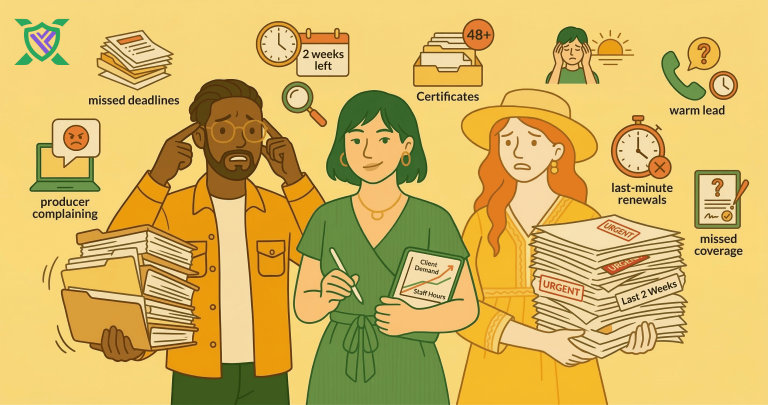
Every growing insurance agency reaches a point where an insurance agency outgrown staffing model becomes a reality, and what worked at one size stops working at the next. The signs arrive gradually—an extra hour here, a missed deadline there, or a producer complaining about admin work. By the time it’s clearly unsustainable, the agency has often been operating in a stressed state for months.
Identifying the signs early gives you options. You can restructure your workflow, bring in additional support, or add a trained VA before the pressure damages your retention rates, team morale, or E&O record. Here are the five most reliable indicators that your insurance agency outgrown staffing model is reaching its limit and needs to evolve.
Sign 1: Your Agency Owner or Principal Is Doing CSR Work
This is the most common and most expensive warning sign in independent agencies. When the agency owner is processing certificates, handling endorsements, or chasing trailing documents, they are doing $20-per-hour work at a $150-per-hour cost. They waste an hour of new business development, producer coaching, carrier relationships, or strategic planning for every hour they spend on process work.
If you are an agency owner and you can look at your calendar from the past month and find blocks of time spent on tasks a trained CSR or VA could handle, your insurance agency outgrown staffing model has fallen behind your growth. The fix is not to work harder — it is to delegate the work that does not require your expertise or your license.
Sign 2: Renewals Are Being Worked in the Last Two Weeks Before Expiration
A proactive renewal workflow starts 90 days out. Your team orders loss runs, markets accounts, prepares renewal comparisons, and contacts clients with options long before the expiration date. When they consistently work renewals only 14 days before expiration, they lack the bandwidth to stay ahead of the pipeline.
The consequences are significant. Reactive renewals mean no time for remarketing. No time for a meaningful coverage conversation. No time to catch the coverage gaps that have developed since the last renewal. And no time to recover gracefully if the client has questions or requests changes. Last-minute renewals are both a retention risk and an E&O risk.
Sign 3: Turnaround Time on Certificates or Endorsements Exceeds 24 Hours
In a well-run agency, standard certificates of insurance should be delivered within two to four hours of request. Standard endorsements should be submitted to the carrier within the same business day. When turnaround times slip beyond 24 hours consistently, it indicates a workload bottleneck.
The risk is not just client satisfaction — though that matters. Commercial clients who cannot get timely certificates miss contract deadlines and lose business. When that happens, the client does not blame themselves for poor planning. They blame the agency. And they look for alternatives at the next renewal.
Sign 4: Your Team Is Working After Hours Consistently
Occasional after-hours work is part of any busy agency. But when your CSRs are regularly finishing tasks in the evening, when your producers are processing endorsements on weekends, or when you as the agency owner find yourself catching up on administrative work after dinner — that is a staffing capacity problem masquerading as a dedication story.
Staff burnout is one of the primary drivers of CSR turnover, and CSR turnover in insurance runs at 25 to 35 percent annually. Every departure costs your agency $10,000 to $20,000 in recruiting, onboarding, and lost productivity. Consistently asking your team to work beyond their scheduled hours accelerates the burnout timeline and brings that turnover cost closer.
Sign 5: New Business Opportunities Are Being Missed or Delayed
The most telling sign of an insurance agency outgrown staffing model is when growth opportunities start to slip. A producer cannot follow up on a warm lead because they are tied up in service work. A commercial prospect requests a quote package and does not get it for four days because the team is backed up. A cross-sell opportunity is noticed in a client’s renewal file but never actioned because there is no time.
When your agency’s administrative backlog is actively preventing revenue activity, the cost of understaffing becomes directly visible on your top line. This is the point at which the math of hiring support — whether in-house or via a VA — becomes completely obvious. The VA pays for itself in the first month of recovered producer capacity.
What to Do When You Recognize These Signs
The natural response is to think about hiring another full-time CSR. But as we covered in our analysis of CSR hiring costs, that process takes months and comes with significant overhead. By the time a new in-house hire is fully productive, you have been operating at reduced capacity for a quarter or more.
A trained insurance VA from X Assure can be onboarded and handling real tasks within the first week. The 2-week free trial means you can test the model before committing financially. And because the VA arrives already trained on your AMS — AMS 360, EzLynx, Applied Epic, HawkSoft, or NowCerts — the ramp-up time is a fraction of what a new in-house hire requires.
The question is not whether you need more capacity. If you are seeing two or more of these five signs, you clearly do. The question is whether you want that capacity available in five days or five months.
Add VA capacity to your agency this week. Start your 2-week free trial at xassure.co/try-free.