
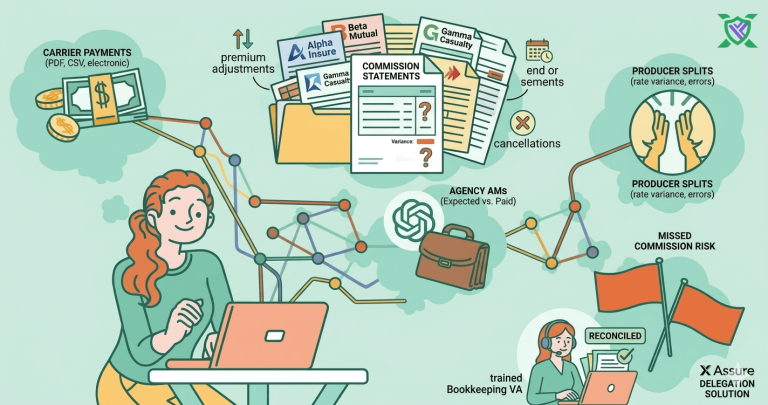
Ask any independent insurance agency owner what administrative task they dread most, and commission reconciliation comes up with remarkable frequency. This unglamorous problem consumes the most time and carries heavy financial consequences if ignored or handled poorly.
Carriers pay commissions on different schedules, at different rates, through different delivery methods, and with varying levels of detail on the commission statement. You meticulously match what was paid to what was owed—account by account, policy by policy.. In a mid-size agency with 200 to 500 active accounts across multiple carriers, it can consume a full Friday every month. Sometimes more.
This article explains exactly what commission reconciliation involves, why it matters so much financially, and how to get it off your plate permanently.
What Commission Reconciliation Actually Involves
At its simplest, commission reconciliation is matching the commission payments you receive from carriers against the commissions you expected to earn based on your policy data. But in practice, it is far more nuanced.
Carriers send commission statements in different formats — some electronically through your AMS, some as PDFs, some as CSV files with their own column structures. You must review each statement line by line to identify which policies the carrier paid, the specific rates, and the policy periods. Premium adjustments, mid-term endorsements, cancellations, and audits all create variances that you must reconcile or investigate.
When a commission appears short or missing, the agency must determine if it is a timing difference—where the payment arrives next month—or a genuine discrepancy they must raise with the carrier. Agencies that do not reconcile carefully regularly leave commission money uncollected, sometimes for months.
Why Most Agencies Reconcile Poorly
Commission reconciliation is one of those tasks that is easy to deprioritize when the agency is busy — and the agency is always busy. It does not have a hard external deadline the way a renewal or a certificate does. The carrier already paid something. Agencies often succumb to the temptation to accept whatever the carrier paid, note the obvious discrepancies, and move on.
The cost of this approach compounds over time. A carrier that has been systematically underpaying a small commission variance on a class of policies may owe an agency thousands of dollars that has never been claimed. Without reconciliation, that money is simply gone.
Equally important is producer commission tracking. Agencies with multiple producers need to calculate each producer’s share accurately — by line of business, by account, by new versus renewal business. Errors in producer commission calculations create disputes that damage relationships and morale.
The Month-End Commission Reconciliation Workflow
Step 1: Collect All Commission Statements
Download or collect commission statements from every carrier that paid during the month. For carriers that deliver statements through IVANS or your AMS, pull the electronic data. For carriers that send statements by email or mail, collect and organize them before beginning reconciliation.
Step 2: Match Payments to Expected Commissions
Compare each line item on the carrier statements to the expected commission in your AMS. For standard renewals, this is straightforward. For accounts with endorsements, audits, or coverage changes during the period, it requires pulling the policy detail to verify the correct premium and commission rate.
Step 3: Identify and Investigate Variances
Flag any line items where the paid commission differs from the expected commission. Categorize each variance: timing difference (payment expected next month), rate discrepancy (carrier applied wrong commission rate), audit adjustment (premium changed retroactively), or potential error requiring carrier follow-up.
Step 4: Post and Record
Post commission receipts in your accounting system — whether that is QuickBooks, your AMS’s accounting module, or a dedicated bookkeeping platform. Record the carrier, the amount, the policy, and the period. Generate the month-end commission report for the agency principal and any producers who receive commission splits.
How to Delegate Commission Reconciliation to a Bookkeeping VA
Commission reconciliation is one of the clearest examples of high-value, high-skill process work that nonetheless does not require the agency owner’s personal involvement. It requires attention to detail, knowledge of insurance commission structures, and familiarity with your AMS and accounting system. A trained bookkeeping VA who specializes in insurance agencies has all three.
X Assure’s bookkeeping service handles end-to-end commission reconciliation as part of its monthly close package. The VA collects statements, performs the matching and variance analysis, investigates discrepancies, posts the receipts, calculates producer splits, and delivers a commission variance report to the agency principal. The agency owner reviews the report and approves it — the process work is entirely handled.
The result is a complete, accurate commission reconciliation delivered every month without consuming your time. And because the VA is tracking variances systematically, agencies frequently discover missed commissions they had not been pursuing — recovering real money that was previously being left with the carriers.
What Accurate Commission Reconciliation Is Worth
Let us be specific. If your agency has $500,000 in annual commission revenue and your reconciliation is accurate to within 98 percent, you are potentially missing $10,000 per year in commissions that were either underpaid or unpaid by carriers. Many agencies operate at lower accuracy than that.
Add the time savings — four to eight hours per month recaptured from reconciliation work — and the value of accurate producer tracking to avoid internal disputes, and the case for delegating commission reconciliation to a specialist VA is overwhelming.
Let X Assure handle your commission reconciliation. Start your 2-week free trial at xassure.co/try-free.