
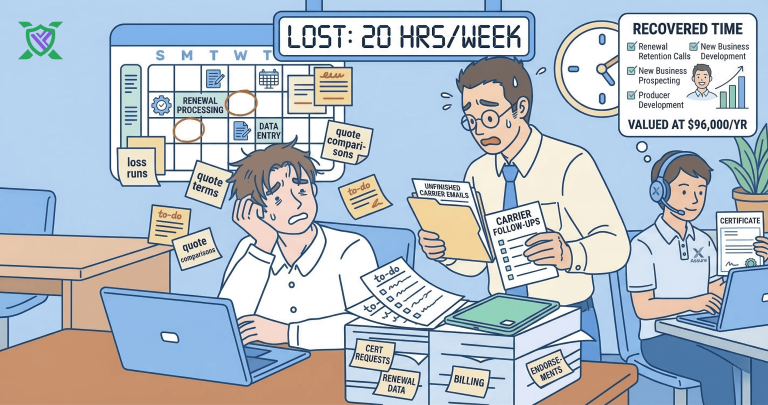
Imagine the impact if you could free up 20 hours a week: insurance agency owners and producers often lose that much time—half a work week—to process tasks. Redirecting those 80 hours a month toward revenue-generating activities could change your growth trajectory, especially since a trained VA can handle that administrative workload for you.
The math is straightforward but the execution requires deliberate action. This article walks through exactly which tasks to delegate, how to structure the delegation, and — critically — how to use the recovered time to grow your book rather than simply fill it with other administrative work.
Where the 20 Hours Are Hiding
Before you can recapture time, you need to know where it is going. Track your actual time for one week — not how you plan to spend it, but how you actually spend it. Write down what you did in each hour. Most agency owners who do this exercise are surprised by the results.
The hours typically cluster in a few categories: renewal processing and follow-up (4 to 6 hours per week), certificate and endorsement requests (3 to 5 hours), policy changes and data entry (2 to 4 hours), carrier follow-up calls and emails (2 to 3 hours), commission tracking and billing (2 to 3 hours), and miscellaneous administrative tasks (2 to 4 hours). That is 15 to 25 hours per week of work that does not require a producer’s expertise or license.
The Delegation Blueprint
Renewals
Delegate the entire renewal workflow except the coverage recommendation conversation with the client. Your VA pulls the renewal pipeline, orders loss runs, prepares remarketing submissions, enters quotes for comparison, generates renewal letters, and follows up with non-responsive insureds. You review the comparison and make the recommendation. That conversation — the one that requires your expertise and your relationship with the client — takes 15 minutes. The three to four hours of process work around it does not need to be yours.
Certificates and Endorsements
Standard certificates and endorsements should be fully delegated. Create a simple routing rule: if the request is standard — no non-standard additional insured language, no waiver of subrogation, limits match the policy — the VA processes and delivers it without coming to you. Non-standard requests get flagged for a 5-minute producer review before processing. Most certificate requests are standard. Your involvement drops from 100 percent to roughly 10 percent of the volume.
Policy Changes
When a client requests a coverage change — adding a driver, updating a lienholder, changing limits — the VA takes the request, processes it in the AMS, submits to the carrier, and confirms the change. You receive the daily summary. Your involvement is zero unless the change triggers a coverage question that needs producer guidance.
Carrier Follow-Up
Following up with carriers on outstanding endorsements, policy issuance delays, and quote status is time-consuming and interruption-intensive. It is also almost entirely process work. Your VA handles the carrier follow-up queue daily, escalating only the items that require producer judgment or relationship leverage.
How to Use the Recovered Time
Agency owners often make a mistake here: they free up 20 hours a week, insurance agency owners then filling that time with other reactive tasks rather than proactive growth. That recovered time must be protected and intentionally directed toward activities that actually move the revenue needle.
Renewal Retention Calls
Use four to six hours per week on proactive renewal calls — not reactive ones, but calls made 60 to 90 days before expiration to check in with your best commercial lines and personal lines clients. These calls are not just about retention; they are the primary source of cross-sell revenue in most independent agencies. Clients who hear from their agent proactively renew at higher rates and buy more coverage.
New Business Prospecting
Use four to six hours per week on new business activity — referral outreach, networking, LinkedIn engagement, follow-up on warm leads. These are the activities that most agency owners know they should be doing but consistently deprioritize when the service queue gets heavy. With the service queue handled by your VA, you finally have the protected time to do them.
Producer Development
If you have producers, use two to three hours per week on coaching and development. Producers who receive regular coaching close more business and have higher retention rates. This is high-leverage time that most agency owners sacrifice first when they are operationally overwhelmed.
What 20 Hours per Week of Producer Time Is Worth
Let us put a revenue number on this. An independent insurance producer generating $200,000 in annual commission revenue is earning roughly $100 per productive hour. Twenty additional productive hours per week at that rate is $2,000 per week, $8,000 per month, $96,000 per year in recovered revenue capacity.
The X Assure Professional VA costs $2,000 per month. The potential revenue value of the time it frees up is $8,000 per month. The return on investment is not subtle.
The key word is potential. The return is real only if the recovered time is used for revenue-generating activity rather than filled with other administrative work. That requires intentionality — blocking the time, protecting it, and holding yourself accountable to using it for growth rather than drift.
Reclaim your selling hours. Start your 2-week free VA trial at xassure.co/try-free — no credit card required.