
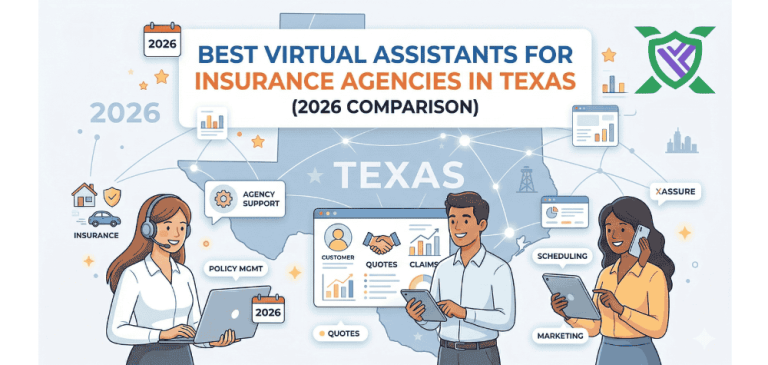
Texas insurance agencies are drowning in paperwork at a time when their licensed agents should be selling. Between hail season claim surges, a large Spanish-speaking client base, and a wave of new compliance paperwork created by the 89th Texas Legislature, the administrative load on a small-to-mid-size agency right now is unlike anything in recent memory. This guide compares the top virtual assistant providers for Texas agencies — including pricing tiers, compliance framing, and which type of shop each provider fits best — so you can make an informed decision before you pick up the phone.
Quick Comparison: Top VA Providers for Texas Insurance Agencies
| Provider | Best For | Texas Fit | Pricing (est.) | Standout Feature |
|---|---|---|---|---|
| XAssure | Personal lines, HO-heavy agencies | High | Quote-based | P&C lines training depth, non-renewal triage results, Most AMS, SOC2 certified & 24-hour onboarding |
| Texas Edge VA | Independent agents, all lines | Highest | Quote-based | Texas-native brand, ELITE Agency Training System |
| Agency VA | Mid-to-large agencies, commercial lines | High | Quote-based | SOC2 certified, proprietary AVA productivity tracking |
| Cover Desk | Agencies wanting flex staffing options | High | Quote-based | 2-week onboarding, Cover Desk Cloud access system |
| InsBOSS | P&C agencies, QA-focused operations | Medium | Quote-based | 56,000+ task QA audit process, named VA model |
| VIVA VS | Community-focused independent agencies | Medium | Quote-based | 3-year average client retention |
| BruntWork | Budget-constrained agencies, basic admin | Low | $4–$8/hr | No contracts, fast hiring |
How we evaluated providers: Each provider was scored on training specificity for Texas P&C workflows, compliance framing for TDI unlicensed task rules, AMS and CRM platform compatibility (EZLynx, AMS360, Applied Epic), onboarding speed, and published client outcomes. Providers with vague training curricula or no documented compliance framework were ranked lower regardless of price.
Why Texas Insurance Agencies Are Turning to VAs Right Now
Texas Is the Second-Largest Insurance Market in the Country
This is not a minor detail. With $293.9 billion in premiums in 2024, Texas is the nation’s second-largest insurance market. That kind of volume creates an administrative throughput problem that simply does not exist at the same scale in most other states. A 400-policy book of business in Texas means more renewals, more non-renewal notices, more ACORD forms, and more carrier correspondence than a comparable book almost anywhere else — because the underlying market is larger, faster-moving, and more exposed to catastrophic loss events.
Seasonal Surges Your Staff Cannot Absorb Alone
Hail is the defining claim peril in Texas. In 2024, hail losses across Texas homeowners policies reached nearly $4.9 billion in direct incurred losses, according to the Texas Statistical Plan for Residential Risks. That kind of volume hits agencies in concentrated windows — typically spring through early summer across North Texas and the Hill Country — and it hits all at once. Licensed agents who should be handling renewals and cross-sells are suddenly buried in claims communication triage, follow-up calls, and documentation requests. A trained VA can own that triage work, freeing licensed staff to do what only they can do legally.
The same pattern applies to hurricane season along the Gulf Coast, where TWIA (Texas Windstorm Insurance Association) policy activity spikes, and to freeze events like the ones that drove water and freeze losses to nearly $4.7 billion in 2021 — a figure that still has many North Texas agencies reprocessing claims-related correspondence years later.
The Bilingual Service Imperative
Texas’s Hispanic and Latino population now makes up 40% of the state’s total population, at more than 12 million people. In major metro markets — Houston, San Antonio, Dallas, El Paso — a significant share of personal lines policyholders prefer to communicate in Spanish, even when they speak English.
A bilingual VA is not a nice-to-have in these markets. It is a client retention tool. Agencies that cannot conduct policy review conversations, renewal outreach, or certificate requests in Spanish are losing policyholders to competitors who can. Most VA providers on this list offer bilingual English/Spanish capacity; always confirm this specifically for your book’s geographic footprint before signing an agreement.
What Texas Law Says About What a VA Can and Cannot Do
Disclaimer: This is not legal advice. The information below summarizes publicly available provisions of the Texas Insurance Code and Texas Administrative Code. Consult a licensed Texas insurance attorney or contact TDI directly at (800) 578-4677 to confirm task boundaries for your specific agency structure.
The Licensed vs. Unlicensed Line Under Texas Law
Under Texas Insurance Code Chapter 4001, an “act of an agent” includes soliciting applications, binding coverage, and quoting policy terms. These acts require a license. An unlicensed person — including any VA, regardless of provider — cannot advise a client on which policy to buy, provide a binding quote, or make coverage decisions on behalf of the agency or the client.
The referral by an unlicensed person of a customer or potential customer to an agent is not an “act of an agent” under Texas law — unless the unlicensed person discusses specific insurance policy terms or conditions with the customer or potential customer.
That distinction is important. It means a VA can call a policyholder to confirm a renewal appointment, collect information, or flag a non-renewal notice for licensed review — but the moment that conversation turns to coverage options, the VA has crossed a legal line.
The fix is simple: document the task boundaries in writing before the VA starts, build a handoff protocol into your workflow, and do not ask your VA to field policy questions.
Tasks that are generally permissible for unlicensed VAs in Texas include data entry into your AMS, processing certificate of insurance requests using information the licensed agent has already approved, scheduling client calls, following up on outstanding documents, and gathering information for renewal reviews.
Texas Administrative Code also specifically permits unlicensed staff to contact clients, insureds, agents, and insurers to gather and transmit information regarding claims and losses under a policy — as long as the contact does not require a licensed adjuster.
What HB 2067 Just Added to Your VA’s Workload
The 89th Texas Legislature passed HB 2067, which was signed and enacted on June 20, 2025, effective January 1, 2026. The law requires insurers to provide to TDI — at least once each quarter — written reports summarizing their reasons for declinations of insurance applications and cancellations and nonrenewals of existing policies.
What does this mean for your agency?
When a carrier declines, cancels, or non-renews a policy, the insurer must now deliver written notices explaining their reasons not only to the affected applicant or policyholder, but also to their insurance agent, if that agent is a licensed property and casualty agent and not a captive agent. These agents must then provide a disclosure to their clients and ensure that clients receive the insurer’s written explanation.
That last part is the key point for agency owners. You now have a disclosure obligation on every non-renewal and cancellation that flows through your shop. That means logging the notice, confirming the client received the insurer’s written explanation, and documenting the disclosure in your AMS. A trained VA can own all three of those steps — it is pure administrative process, no license required. But your VA needs to know the workflow exists and know what to do with each notice when it arrives.
What to Ask Any Insurance VA Provider About Compliance
Before signing with any VA provider, ask these questions in writing:
- Does your VA training curriculum include Texas Insurance Code boundaries for unlicensed staff?
- What role-based permission controls do you use to prevent VAs from accessing policy pricing or binding functions in the AMS?
- Do your VAs sign an NDA that includes client data protection and restricts unauthorized disclosure of policyholder information?
- Have your VAs worked with Texas-domiciled agencies operating under TDI jurisdiction, or only with agencies in other states?
If a provider cannot answer those questions clearly, that is a signal about how much they have actually thought through the Texas compliance context.
The 7 Tasks Texas Agencies Delegate to Insurance VAs First
Most agencies start with a narrow set of tasks and expand over the first 90 days as the VA learns the workflow. The tasks below are the ones agencies typically delegate in the first 30 days — the ones that generate the fastest time savings with the lowest ramp-up risk.
Certificate of Insurance (COI) Processing. High volume, time-sensitive, and almost entirely process-driven. Once the agency defines which certificate types the VA is authorized to process and what the approval chain looks like for non-standard requests, this task can be almost fully delegated.
CRM and AMS Data Entry. New client setup, policy updates, and contact record maintenance in EZLynx, AMS360, or Applied Epic. This is the highest-volume administrative task at most agencies and the one that most often falls on licensed agents by default — which is a waste of their time and your payroll.
Renewal Reviews and Remarketing Prep. Pulling expiring policy lists, gathering renewal documentation from clients, flagging gaps, and prepping the file for the licensed agent’s review. The agent still reviews and advises; the VA handles all the legwork.
Non-Renewal and Cancellation Triage. Under HB 2067 (effective January 1, 2026), this task just got more structured. A VA can log incoming non-renewal notices, confirm client disclosure documentation, identify remarket candidates, and set follow-up tasks for licensed agents.
Lead Qualification and Appointment Setting. A VA can gather intake information from inbound leads, qualify them against the agency’s target profile, and schedule the licensed agent’s call. This is a meaningful pipeline management function at agencies doing any volume of digital or referral lead generation.
Bilingual Client Outreach (English/Spanish). Renewal reminder calls, missing document requests, appointment confirmations. In markets with significant Spanish-speaking policyholder populations, this is a client experience function as much as an administrative one.
Digital Marketing Support. Social media scheduling, email campaign execution, local SEO content updates, and Google Business Profile management. Not every agency needs this in month one, but it is a legitimate and common VA function once the core admin workflow is stable.
Start here: Most agencies see the fastest ROI from COI processing and AMS data entry in the first 30 days. Renewal triage and bilingual outreach are typically added in days 31-90 once the VA is comfortable with the workflow and the AMS navigation.
Virtual Assistants Providers for Insurance Agencies in Texas
XAssure
XAssure positions itself specifically for personal lines agencies managing high volumes of homeowners and auto policies. Their training curriculum goes deep on personal lines workflows — policy processing, non-renewal triage, carrier outreach — rather than trying to cover every line type at a surface level. Agencies writing HO policies at volume in Texas hail markets, where non-renewal activity has been elevated since 2022, report using XAssure VAs specifically to manage the non-renewal triage process: identifying at-risk policies, reaching out to carriers for reinstatement options, and flagging remarketing candidates for licensed agents. XAssure is a strong fit for agencies that need a VA who understands HO3 versus DP3 distinctions and knows what an ACORD 28 is without a tutorial.
Best for: Independent agencies writing personal lines at volume, particularly in hail-exposed North Texas and Gulf Coast markets.
Texas Edge VA
Texas Edge VA is the only provider on this list built specifically for Texas agents, from the ground up. Their training system is built around Texas-specific agency workflows and the state’s regulatory context, which matters in a market where TDI rules do not always translate directly from other states. For independent agents who want a VA partner that already speaks the local market language — TWIA, Texas mutual carriers, TDI filing deadlines — Texas Edge is worth a hard look. The downside is that their Texas-focused positioning makes them a less obvious fit for agencies writing significant commercial lines business across multiple states.
Best for: Independent personal lines and small commercial agents who want a Texas-native partner.
Agency VA
Agency VA is the only provider in this space with a SOC2 Type II certification, which is an independently audited security and data protection credential. For agencies handling high volumes of sensitive policyholder data — Social Security numbers, claims histories, financial information — that credential is meaningful. They also operate a proprietary productivity tracking platform called AVA, which gives agency principals visibility into VA activity and output. If your agency has a compliance-first culture, runs commercial lines, or works with clients who have data security expectations (real estate, healthcare, financial services), Agency VA’s security posture is a real differentiator.
Best for: Mid-to-large agencies, commercial lines shops, agencies with documented compliance requirements.
Cover Desk
Cover Desk offers both dedicated and on-demand VA models, which makes them unusual in a market where most providers only offer dedicated placement. Their two-week onboarding timeline is one of the fastest in the category, and their proprietary Cover Desk Cloud platform gives agencies real-time access to their VA’s workflow. For agencies that are not sure how much VA capacity they need yet, or that want to test the model before committing to a full-time dedicated VA, the on-demand option is worth exploring.
Best for: Agencies that want flexibility in staffing model, or those that need to get a VA operational quickly.
InsBOSS
InsBOSS takes a QA-heavy approach to VA operations, running internal audits on a significant volume of tasks to catch errors before they become E&O exposures. Their model assigns named VAs to each agency rather than rotating staff, which builds relationship continuity and reduces the ramp-up time on agency-specific workflows. For P&C agencies where accuracy on certificates and policy endorsements is a top priority, the QA infrastructure is a meaningful differentiator.
Best for: P&C agencies where accuracy and audit documentation are top priorities.
VIVA VS
VIVA VS has a strong reputation within the independent agency community, with an average client tenure of around three years — a number that speaks to both VA quality and client satisfaction. Their positioning is less features-driven than some competitors and more relationship-driven, which suits agency owners who want a long-term staffing partner rather than a transactional vendor.
Best for: Independent agencies that prioritize long-term relationship continuity over feature sets.
BruntWork
BruntWork is the budget entry point in this category, placing offshore Philippines-based VAs at $4–$8 per hour with no contracts. For basic administrative tasks — data entry, scheduling, email management — the cost savings are real. The tradeoff is training specificity: BruntWork VAs are generalists, not insurance professionals, which means the agency takes on more of the training burden. They are not a good fit for agencies that need a VA to navigate EZLynx or process certificates independently from day one.
Best for: Budget-constrained agencies, basic admin tasks, agencies willing to invest significantly in internal training.
Which provider fits your agency size?
- Solo agent (1 licensed person): Start with Cover Desk’s on-demand option or XAssure’s entry tier. You need fast onboarding and a low commitment threshold. BruntWork works here only if you have time to train.
- 2–5 agent shop: Texas Edge VA or XAssure for personal lines focus; Agency VA if you’re writing commercial and need the compliance documentation. Cover Desk if you want flexibility.
- 10+ agent agency: Agency VA (SOC2, AVA tracking) or InsBOSS (QA infrastructure). You’re managing more E&O exposure and need audit trails and accuracy documentation at scale.
How Much Does a Virtual Assistant Cost for a Texas Insurance Agency?
| Option | Estimated Cost | What You Get | Texas Fit |
|---|---|---|---|
| Offshore generalist VA (BruntWork, similar) | $4–$8/hr | General admin, no insurance training | Low |
| Insurance-specialized VA (XAssure, Agency VA, Cover Desk, others) | $18–$25/hr or flat monthly (~$2,000–$3,500/mo) | Insurance-trained, AMS-familiar, compliance-aware | High |
| In-house licensed CSR in Texas | Fully loaded $55,000–$75,000+/yr | Licensed, local, fully integrated | Highest — but at a different price point |
On the in-house number: the average P&C CSR salary reached $55,384 in 2022 and climbed to $71,000 at the high end in 2023, according to Capstone Search Group’s 2024 Insurance Agency Compensation Report. Add benefits, payroll taxes, E&O exposure from internal staff, recruiting costs, and office overhead, and you’re looking at a fully loaded annual cost somewhere between $65,000 and $90,000 for a single in-house licensed CSR in most Texas markets.
An insurance-specialized VA at $2,500 per month runs about $30,000 per year, handles unlicensed tasks, requires no benefits, and can be up and running in two to four weeks. The math only works if the VA is handling work that was previously consuming licensed agent time — which is the right question to ask before you start the engagement.
What to Expect When Onboarding a VA Into Your Texas Agency
Most agencies underestimate how much preparation work happens before the VA’s first day.
Agencies that skip the prep step spend their first month in correction mode instead of delegation mode.
Week 1–2: Before the VA Touches Anything
Before onboarding starts, you need: documented login credentials and permission levels for each system the VA will access, a written task list with specific instructions for each process they will own, a handoff protocol that defines what the VA does versus what gets escalated to a licensed agent, and a signed NDA and data access agreement.
If your agency does not have documented workflows yet, write them now. A VA cannot follow a process that only exists in the agency owner’s head. This is also the stage where you configure role-based permissions in your AMS so the VA can see what they need to see — and cannot see what they should not.
Days 30–60: When Relief Actually Shows Up
Most agencies with structured onboarding start feeling meaningful administrative relief between days 30 and 60. This is when the VA is fluent enough in the agency’s systems and clients to work independently on the core task set. Agencies that rush the first two weeks and skip documentation typically do not reach this milestone until day 90 or later — and some never fully get there.
The Biggest Mistake Texas Agencies Make in Onboarding
Delegating tasks before workflows are documented is the most common onboarding failure. The second most common mistake is giving the VA access to more systems than they need before trust is established. Start narrow: two or three core tasks, limited AMS access, a daily check-in cadence. Expand as performance is demonstrated.
Frequently Asked Questions
No — a VA does not need a Texas insurance license to perform administrative tasks. What matters is that the tasks they perform do not cross into licensed activity: they cannot quote, bind, or advise on coverage. Under Texas law, referrals by unlicensed staff are permissible, but discussing specific policy terms or conditions with a client is not. Any VA provider you work with should be able to explain this distinction and show you how their training enforces it.
Yes, and for many Texas agencies this is one of the most valuable things a VA can do. Bilingual client outreach — renewal reminders, appointment scheduling, document collection, service calls — is an administrative function that does not require a license. Always confirm bilingual capacity with your provider before signing, and ask to review the VA’s English/Spanish proficiency directly before they start.
Timelines vary by provider. Cover Desk advertises a two-week onboarding timeline. Most insurance-specialized providers work on a two-to-four week placement window. BruntWork can move faster but requires more internal training time before the VA is operational. Regardless of provider, plan for two to four weeks of onboarding before the VA is independently handling tasks with minimal supervision.
A dedicated VA works exclusively with your agency during agreed hours — they learn your systems, your clients, and your processes over time. An on-demand model gives you access to a pool of trained VAs for specific tasks or overflow work, without a committed resource. Dedicated VAs are better for ongoing, relationship-driven work like renewal management and client outreach. On-demand models are better for agencies with variable workloads or those testing the VA model before committing.
The Bottom Line
Texas is the second-largest insurance market in the country, and it is also one of the most operationally complex — hail exposure, TWIA coastal lines, a large bilingual client base, and now a new disclosure compliance layer under HB 2067. Licensed agents who spend their days on data entry and COI requests are not doing the work they were licensed to do. A trained, insurance-specific VA changes that math.
The right approach: compare at least two providers from this list, specifically those that publish compliance frameworks for unlicensed task management. Then request a scoping call to map your agency’s specific workflows — not a generic sales conversation, but a real review of what your licensed agents are doing today that does not legally require a license. That conversation will tell you more about fit than any provider’s marketing page.
Check out Virtual Assistants for Insurance Agencies in Other States
- VA for insurance agencies in New York
- VA for insurance agencies in Florida
- VA for insurance agencies in California
Author note: This comparison was developed for Texas P&C insurance agency owners evaluating VA options in the 2025-2026 market. All regulatory references are based on publicly available TDI bulletins, Texas Insurance Code Chapter 4001, and 89th Legislature enrolled bill text. Confirm current applicability with a licensed Texas insurance attorney before making staffing decisions.
Sources: TDI 2025 Annual Report (tdi.texas.gov); TDI Bulletin B-0008-25 (HB 2067 implementation); TDI Bulletin B-0012-25 (89th Legislature summary); Texas Statistical Plan for Residential Risks (tdi.texas.gov); 28 Texas Administrative Code §15.101; Texas Insurance Code Chapter 4001; Capstone Search Group 2024 Insurance Agency Compensation Report; Every Texan Hispanic Heritage Data Brief (2024); Capstone DC Texas Insurance Market Analysis (2025).