
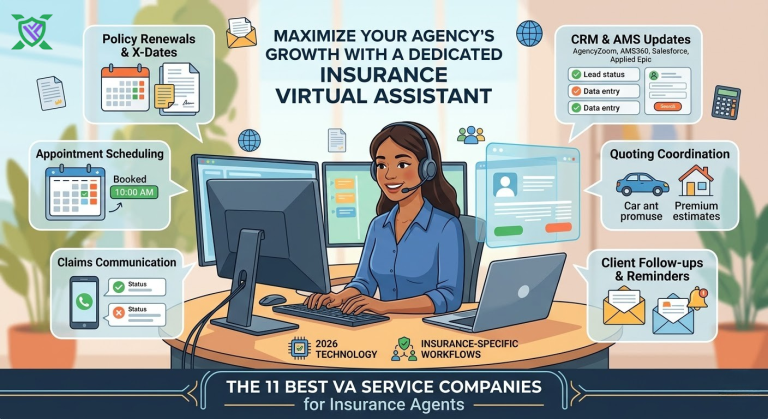
If you are a licensed insurance agent or run a growing independent agency, you already know the problem. You spend half your day on emails, CRM updates, renewal reminders, and appointment scheduling. That is time you are not spending selling or advising clients. Hiring a full-time in-house assistant costs $40,000 to $55,000 per year in salary alone once you add benefits. A virtual assistant (VA) gives you dedicated support at a fraction of that cost, and the right one already knows how insurance workflows operate.
This guide is for independent agents, brokers, and small agency owners who want to delegate back-office work without sacrificing accuracy or compliance. We looked at eleven VA companies and evaluated them on one specific standard: how well they actually support insurance workflows, not just general admin tasks.
Some providers on this list are general VA firms that can handle insurance tasks with proper onboarding. Others are purpose-built for insurance operations. Knowing the difference before you sign a contract will save you real money and frustration.
Keep in mind
The best virtual assistant companies for insurance agents are those that support insurance-specific workflows such as policy renewals, CRM and AMS updates, quoting coordination, client follow-ups, claims communication, and appointment scheduling. General VA firms can work with strong SOPs, but insurance-specific providers reduce your onboarding time significantly.
Quick Comparison Table: Best 11 Virtual Assistant Companies for Insurance Agents
Disclaimer: The information in this table is based on publicly available data, published pricing, and company websites as of 2026. This comparison is intended as a starting point for research, not a definitive ranking. The service quality, pricing, and availability vary by agency size and workflow need, so confirm details directly with each provider before committing
| Company | Best For | Insurance Workflows | CRM / AMS | US Time Zone | Pricing | Starting Price |
|---|---|---|---|---|---|---|
| XAssure by eDesk | Insurance-specific ops | Renewals, CRM, follow-ups | AgencyZoom, AMS360 | Yes | Managed/dedicated | Custom |
| Belay | US-based exec assist | General admin | Google, M365 | Yes | Monthly package | $1,500+/mo |
| MyOutDesk | Real estate & insurance | Lead follow-up, CRM | Salesforce, Zoho | Yes | Dedicated FT | ~$1,988/mo |
| Boldly | Premium exec support | General admin | Various | Yes | Monthly package | $2,600+/mo |
| Wing Assistant | Startups, SMBs | Basic admin, CRM entry | HubSpot, Zoho | Partial | Monthly subscription | $699/mo |
| TaskUs | Claims & servicing | Policy admin, claims | Applied Epic | Partial | Custom enterprise | Custom |
| Cover Desk | Indie agencies, Vertafore shops | Renewals, policy admin, CRM, certs | AMS360, QQCatalyst, Applied Epic, HawkSoft | Yes (Philippines overlap) | Dedicated + on-demand | Custom |
| Agency VA | Security-conscious agencies | Lead gen, quoting, renewals, book mgmt | AMS platforms, carrier portals | Yes (global recruiters) | Dedicated staffing | From $2,349/mo |
| Patra Corp | Mid-size to enterprise, MGAs | Policy checking, processing, renewals, small accts | Applied Epic, AMS360, PatraOne | 24/7 global | BPO / enterprise contract | Custom |
| ReSource Pro | Growing agencies and brokers | P&C processing, policy servicing, compliance | Applied Epic, AMS360 | Yes (US + offshore) | Managed BPO contract | Custom |
| InsBOSS | Independent P&C agents | Policy admin, endorsements, renewals, claims, quoting | AMS entry, carrier portals | Partial (Philippines) | Monthly subscription | $999–$2,419/mo |
Top 11 Virtual Assistant Companies for Insurance Agents – Detailed Overview
1. XAssure by eDesk- Best for Insurance-Specific Workflow Support
XAssure is built specifically for insurance agencies, which separates it from most VA companies on this list. Rather than placing a general assistant and hoping they figure out AgencyZoom, XAssure trains its team on insurance-specific processes before they ever touch a client account. The model is managed service, meaning you get a dedicated assistant supported by a team and operational layer, not a freelancer working solo.
XAssure handles the operational workflows that bog down most agents: renewal follow-up sequences, policy change coordination, inbound lead response, CRM hygiene, and claims status communication. Their assistants work in your time zone and follow documented SOPs, which matters when you are dealing with time-sensitive renewals or X-dates.
XAssure Key Differentiators
- Insurance-specific onboarding — no ramp-up time explaining what an endorsement is
- SOP-based execution — every workflow is documented and repeatable
- US business hours coverage with dedicated point of contact
- Familiar with AgencyZoom, AMS360, Salesforce, and Zoho CRM
- Renewals, policy changes, lead follow-up, and client communication covered
- Backup coverage model — your work does not stop if your VA is out
Best for insurance agents who need: Renewal management, policy administration support, CRM updates, lead follow-up, claims communication routing, and appointment scheduling.
Insurance software familiarity: AgencyZoom, AMS360, Applied Epic, Salesforce, Zoho CRM, Google Workspace, Microsoft 365, DocuSign, VoIP systems including RingCentral and Dialpad.
Pros: Insurance-focused, structured onboarding, process-driven, dedicated assistant, backup coverage, strong CRM/AMS familiarity.
Cons: Custom pricing means you need a discovery call before you know exact costs. Not the right fit if you just need 5 hours of general admin per week.
Pricing: 2 weeks free. After that, based on your needs XAssure provides quote for your workflow.
Case Study: When 1,500 Policies Were at Risk, eDesk Delivered
Overview:
Insurance agencies rely heavily on timely remarketing and renewal management to retain clients. When remarketing activities fall behind, agencies risk losing a significant number of policies and valuable client relationships.
In this case, an insurance agency faced a critical situation where 1,500 policies were at risk due to delayed remarketing activities. The agency needed immediate operational support to prevent client churn and protect their revenue stream.
The challenge:
The agency was struggling with:
- A large backlog of policies that required remarketing
- Limited internal staff to manage the workload
- The risk of policy cancellations and client dissatisfaction
- Time-sensitive renewal deadlines approaching quickly
Without quick intervention, the agency stood to lose a substantial portion of its policy base.
The Solution:
Xassure by eDesk stepped in to provide swift remarketing support.
The team deployed trained insurance virtual assistants to handle the backlog efficiently. Their responsibilities included:
- Reviewing policy data and renewal timelines
- Coordinating remarketing efforts with carriers
- Managing documentation and follow-ups
- Supporting the agency’s back-office insurance operations
By integrating quickly into the agency’s workflow, the eDesk team ensured that remarketing activities resumed without delay.
With the support of Xassure by eDesk:
- The agency was able to process the backlog of remarketing tasks
- Potential policy cancellations were avoided
- Client relationships were preserved
- Internal staff were able to refocus on high-value activities such as sales and customer engagement
Bottom line: XAssure is the strongest option for independent agents and small agencies that need a VA who already understands the insurance business. The structured approach means less time training and more time getting actual work done.
2. Belay– Best for US-Based Executive Administrative Support
Belay is one of the most well-known US-based VA companies and has been placing assistants with executives and small business owners since 2010. Their model is fully US-based, which means no time zone gaps and strong written communication quality. According to their published case studies, clients typically get matched within two to three weeks (Belay Solutions, 2024).
How do they work?
Belay assistants handle calendar management, email inbox, travel coordination, research, and general business admin. For insurance agents, they can handle scheduling and client communication, but they are not trained on insurance-specific workflows like renewals or AMS data entry.
You will need to invest real onboarding time to make Belay work for policy-heavy tasks.
Pros: All US-based, reliable quality, strong communication, good for executive-level admin tasks.
Cons: No insurance specialization. Pricing is higher for what you get if your primary need is insurance workflow support.
Pricing: Starts around $1,500/month. They also have hourly pricing ranging between $40 and $50 per hour.
Bottom line: Good choice if you need a polished US-based assistant for general business operations and are willing to train them on insurance workflows yourself.
3. MyOutDesk– Best for Full-Time Dedicated Remote Staff
MyOutDesk has placed over 7,500 virtual professionals and is one of the few VA companies that openly markets to insurance agencies and real estate teams. Founded in 2008, they specialize in dedicated full-time VAs, primarily based in the Philippines, at significantly lower cost than US-based alternatives.
How do they work?
For insurance agents, MyOutDesk VAs can handle CRM updates, lead follow-up, renewal reminders, and appointment setting. Their insurance-specific experience varies by individual placement.
The onboarding process involves a skills assessment and matching period, but SOP documentation is largely the client’s responsibility.
Pros: Dedicated full-time staff, cost-effective, large talent pool, some insurance-specific candidates available.
Cons: Variable insurance experience depending on who you are matched with. Time zone overlap requires scheduling. Client responsible for SOPs.
Pricing: Starting around $1,988/month for a full-time dedicated VA.
Bottom line: Solid option for agencies that want a full-time dedicated person and are prepared to do their own onboarding and process documentation.
4. Boldly– Best Premium US-Based Assistant Service
Boldly positions itself as a premium subscription staffing service, placing experienced US-based assistants with 10 or more years of professional experience. Their model is subscription-based, and assistants work part-time across a small number of clients rather than being pooled.
How do they work?
For insurance agents, Boldly excels at executive admin, project coordination, and client communication. They do not have insurance-specific training, so workflow depth for tasks like AMS data entry or renewal campaigns will require your input upfront. Their assistants are highly professional and easy to work with.
Pros: Highly experienced US-based staff, professional quality, subscription model provides consistency.
Cons: One of the higher price points on this list. No insurance workflow specialization.
Pricing: Starts around $2,600/month for 40 hour/month. $6500 for 100 hour/month. If you need a bigger plan then you should contact their sales team.
Bottom line: Best for agents who want premium quality and can document their own insurance workflows for onboarding.
5. Wing Assistant – Best for Budget-Conscious Agents Needing Daily Admin
Wing Assistant is a subscription-based VA service aimed at startups and small businesses. Their model gives you a dedicated assistant at a flat monthly fee, with additional layers of quality oversight and task management software built in.
How do they work?
Wing assistants can handle email management, data entry, scheduling, lead research, and basic CRM updates in tools like HubSpot and Zoho. Insurance-specific knowledge is limited, so you will need to create SOPs for tasks like renewal reminders or policy change requests.
For high-volume administrative tasks where insurance expertise is less critical, Wing delivers reasonable value.
Pros: Affordable, flat monthly pricing, dedicated assistant with oversight, good for volume admin tasks.
Cons: No insurance background. Quality can vary. US time zone overlap is partial depending on your plan.
Pricing: $699/month for part-time, $999/month for full-time.
Bottom line: Works well for agents on a budget who have already built out their SOPs and need affordable help executing repetitive tasks.
6. TaskUs Insurance – Best for Enterprise Claims and Servicing Operations

TaskUs is a large business process outsourcing company serving mid-market and enterprise clients. Their insurance vertical handles claims processing, policy servicing, and customer support at scale.
They are not a fit for a solo agent or small agency, but if you run a high-volume operation or MGA, their insurance-specific delivery teams are worth evaluating.
How do they work?
InsureVA is a separate company that also focuses specifically on insurance virtual staffing, placing trained assistants familiar with Applied Epic and standard insurance workflows. Their target market skews toward mid-size agencies rather than solo practitioners.
Pros: Deep insurance process knowledge, scalable for high volume, familiarity with Applied Epic.
Cons: Designed for larger operations. Solo agents and small agencies may find the model overkill and pricing unworkable.
Pricing: Custom enterprise pricing. Not published.
Bottom line: Right fit for MGAs, regional brokers, or agencies processing hundreds of policies per month.
7. Cover Desk– Best for Independent Agencies Running Vertafore Platforms
Cover Desk was founded by Andy Priesman, an independent insurance agency owner who built the service by solving his own operational problems before offering it to other agencies. That origin matters because Cover Desk is not a general staffing firm that added an insurance vertical as an afterthought.
Every part of the model was designed around how an independent agency actually runs day to day.
The company fields a team of over 200 highly educated virtual assistants based in the Philippines, serving independent insurance agents across the United States and Canada.
Cover Desk operates under two models:
- The dedicated model gives you a single VA who participates in your interview process, goes through agency-specific training, and works exclusively on your account. The on-demand model, called Cover Desk Direct, is backed by a pool of trained VAs and guarantees a 24-hour turnaround on task requests.
- The Vertafore partnership is one of Cover Desk’s most meaningful differentiators. Their team has documented familiarity with AMS360, BenefitPoint, FSC Rater, ImageRight, PL Rating, QQCatalyst, and Sagitta – a depth of platform coverage that most VA firms simply cannot offer.
For agencies already running on Vertafore tools, the onboarding time is significantly shorter than with a general VA provider.
One agency owner’s published review described their VA handling certificate requests, mortgagee changes, document filing, data entry, and client follow-ups — a realistic picture of what Cover Desk actually delivers at the task level.
Best for: Policy administration support, renewal follow-up, CRM and AMS data entry, claims communication routing, endorsement coordination, and certificate of insurance management.
Insurance software familiarity: AMS360, QQCatalyst, Applied Epic, HawkSoft, BenefitPoint, ImageRight, PL Rating, Sagitta, FSC Rater, Google Workspace, Microsoft 365.
Pros: Insurance-specific from day one; deep Vertafore platform knowledge; two service models for different volume needs; client participates in VA selection; accounting support also available; backup coverage on the on-demand model.
Cons: Pricing is not published and requires a discovery call. On-demand hours are use-it-or-lose-it monthly. Philippines-based team means planning for time zone overlap.
Pricing: Custom. One-time setup fee plus monthly commitment. Volume discounts available for multi-VA arrangements.
Bottom line: Cover Desk is one of the most credible insurance-specific VA options on this list, with real agency ownership in its founding story and genuine depth in Vertafore platforms. Strong choice for independent agencies that want insurance knowledge built in rather than trained from scratch.
8. Agency VA – Best for Security-Conscious Agencies That Want Scalable Global Staffing
Agency VA makes one claim that no other company on this list can match: it is the only SOC 2 certified virtual assistant provider in the insurance industry. For agency owners who handle sensitive personal lines data or commercial client information and have thought seriously about cybersecurity liability, that certification is not a small thing.
Their assistants receive extensive personal lines and commercial lines training with hands-on instruction on AMS platforms, carrier sites, and specific task workflows.
How do they work?
- Agency VA also maintains a network of over 50 local frontline leaders around the world to provide oversight and quality support for both clients and their VAs. Every VA works on a remotely secured device, and productivity is monitored through their proprietary AVA platform, which tracks keyboard and mouse activity with real-time engagement indicators.
- Their VAs can handle the full insurance workflow from lead generation, quoting coordination, follow-up, and bind support through renewal reviews, remarketing, and policy issuance always within the boundaries of unlicensed work, but with enough insurance depth to operate close to those boundaries competently.
- Bilingual staff is available for agencies serving Spanish-speaking clients. They also handle payroll in the VA’s local currency through legal entities in every country they operate in, which removes international banking complexity from the client’s plate.
Best for: Agencies that want a scalable, compliance-conscious staffing partner for personal lines, commercial lines, lead management, quoting coordination, and AMS data work.
Insurance software familiarity: AMS platforms, carrier portals, AVA proprietary management software, CRM tools.
Pros: Only SOC 2 certified insurance VA provider; proprietary productivity and security platform; bilingual staff available; EOR services handle payroll and HR compliance in the VA’s country; leadership team has real agency ownership experience.
Cons: Higher starting price than most competitors. Better suited for agencies ready to commit to a structured, longer-term staffing relationship than those looking for low-commitment trial arrangements.
Pricing: Starting at $2,349/month. Higher-tier plans available depending on volume and service scope.
Bottom line: Agency VA is the right fit for growth-stage agencies that take data security seriously and want an insurance VA provider with genuine operational credibility. The SOC 2 certification and proprietary management software set it apart on the compliance and accountability side.
9. Patra Corp – Best for High-Volume Agencies and MGAs Needing AI-Powered BPO
Patra Corporation is not a VA firm in the traditional sense. It is one of the most established insurance-specific business process outsourcing companies in the country, trusted by over 880 insurance organizations and processing tens of millions of policy transactions annually.
Founded in 2005 by John Simpson, Patra was built to address the insurance industry’s need for 24-hour operations support across the policy lifecycle.
How do they work?
The most relevant entry point into Patra is their Patra Assist product, which places full-time virtual assistants to handle back-office tasks, clear backlogs, and support policy processing. That VA layer is backed by their PatraOne technology platform, which includes AI-powered policy checking, a capability only XAssurecan offer than any other VA firm on this list can offer.
Early clients of Patra’s AI-assisted policy checking have reported up to 300% increases in quote processing capacity, according to Patra’s published case studies.
Patra’s global team includes over 6,500 process executives operating in geopolitically stable countries. They hold SOC 2 Type 2 compliance and ISO/IEC 27001:2022 certification.
One trust signal that stands out for risk-conscious agency owners: Patra carries E&O coverage for errors made during outsourced work, which is not standard in this industry.
Beyond VA services, Patra also handles certificate issuance at scale, print and virtual mail, and small commercial account management — making them a genuine operational partner for high-volume shops.
Best for: Enterprise-grade policy processing, AI-assisted policy checking, small account management, certificate issuance at volume, and compliance-backed outsourcing for commercial lines agencies and MGAs.
Insurance software familiarity: Applied Epic, AMS360, PatraOne platform. System-agnostic for contact center and processing work.
Pros: Twenty years of insurance BPO experience; SOC 2 and ISO 27001 certified; E&O coverage on outsourced work; AI-powered policy checking; 880+ insurance organization client base; scales from task support to full BPO.
Cons: Designed for mid-size to enterprise operations. Solo agents and small agencies will find the engagement model, minimum commitments, and pricing structure more than they need.
Pricing: Custom enterprise contracts. Not published. Requires a formal scoping call.
Bottom line: Patra is the category leader for high-volume insurance processing outsourcing. If you run a commercial lines operation, an MGA, or a regional broker and need a compliance-backed BPO partner with real technology behind it, Patra belongs on your shortlist. It is not the right match for independent agents looking for a single dedicated assistant.
10. ReSource Pro – Best for Agencies That Want a Long-Term Operations Partner
ReSource Pro is one of the most established insurance-specific outsourcing companies in the country. Founded in 2003 by Matthew Bruno, the company pioneered insurance process outsourcing and has appeared on the Inc. 5000 ranking of privately held US companies sixteen consecutive times.
They now serve more than 1,800 clients across the carrier, broker, and MGA segments, with over 10,000 employees globally and a client retention rate above 96% sustained for over a decade.
How do they work?
Their services span insurance BPO and business process management, AI-driven automation, technology integration, and strategic consulting for carriers, MGAs, wholesalers, and agencies.
For a growing independent agency, the most relevant service line is their capacity lift offering, where offshore P&C experts handle policy servicing, submission-to-issue processing, and back-office workflow on an ongoing basis.
They also offer compliance services for insurance licensing, surplus lines management, and regulatory filings — a layer of operational capability that no pure VA firm on this list provides. For agencies that are running into compliance bottlenecks or licensing complexity as they grow, that additional depth has real value.
ReSource Pro is not a quick-start solution. They are built for organizations that want to rebuild how they operate, not just add bandwidth.
Best for: Strategic back-office operations, P&C processing at scale, compliance and licensing support, technology integration, and agencies looking for a long-term outsourcing partner with a documented track record.
Insurance software familiarity: Applied Epic, AMS360, and other major AMS platforms. System-agnostic for processing work.
Pros: Twenty-plus years of insurance-exclusive experience; 1,800+ clients; 96%+ client retention for over a decade; compliance and licensing services included; AI and automation capabilities; strategic consulting available alongside operational support.
Cons: Minimum commitment and pricing are not published and require a formal sales process. Not a fit for solo agents or small agencies that want a simple, low-commitment VA arrangement.
Pricing: Custom. Contact ReSource Pro directly for a scoped proposal.
Bottom line: ReSource Pro is the right partner for regional brokers, established independent agencies, and MGAs that want to improve operations at a structural level. If you are a two- to five-person agency, you may not be the right fit today — but knowing ReSource Pro exists for when you scale is worth the bookmark.
11. InsBOSS – Best for Independent P&C Agents Wanting Transparent Monthly Pricing
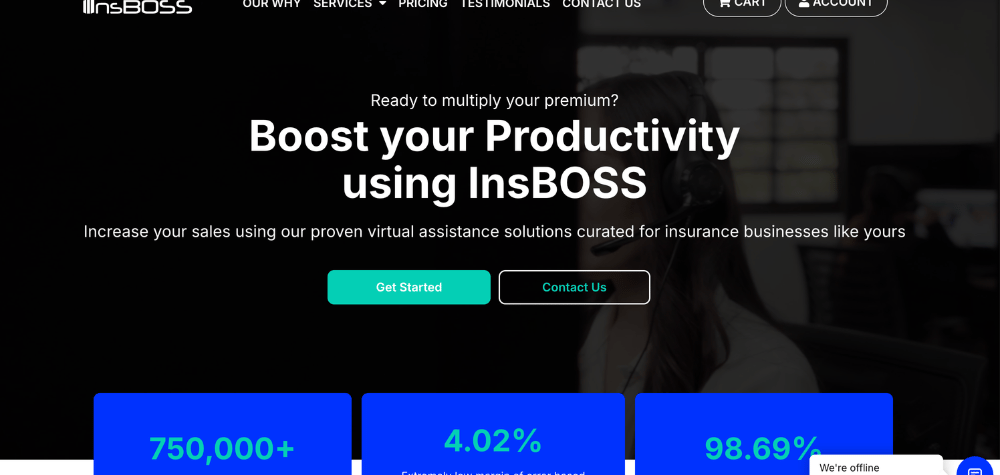
InsBOSS stands for Insurance Back Office Solutions and Services. Founded in 2017, the company was trained by a New York licensed insurance broker and commercial lines underwriter with over twelve years of experience. That foundation means their VAs are not general assistants who have read an insurance primer. Each assistant goes through more than 160 hours of intensive training on the basics of property and casualty insurance before they work a single client account.
InsBOSS caters exclusively to the US property and casualty insurance industry, which narrows their scope but deepens their focus.
How do they work?
The task coverage is broad for the price point: endorsements, cancellations, reinstatements, invoices, payments, certificates of insurance, audits, renewals, and rewrites. Their VAs can also handle quoting with direct carriers, submit accounts to agencies, and manage inbound and outbound calls using client-provided scripts. Telemarketing services and virtual accounting are available as add-ons.
The quality assurance layer is one of InsBOSS’s strongest differentiators at this price range. They run a dedicated QA team that audits completed tasks – approximately 56,000 insurance back-office tasks reviewed — to maintain accuracy across their client base. VAs operate on Teramind for data security and client confidentiality protection.
The company also carries E&O and cybersecurity policies covering their work. Unlike most providers at this price point, InsBOSS offers no lock-in contracts, no setup fee, and a free ten-day integration phase to test the working relationship before committing.
Best for: P&C-specific back-office support with transparent pricing, QA-backed task accuracy, and no long-term commitment required for independent agents and small agencies.
Insurance software familiarity: AMS systems and carrier portal data entry. Trained on P&C workflows across personal and commercial lines.
Pros: Insurance-exclusive P&C focus; 160+ hours of training per VA; dedicated QA team auditing completed work; no setup fee or lock-in contract; free ten-day integration period; backup coverage included; published pricing; E&O and cybersecurity protection.
Cons: Philippines-based team means partial US time zone overlap. Not suitable for life, health, or benefits-focused agencies. Telemarketing and accounting are add-on costs not included in the base plans.
Pricing: $999 to $2,419 per month depending on hours and service scope. Part-time (4 hrs/day) and full-time (8 hrs/day) plans available.
Bottom line: InsBOSS is one of the most transparent and P&C-specific options on this list. Published pricing, a real QA layer, insurance-trained VAs, and no lock-in contract make it a low-risk starting point for independent agents who want to test a dedicated VA without a large upfront commitment.
How We Evaluated These Virtual Assistant Companies
We evaluated each provider against six criteria that matter specifically to insurance agents and agency owners, not general business users.
1. Insurance Workflow Relevance
Does the company have documented experience with insurance-specific tasks? We looked for support across policy renewals, quoting coordination, claims communication, client servicing, lead response, and document handling. Generic admin capability was not enough to score well here.
2. CRM and Agency Management System Familiarity
Insurance agencies use specific platforms. We evaluated familiarity with AgencyZoom, AMS360, Applied Epic, Salesforce, and Zoho CRM. A VA who has never used AMS360 is not necessarily a bad hire, but onboarding takes longer and errors are more likely early on.
3. Communication and Availability
We looked at US business hours coverage, phone handling capability, email management, and calendar coordination. For time-sensitive tasks like renewal follow-ups or inbound lead response, time zone alignment is not optional.
4. Data Handling and Professionalism
Insurance work involves sensitive client data, policy details, and documentation accuracy. We evaluated whether companies had documented confidentiality practices, structured quality review, and clear accountability for errors.
5. Pricing Transparency and Scalability
We noted whether pricing was published or custom. We also looked at whether companies could scale with a growing agency, from part-time support to full-time dedicated staff.
6. Reviews, Trust Signals, and Service Quality
We reviewed publicly available client testimonials, third-party review platforms like Glassdoor and others, and case studies. We also evaluated whether companies had a real methodology behind their placements or just a contractor marketplace dressed up as a managed service.
What Does a Virtual Assistant for Insurance Agents Actually Do?
This section covers what actually happens day to day when an insurance agent delegates to a VA correctly.
Lead Management and Follow-Up
Speed to lead matters in insurance. A VA can respond to inbound leads within minutes using a pre-approved email or call script, qualify the prospect based on your criteria, and schedule them directly into your calendar. They can also manage outbound follow-up sequences for quotes that went cold, pipeline updates in AgencyZoom or your CRM, and reactivation outreach for lapsed clients.
According to Voiso’s study, agents who follow up with web leads within five minutes are nine times more likely to convert them than agents who wait 30 minutes. A VA sitting in your inbox during business hours closes that gap without requiring you to be tethered to your phone.
Policy Administration Support
This is where insurance VAs add the most operational value. A trained VA can send renewal reminder emails and calls at 90, 60, and 30 days before expiration, coordinate policy changes and endorsement requests, collect missing documents from clients, follow up on cancellation notices, and flag X-dates that need your direct attention.
The key word is trained. A VA doing this work needs to understand what an endorsement request is, what an X-date means, and when to escalate to a licensed team member. That training investment pays back quickly in reduced renewal leakage.
Claims and Client Communication
A VA can handle the non-licensed communication layer in a claims situation: following up on claims status with carriers, collecting required documentation from clients, sending updates to clients on claim progress, and routing complex situations to your licensed team. They should never advise on coverage or liability. That line needs to be clear in your SOPs.
CRM and AMS Data Entry
Keeping your AMS clean is one of the most consistently neglected tasks in insurance agencies. A VA can update client records after calls, tag and segment leads in your CRM, add notes and call logs, set task reminders, and keep your pipeline accurate. This work directly improves renewal rates and referral tracking because you always have clean data to work from.
Calendar and Administrative Support
Meeting scheduling, inbox management, document filing, and internal coordination are the classic VA tasks. For insurance agents, this means scheduling client review appointments, managing your availability across multiple calendars, responding to routine client inquiries, and keeping you organized during busy renewal seasons.
Marketing and Prospecting Support
A VA can build contact lists for outbound campaigns, manage email follow-up sequences, send review request emails to satisfied clients, and support reactivation campaigns for lapsed policyholders. This does not replace a marketing agency, but it handles the execution layer that most agents ignore due to time constraints.
Tasks an Insurance Virtual Assistant Can and Cannot Handle
This is one of the most important sections in this guide because getting it wrong creates E&O exposure. Know the line before you delegate.
E&O Risk Warning
A virtual assistant is not a licensed insurance professional. Tasks involving coverage advice, policy interpretation, binding authority, or regulated sales conversations must stay with a licensed agent. Delegating these tasks — even unintentionally — can create errors and omissions liability. Document your VA’s scope clearly and review it with your E&O carrier if you are unsure.
| Task | Unlicensed VA Can Handle | Requires Licensed Staff |
|---|---|---|
| Renewal reminder calls/emails | Yes | No |
| Policy change data entry | Yes | No |
| Claims status follow-up | Yes (info only) | Yes if advice given |
| Lead follow-up and scheduling | Yes | No |
| CRM / AMS updates | Yes | No |
| Coverage binding | No | Yes — always |
| Regulated insurance advice | No | Yes — always |
| Final policy interpretation | No | Yes — always |
| Underwriting decisions | No | Yes — always |
| E&O sensitive communication | Limited | Review required |
Best Virtual Assistant Companies by Insurance Use Case
Not every agency has the same need. Here is how the providers stack up based on your specific situation.
| Use Case | Best Pick | Why |
|---|---|---|
| Independent agents | XAssure or Cover Desk | Insurance workflows, dedicated support, no ramp-up time |
| Small agency (2–5 agents) | XAssure or Agency VA | Structured ops, scalable, security-compliant |
| Lead follow-up only | Wing or Agency VA | Fast setup, CRM-ready, lower cost entry |
| Policy renewals and admin | XAssure, Cover Desk, or InsBOSS | Process-based, QA-backed, insurance-trained |
| CRM/AMS data entry at volume | Cover Desk or InsBOSS | Vertafore depth or published flat-rate pricing |
| High-volume back office / MGA | Patra Corp or ReSource Pro | Enterprise BPO, AI tools, compliance coverage |
| Premium managed service | Boldly or Belay | US-based, executive quality, strong communication |
| Budget transparent pricing | InsBOSS or Wing | Published monthly rates, no lock-in contracts |
How a VA Improved Renewal Follow-Up and ROI for an Insurance Agency
Before: Follow-Ups Were Inconsistent
A mid-sized independent insurance agency with around 800 active policies was struggling to stay consistent with renewal follow-up. Producers and account managers were also handling admin work like CRM updates, quote-status checks, and routine client communication.
The Problem: Revenue Was at Risk
Because the team was stretched, renewal outreach often happened late or inconsistently. Some follow-ups were missed, response times slowed down, and producers had less time to focus on advising clients and closing business.
At that stage, the agency’s renewal contact rate was about 61%.
After: A Dedicated VA Took Over Admin Support
The agency hired a dedicated virtual assistant for a three-month pilot. The VA handled renewal reminders, CRM hygiene, follow-up coordination, and quote-status tracking.
The Result: Better Retention and Higher Efficiency
Within 90 days, the agency’s renewal contact rate improved from 61% to 84%. The team also attributed 14 additional bound renewals to more consistent follow-up.
With an average annual premium of $1,200 per policy, that added up to about $16,800 in retained premium revenue.
What the ROI Looked Like
The VA cost $2,200 per month, or $6,600 over three months. Based on retained premium alone, that worked out to roughly a 2.5x return on investment.
Why This Matters
The impact went beyond renewals. The agency also gained cleaner CRM data, faster response times, and more selling time for licensed staff.
Insurance Software and Tools Your Virtual Assistant Should Know
Before you hire, ask directly which of these platforms they have worked in. A VA who claims insurance experience but has never opened AgencyZoom is not the same as one who has actively maintained renewal pipelines in it.
- AgencyZoom
- AMS360
- Applied Epic
- Salesforce and Zoho CRM
- HubSpot
- Google Workspace and Microsoft 365
- DocuSign
- VoIP and Dialer Systems
How Much Does a Virtual Assistant for Insurance Agents Cost?
Disclaimer: Please note that the pricing listed is estimated from publicly available data from Glassdoor, indeed and other sites. May vary based on specific roles, level of experience, or seasonal promotions. For the most accurate and current rates, it is recommended to request a custom quote directly from the provider.
VA pricing varies widely based on location, insurance experience, hours, and whether you are using a freelance model or a managed service. Here is a realistic breakdown.
| VA Type | Typical Cost* | Time Zone | Insurance Experience | Best For |
|---|---|---|---|---|
| Offshore freelance | $8–15/hr | Varies | Often none | Basic data entry, tasks |
| Offshore managed VA | $15–25/hr or $600–1,100/mo | Partial US overlap | Low to medium | CRM updates, follow-ups |
| US-based VA service | $30–60/hr or $1,350–2,000+/mo | Full US | Medium | Client communication, admin |
| Insurance-specific managed | $1,500–3,500/mo | Full US | High | Renewals, claims, policy admin |
| XAssure (specialist) | Custom quote | Full US overlap | High (insurance focus) | Full insurance workflow support |
What Affects Cost
Insurance-specific experience commands a premium because it reduces your onboarding investment. US-based assistants cost more than offshore, but deliver better time zone alignment and communication quality for client-facing work. Dedicated models cost more than pooled models but give you consistency. Phone handling and VoIP support add to cost. Full-time rates are lower per hour than part-time.
How to Choose the Right Virtual Assistant Company for Your Insurance Agency
1. Choose Insurance Workflow Familiarity Over Generic Admin Support
A VA who already knows what a renewal X-date is, why endorsements get flagged, and how to communicate with clients about claims without giving advice will outperform a highly capable general assistant for the first six months. After initial setup, the gap narrows, but insurance familiarity saves real time upfront.
2. Ask About CRM and AMS Experience Before You Sign
Do not assume. During any discovery call or interview, ask the VA to describe how they have used AgencyZoom or AMS360 in a previous role. Ask what they would do if a client called with a coverage question. Their answer tells you a lot about their awareness of licensed versus unlicensed scope.
3. Clarify Phone Handling and Follow-Up Process
If you need your VA handling inbound calls or doing outbound follow-up, confirm they are set up on your VoIP system and have access to your scripts before they start. Vague phone handling arrangements lead to dropped leads and inconsistent client experience.
4. Check Onboarding and SOP Support
The best VA companies help you document processes, not just execute them. If you do not have written SOPs for your renewal workflow or lead follow-up sequence, choose a provider that helps you build them during onboarding. This protects you if the VA changes and ensures consistent execution.
5. Review Security, Reliability, and Accountability
Insurance client data is sensitive. Ask the provider about data security practices, NDA requirements, and backup coverage if your VA is unavailable. A solo freelancer going on vacation with no backup is a real operational risk during a busy renewal period.
6. Start with One Repeatable Workflow
Do not delegate everything on day one. Pick one workflow you repeat every week, such as renewal reminder outreach, and let the VA own it completely. Measure the result after 30 days. Once that workflow is running smoothly, add the next one. This approach produces better outcomes than overwhelming a new VA with your entire operation at once.
For a detailed view, read our How to hire VA for your Insurance Agency
Red Flags to Watch Out for When Hiring a VA for Insurance Work
| Watch Out For These Warning Signs No familiarity with basic insurance terminology (renewal, endorsement, X-date, AMS) No process for documentation accuracy or quality reviewHas never worked with agency management systemsVague or unpublished pricing with no clear scope definition No structured onboarding process or SOP supportNo backup coverage if the VA is unavailable No clarity on what requires a licensed staff member Pooled model where you do not have a dedicated point of contact Promises insurance expertise but cannot name a single AMS platform |
One practical test: before you hire, describe a renewal follow-up scenario and ask how the VA would handle it. A VA with real insurance experience will ask clarifying questions about X-dates, carrier contacts, and escalation paths. A general VA will give you a vague answer about sending emails. The difference matters in live client situations.
Why Insurance Agents Hire Virtual Assistants
The core reason is simple. Licensed agents are most productive when they are advising clients and closing new business. Everything else is overhead. Here is what agents consistently report after hiring a VA:
- Faster lead response, which directly improves conversion rates on inbound inquiries
- Better renewal follow-up rates, which reduce lapse and improve client retention
- Less admin overload, which reduces burnout and improves quality of licensed work
- More consistent client communication, which builds trust and generates referrals
- More selling time, which is the most direct revenue driver in any agency
- Scalable operations without the cost and compliance burden of a full-time hire
A 2022 survey by the Independent Insurance Agents and Brokers of America found that agents spend an average of 40% of their time on administrative tasks. If a VA can take over even half of that, you are effectively adding two days of selling capacity per week without hiring another agent.
FAQ: Best Virtual Assistant Companies for Insurance Agents
XAssure is the strongest overall option for insurance-specific workflow support. Cover Desk is a close second for agencies running Vertafore platforms. Agency VA leads on compliance and security. For high-volume or MGA operations, Patra Corp and ReSource Pro operate at a scale that VA firms cannot match. For independent P&C agents who want published pricing and no long-term commitment, InsBOSS is a low-risk starting point.
A trained insurance VA can handle policy renewal reminders, CRM and AMS data entry, lead follow-up, appointment scheduling, claims status communication, document collection, email inbox management, and marketing support. They should not handle coverage advice, policy binding, or regulated sales conversations.
Yes, with proper training. Some providers like XAssure have VAs with existing familiarity with these tools. Others will require you to provide training and documentation. Always ask about specific platform experience before committing to a provider.
Yes, with proper training. Some providers like XAssure have VAs with existing familiarity with these tools. Others will require you to provide training and documentation. Always ask about specific platform experience before committing to a provider.
Offshore VAs start around $8 to $15 per hour. US-based general VA services run $29 to $60 per hour or $1,500 to $2,500 per month for part-time. Insurance-specific managed VA services like XAssure use custom pricing based on your workflow needs. Budget at least $1,500 to $2,000 per month for a serious, dedicated arrangement.
Yes, this is one of the highest-value tasks to delegate. A VA running a structured 90-60-30 day renewal outreach sequence can meaningfully improve your renewal retention rate. The key is having clear SOPs and a VA who understands the urgency and importance of X-dates.
Yes. Lead follow-up, qualifying inbound inquiries, scheduling appointments, updating your pipeline in AgencyZoom or your CRM, and managing outbound reactivation campaigns are all appropriate VA tasks. Speed-to-lead follow-up is one of the most impactful things a VA can do for a growing agency.
No, unless they are performing licensed activities. Most of what a VA does for insurance agencies is administrative, not licensed. The line is clear: anything involving coverage advice, policy binding, or regulated sales requires a license. SOPs should explicitly define this boundary.
A generic VA can handle general admin tasks and will need significant training to understand insurance terminology, AMS platforms, and the difference between tasks that require licensing and those that do not. An insurance VA already knows what an X-date is, has worked in AMS360 or AgencyZoom, and understands the compliance boundaries. The onboarding time difference can be 4 to 8 weeks or more.